
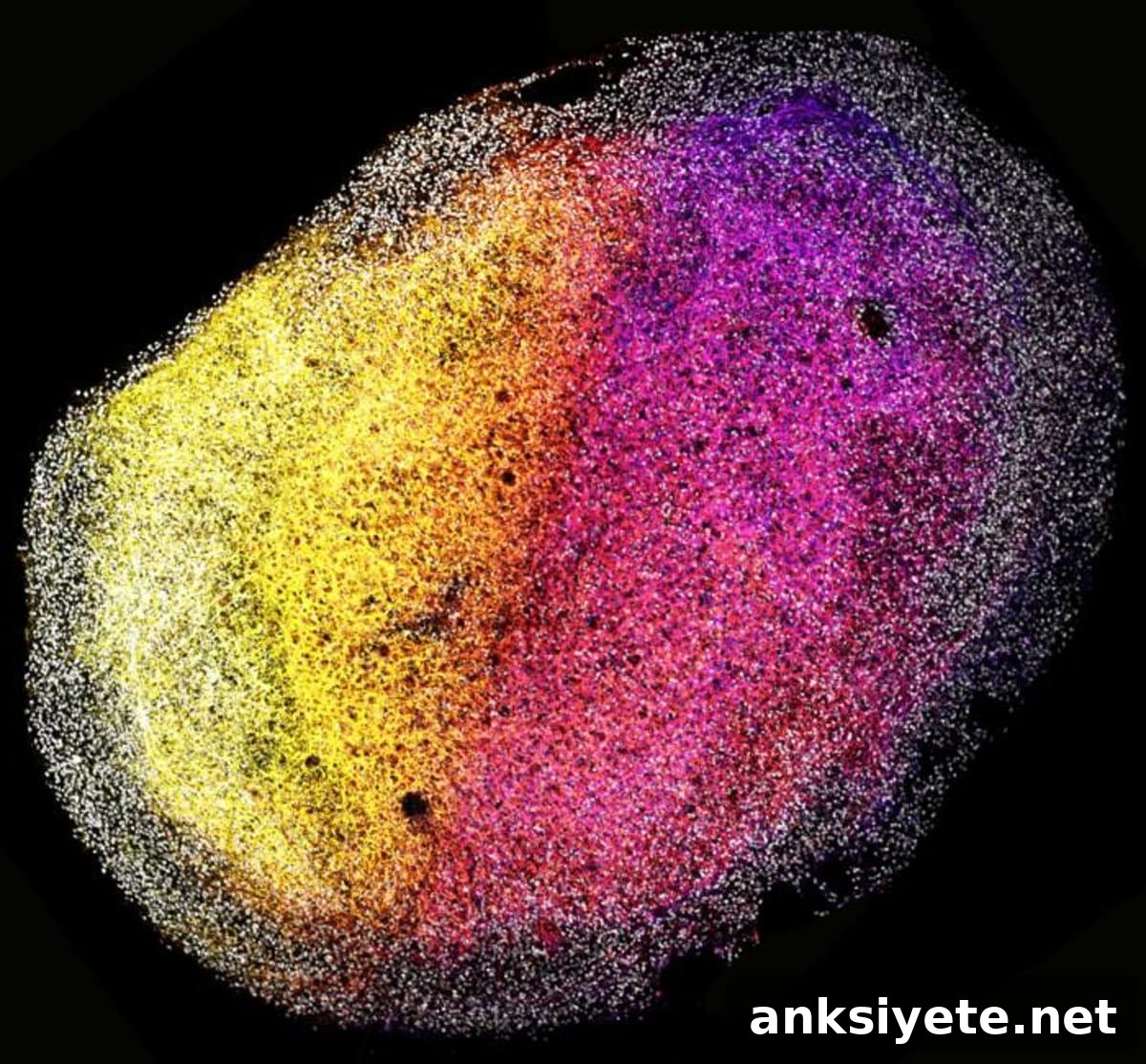
Summary: Researchers have grown three-dimensional (3D) brain organoids directly from human fetal brain tissue that self-organize in vitro. These mini-brains recreate multiple cell types, regional identities and a tissue-like extracellular matrix, making them a powerful new model for studying human brain development, neurodevelopmental disorders, pediatric brain cancer and drug responses.
Key Facts:
- Scientists produced brain organoids from small pieces of human fetal brain tissue that self-assemble into complex 3D structures.
- These organoids preserve regional characteristics, respond to developmental signaling molecules and generate an extracellular matrix similar to that in vivo.
- Tissue-derived organoids enable scalable modeling of brain development, tumor formation (including glioblastoma-related mutations) and drug sensitivity testing.
Source: Princess Máxima Center for Pediatric Oncology
Overview: A team at the Princess Máxima Center for Pediatric Oncology and the Hubrecht Institute (Utrecht, the Netherlands) has demonstrated that small fragments of healthy human fetal brain tissue can self-organize in culture to form expanding 3D organoids. Published in the journal Cell, this work shows that maintaining tissue integrity rather than dissociating tissue into single cells enables formation of organoids that better reflect the cellular diversity, architecture and extracellular environment of the developing human brain.
Traditionally, brain organoids have been created by differentiating pluripotent stem cells with carefully tuned molecular “recipes.” In contrast, these fetal tissue–derived brain organoids (FeBOs) emerge from intact pieces of tissue and reach roughly the size of a grain of rice while exhibiting complex organization and multiple neural cell types. Notably, FeBOs contain abundant outer radial glia—an evolutionary cell type important in human cortical development—highlighting their relevance to human-specific aspects of brain formation.
A distinguishing feature of FeBOs is their production of extracellular matrix (ECM) proteins. This tissue-like ECM appears essential for the pieces to self-organize and expand long-term in culture. Because the organoids generate their own ECM niche, researchers can explore how cell–matrix interactions shape development and how ECM disruption contributes to disease.
The organoids retain characteristics of the brain region from which the tissue was taken and respond to known morphogens and signaling pathways that guide regional identity. This regional fidelity makes FeBOs a valuable platform to dissect the molecular signals that pattern the developing central nervous system and to study positional effects across forebrain subregions.
Beyond developmental biology, the team tested the organoids’ potential for cancer modeling. Using CRISPR-Cas9 gene editing, they introduced mutations in known cancer genes such as TP53. Cells carrying a TP53 defect rapidly outcompeted normal cells over several months, demonstrating a growth advantage characteristic of cancerous transformation. The researchers also created organoids bearing combined mutations in TP53, PTEN and NF1—genes linked to glioblastoma—then assessed responses to existing cancer drugs. These experiments illustrate how tissue-derived organoids can serve as a scalable, bottom-up platform for linking specific genetic lesions to drug sensitivity.
FeBO lines can be expanded and propagated for more than six months, and scientists were able to generate multiple similar organoids from a single tissue sample. The ability to multiply organoids while preserving the same mutation profile supports reproducible experiments and higher-throughput drug testing.
The research team emphasizes ongoing collaboration with bioethicists and plans to continue evaluating the scientific and ethical dimensions of using fetal tissue–derived organoids. The fetal tissue used in the study came from fully anonymous donors following elective termination between gestational weeks 12–15; donors provided informed consent and were informed that the material would be used for research into normal organ development and related applications.
Dr. Benedetta Artegiani (Princess Máxima Center), who co-led the project, commented that fetal tissue–derived brain organoids are an invaluable tool for studying how the developing human brain expands and how different cell types and their environment determine cell identity. The model offers opportunities to investigate developmental disorders such as microcephaly as well as childhood brain cancers that arise from disrupted development.
Dr. Delilah Hendriks (Princess Máxima Center and Hubrecht Institute) noted that these organoids complement pluripotent stem cell–derived models. By combining insights from both approaches, researchers can more effectively decode the cellular diversity and regional organization of the human brain. Prof. Hans Clevers, a pioneer in organoid technology, highlighted that deriving organoids directly from brain tissue fills a long-standing gap in the organoid field.
About this neurodevelopment and neurotech research news
Author: Sarah Wells
Source: Princess Máxima Center for Pediatric Oncology
Contact: Sarah Wells – Princess Máxima Center for Pediatric Oncology
Image: Image credit: Princess Máxima Center, Hubrecht Institute / B Artegiani, D Hendriks, H Clevers
Original Research: Open access. “Human fetal brain self-organizes into long-term expanding organoids” by Delilah Hendriks et al., Cell. DOI: 10.1016/j.cell.2023.12.012
Abstract
Human fetal brain self-organizes into long-term expanding organoids
Highlights
- FeBOs display cellular heterogeneity and can be expanded over long periods.
- FeBOs produce a tissue-like extracellular matrix niche, enabling ECM perturbation studies.
- Regional FeBO derivation lets researchers study the effects of morphogens on regional identity.
- CRISPR-engineered FeBOs provide a scalable platform for bottom-up tumor modeling and drug response testing.
Summary
Human brain development requires coordinated expansion of neural progenitors while establishing a multicellular tissue architecture. While many organoid systems are created from pluripotent stem cells, this study shows that healthy human fetal brain tissue can self-organize in vitro to form organoids (FeBOs) that recapitulate aspects of in vivo cellular heterogeneity and organization. FeBO expansion depends on preserved tissue integrity and the production of an ECM niche. FeBO lines derived from different central nervous system regions, including dorsal and ventral forebrain, maintain regional identity and allow investigation of positional signaling. Using CRISPR-Cas9, syngeneic mutant FeBO lines were generated to model brain tumorigenesis, establishing FeBOs as a complementary CNS organoid platform.