Is Your Smile Male or Female? AI Uses Smile Dynamics to Recognize Gender
Summary: Researchers at the University of Bradford developed an AI system that can infer a person’s gender from the dynamic movement of a smile. Their findings indicate that female smiles tend to be wider and more expansive than male smiles.
Source: University of Bradford.
New research shows that measurable differences in smile movement allow artificial intelligence to classify gender from video alone.
Most existing automatic gender-recognition systems rely on static images and fixed facial features. In contrast, this study from the University of Bradford is the first to use the dynamic motion of the face during a smile as the primary signal for gender classification. Instead of comparing single frames, the team analyzed how facial features change and move over time as the smile forms.
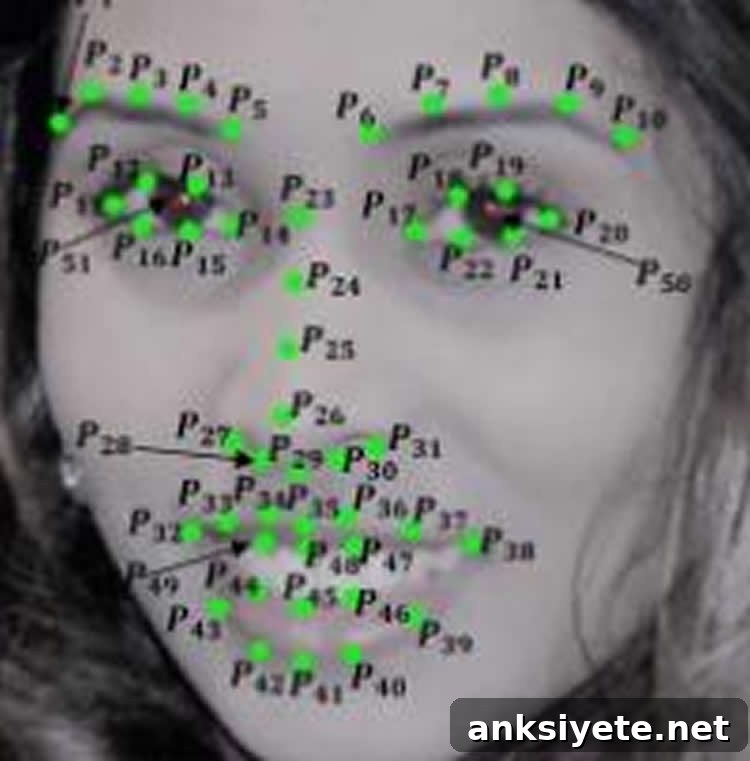
Led by Professor Hassan Ugail, the researchers mapped 49 facial landmarks concentrated around the eyes, mouth and nose. These landmarks were tracked through the smile sequence to capture both spatial changes—such as distances and area changes—and temporal flow, meaning how much, how far and how quickly points on the face moved while smiling. The combined spatial and temporal measures were used to quantify the smile’s dynamics.
The analysis revealed consistent gender differences. Women’s smiles were found to be more expansive, producing broader mouth and lip area changes compared with men. As Professor Ugail explains, “Anecdotally, women are thought to be more expressive in how they smile, and our research has borne this out. Women definitely have broader smiles, expanding their mouth and lip area far more than men.”
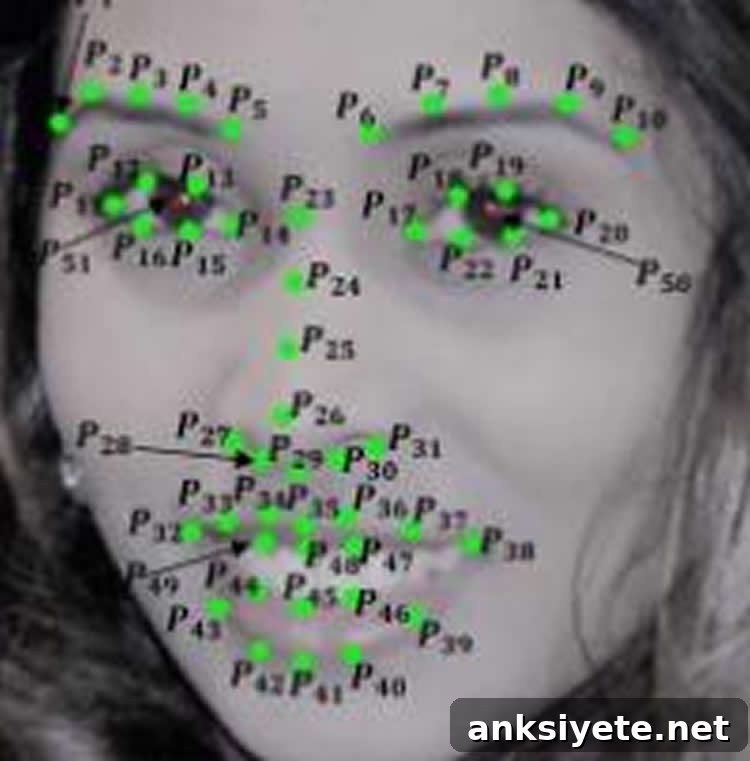
From the landmark data, the team derived a set of dynamic features that describe smile behavior. These features included overall facial spatial metrics, mouth area changes, geometric flow around key facial regions, and intrinsic measures based on dynamic face geometry. Altogether, the framework produced 210 distinct dynamic parameters to serve as input for machine learning models.
Using a straightforward machine classification approach, the researchers trained and evaluated classifiers on video recordings of 109 subjects smiling. With k-Nearest Neighbour (k-NN) and tenfold cross-validation, the system achieved an accuracy of over 85% in correctly predicting gender from smile dynamics. Professor Ugail noted that this experiment used a relatively simple classifier to demonstrate the concept, and that more advanced AI methods could increase recognition rates further.
The primary aim of the work is to advance machine learning techniques for dynamic facial analysis rather than to create a commercial gender-identification product. Nonetheless, the findings raise several important questions for future research. The team plans to investigate how the system responds to smiles from transgender individuals and to examine the impact of cosmetic facial surgery on recognition performance. Because the method measures underlying muscle movements during a smile, the researchers hypothesize that the core dynamics may persist even when external features are altered surgically.
Professor Ugail suggests that dynamic facial signatures such as smile motion could become a next-generation biometric: “This kind of recognition is not dependent on a single static feature, but on a unique dynamic pattern that would be difficult to mimic or alter.” Such dynamic biometrics could complement existing static methods and has potential applications in human-computer interaction, behavioral analysis, and video-based biometric systems.
Source: University of Bradford
Publisher: Organized by NeuroscienceNews.com
Image credit: Research team (as noted above).
Original research: Open-access research published in The Visual Computer: International Journal of Computer Graphics.
Is gender encoded in the smile? A computational framework for the analysis of the smile-driven dynamic face for gender recognition
Automatic gender classification from facial data is an active area in visual computing with applications spanning face perception, age and ethnicity estimation, identity analysis, surveillance and interactive systems. This study presents a machine learning approach that identifies gender based solely on the dynamics of a person’s smile. The researchers developed a computational framework to capture smile dynamics by tracking spatial changes across the face, measuring mouth area variation, mapping geometric flow around prominent facial parts, and extracting intrinsic features derived from dynamic facial geometry. These measures yield 210 dynamic smile parameters used as features for classification. Both Support Vector Machine (SVM) and k-Nearest Neighbour (k-NN) classifiers were applied. Evaluated on two standard databases (CK+ and MUG) with a total of 109 subjects, the approach achieved gender classification rates exceeding 85% with k-NN and tenfold cross-validation, demonstrating that smile dynamics carry strong indicators of gender dimorphism.