Tübingen researchers identify neurons that let crows hold short-term memories despite having very different brains from mammals.
Working memory — the brain’s short-term storage and processing system — is essential for many intelligent behaviors. It acts like a mental notepad that allows animals and humans to keep information readily available for ongoing tasks: following a conversation, performing mental calculations, or playing a game. Among animals, corvids (the group that includes crows and ravens) are noted for their cognitive skills, and a key component of that intelligence is an effective working memory.
What makes corvid cognition especially intriguing is that their endbrain (the avian equivalent of the mammalian forebrain) does not contain a layered cerebral cortex like mammals. In mammals, the cortex is closely associated with working memory functions. This raises a fundamental question: how do corvids sustain brief, accessible memories without a cortex?
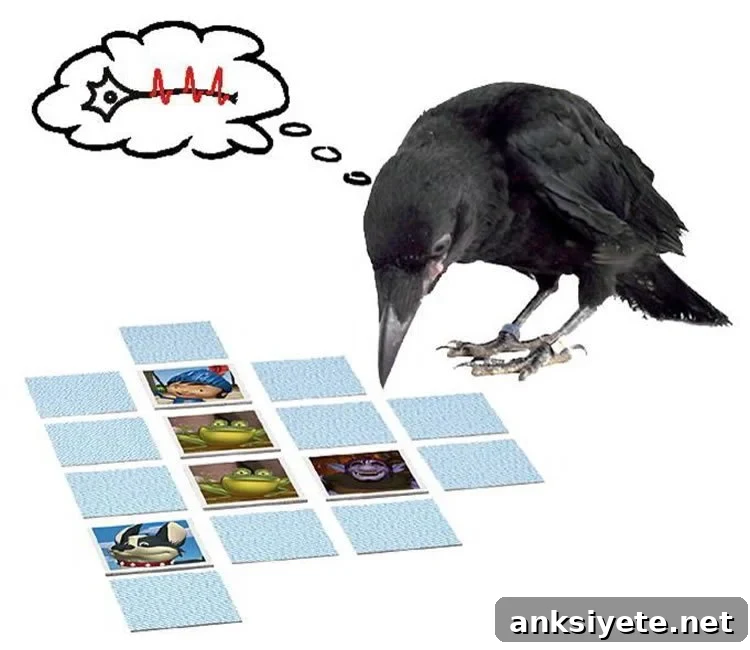
To investigate this, researchers at the Institute for Neurobiology at Tübingen University trained crows on a visual memory task reminiscent of the children’s game “pairs.” In the experiment, the birds were briefly shown a single random image on a monitor, then after a one-second delay they had to select that same image from an array of four by pecking it. Succeeding in this task requires retaining the visual stimulus in working memory for the short delay. The crows learned the task and reliably chose the correct image, demonstrating that they were able to maintain a short-term representation of what they had seen.
While the birds performed the task, the researchers recorded electrical activity from neurons in the crows’ endbrain. These simultaneous measurements revealed that a specific region contained neurons whose sustained activity matched the brief period of memory retention. Even after the image vanished from the screen, these neurons stayed active throughout the one-second delay, effectively holding the visual information until the bird made its choice. When a crow chose incorrectly, the neurons in that same area exhibited little to no sustained activation, suggesting a tight link between the persistent firing of these cells and successful short-term memory performance.
The findings make it clear that prolonged activation of particular nerve cells in the avian endbrain enables the temporary storage and retrieval of visual information. Rather than relying on a layered cortical structure, corvids appear to use a different neural architecture to achieve the same functional outcome: an active working memory capable of maintaining information for brief periods.
Professor Andreas Nieder and colleagues Lena Veit and Konstantin Hartmann emphasize that this discovery illustrates how evolution can arrive at multiple solutions for complex cognitive functions. “Clearly, a good working memory — an important characteristic of human beings — can also exist without a layered cerebral cortex. The corvids’ fundamentally differently-structured endbrain shows that evolution has found a number of independent solutions,” says Lena Veit.
The ability to hold information temporarily confers important behavioral advantages. An organism with a reliable working memory is not compelled to respond instantly to every stimulus; instead it can pause, evaluate options, and act based on stored information. As Professor Nieder notes, the next major question is how the specific connectivity and organization of neural networks produce this capacity for active storage and processing of information in differently structured brains.
Contact: Janna Eberhardt – Tübingen University
Source: Tübingen University press release
Image Source: Image credited to LS Tierphysiologie and adapted from the Tübingen University press release.
Original Research: Abstract for “Neuronal Correlates of Visual Working Memory in the Corvid Endbrain” by Lena Veit, Konstantin Hartmann, and Andreas Nieder in Journal of Neuroscience. Published online June 4, 2014; doi:10.1523/JNEUROSCI.0612-14.2014