
Summary: New estimates indicate axon density between distant brain regions is far lower than previously assumed.
Source: PLOS
Understanding how the brain processes information across activities depends on knowing how many axons exist and how densely different functional regions are interconnected.
In a study led by Burke Rosen and Eric Halgren at the University of California, San Diego and published in PLOS Biology on March 24, researchers report that long-range connections across the cortex are comparatively sparse despite their functional importance.
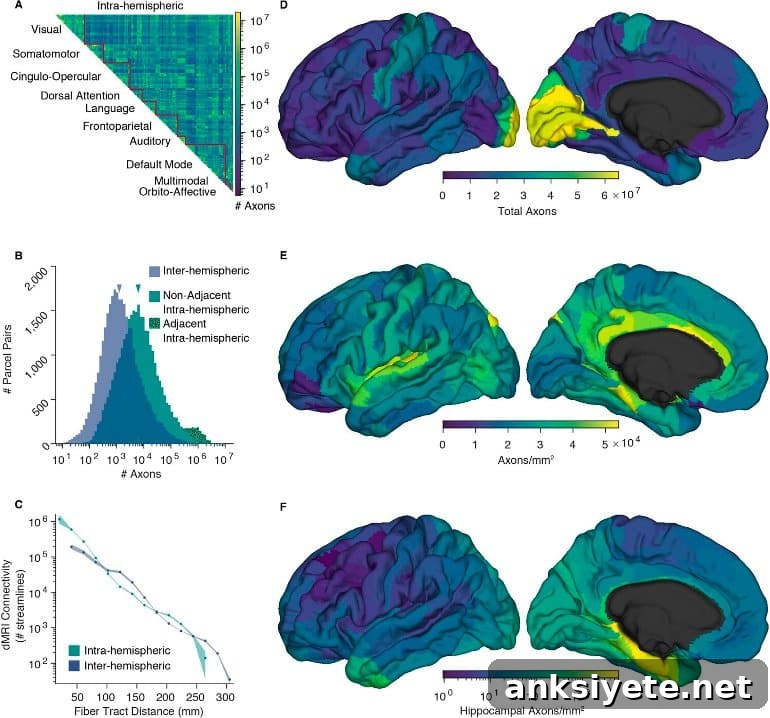
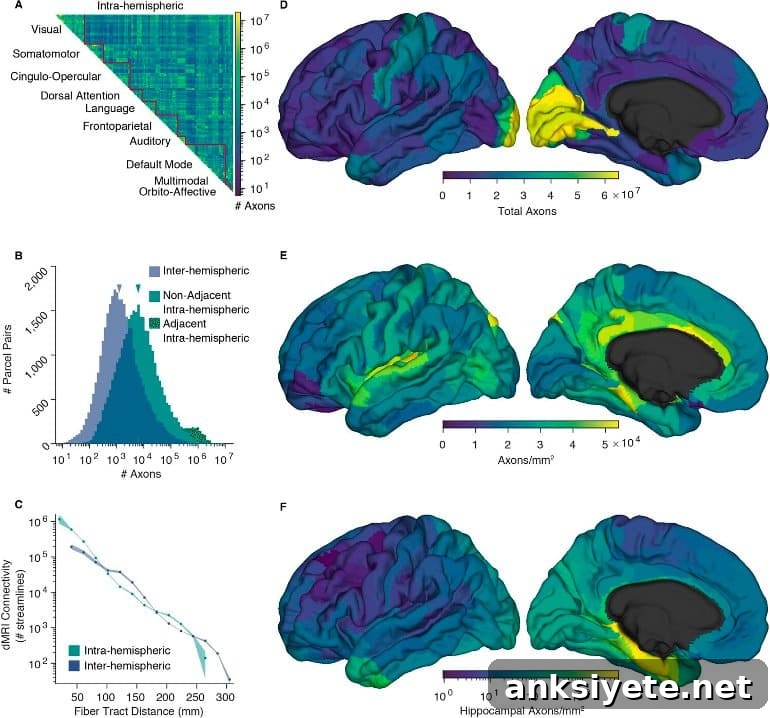
The team combined diffusion MRI (dMRI) connectome data from the Human Connectome Project with histological measurements of axon packing density from cross-sections of the corpus callosum, the brain’s major interhemispheric tract. While dMRI reveals the relative strength and patterns of connectivity across the whole cortex, histology provides absolute measures of how many axons occupy a given volume. By calibrating the MRI-based connectome with the callosal fiber density, the researchers derived estimates of absolute axon counts linking cortical areas.
Their analysis estimates roughly 2.5 billion long-range axons traverse the cerebral cortex. However, when broken down by pairs of cortical areas, the number of axons directly linking functionally related regions is unexpectedly low. For instance, within the arcuate and superior longitudinal fasciculi—tracts implicated in language—only about 1 to 2 million axons (under 2% of the estimated 130 million axons in that trunk) appear to directly connect Broca’s and Wernicke’s areas, which are critical for fluent language processing.
The model further suggests that many presumed long-range pathways—such as those connecting the hippocampus and frontal cortex for memory retrieval—may not rely on large numbers of direct axons but instead operate through multi-step routes or intermediary regions. This implies detailed information transfer between distant cortical areas likely depends on either very dense local circuits that relay information stepwise or on a small subset of exceptionally privileged long-range axons.
These findings refine our understanding of cortical wiring and have important implications for computational and cognitive models that depend on assumptions about connectivity strength and bandwidth between distant regions. Sparse direct connectivity challenges models that assume abundant one-to-one long-range axonal channels for high-fidelity information transfer and highlights the potential importance of local network structure and selective long-range links.
“A central unresolved question is how the human cortex integrates processing across some 16 billion neurons to produce unified perception and cognition,” Rosen commented. “Our results suggest that integration across the cortical surface relies heavily on dense local connections and on a small number of exceptionally privileged long-range axons rather than uniformly dense long-range wiring.”
About this neuroscience research
Author: Press Office
Source: PLOS
Contact: Press Office – PLOS
Image: The image is credited to the researchers
Original Research: Open access. “An estimation of the absolute number of axons indicates that human cortical areas are sparsely connected” by Burke Q. Rosen et al., PLOS Biology
Abstract
An estimation of the absolute number of axons indicates that human cortical areas are sparsely connected
Tracts between cortical areas are widely considered central to cortical information processing, yet their absolute numbers in humans have not been established. Using a whole-cortex diffusion MRI connectome calibrated by histologically measured callosal fiber density, the authors estimate the absolute number of axons linking cortical regions.
Median connectivity is estimated at approximately 6,200 axons between cortical areas within the same hemisphere and roughly 1,300 axons between hemispheres. Axons directly connecting functionally related regions are surprisingly sparse; for example, fewer than 5% of axons in the trunk of the arcuate and superior longitudinal fasciculi connect Wernicke’s and Broca’s areas. These results support the view that detailed information transmission across the cortex relies on dense local circuitry or on a very limited set of privileged long-range connections rather than on uniformly dense long-range axonal links.