
Summary: Stroke is a leading cause of long-term disability worldwide. Even after intensive early physiotherapy, many survivors continue to experience persistent upper-limb impairments, reduced hand dexterity, diminished touch sensation, and distorted body awareness. Conventional rehabilitation typically emphasizes movement training while sensory deficits and body representation problems remain largely untreated. This leaves a critical need for integrated approaches that restore both motor control and sensory feedback.
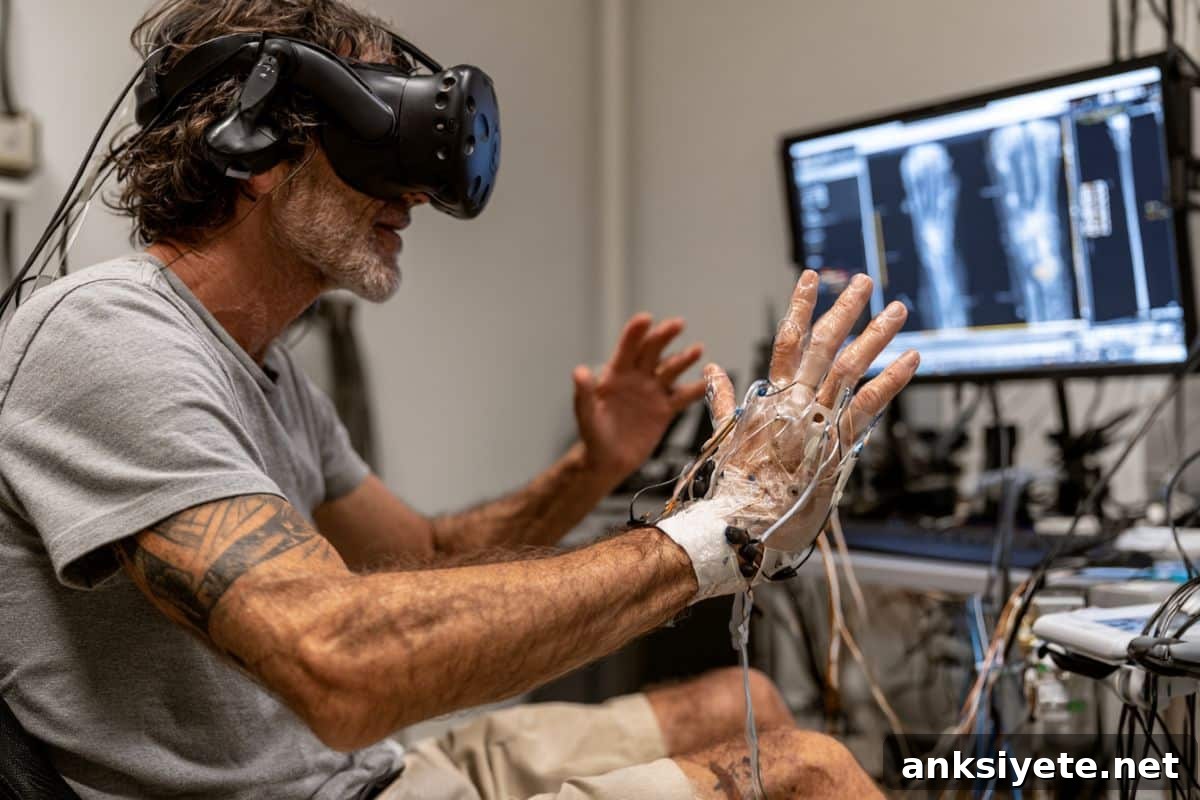
To address this gap, an international engineering and clinical team developed MultiSensy, a personalized rehabilitation platform that integrates immersive virtual reality (VR) with synchronous transcutaneous electrical nerve stimulation (TENS). Instead of training movement alone, MultiSensy pairs task-based virtual exercises—reaching, grasping, pinching and forearm rotation—with real-time skin stimulation that reproduces tactile feedback for the user. The platform is designed to retrain motor function while restoring sensation and recalibrating the brain’s sense of the affected limb.
Key Facts
- Hybrid MultiSensy system: Combines an immersive, task-driven VR environment with real-time transcutaneous skin electrodes that stimulate peripheral nerves so patients can feel the shape, position and texture of virtual objects during rehabilitation tasks.
- Higher motor recovery: On the Fugl-Meyer Assessment for the upper limb (FMA-UE), participants who used MultiSensy showed nearly double the improvement compared with those receiving conventional rehabilitation.
- Functional gains in daily tasks: MultiSensy users achieved substantial improvements on the Action Research Arm Test (ARAT), indicating better transfer of training to everyday activities such as pinching and rotating the forearm.
- Restores body awareness and touch: Real-time electrotactile feedback improved tactile acuity and reduced distortions in body representation, helping patients perceive their affected arm more accurately in size, shape and position.
- Continuous, objective monitoring: The platform continuously records kinematic data during sessions, producing automated, objective markers of movement quality and recovery for clinicians.
- Effective in the chronic phase: The trial demonstrates that sensory-motor integration can trigger neuroplastic recovery in chronic stroke patients (>3 months post-stroke), supporting the feasibility of future home-based, decentralized therapy.
Source: University of Vienna
Background
Stroke affects millions and often leaves survivors with long-term upper-limb sensorimotor deficits. Standard rehabilitation can yield motor improvements but frequently neglects sensory dysfunction and altered body schemas—factors that limit meaningful recovery. Integrating sensory feedback with movement training can close the brain’s sensorimotor loop and accelerate adaptive neural reorganization.
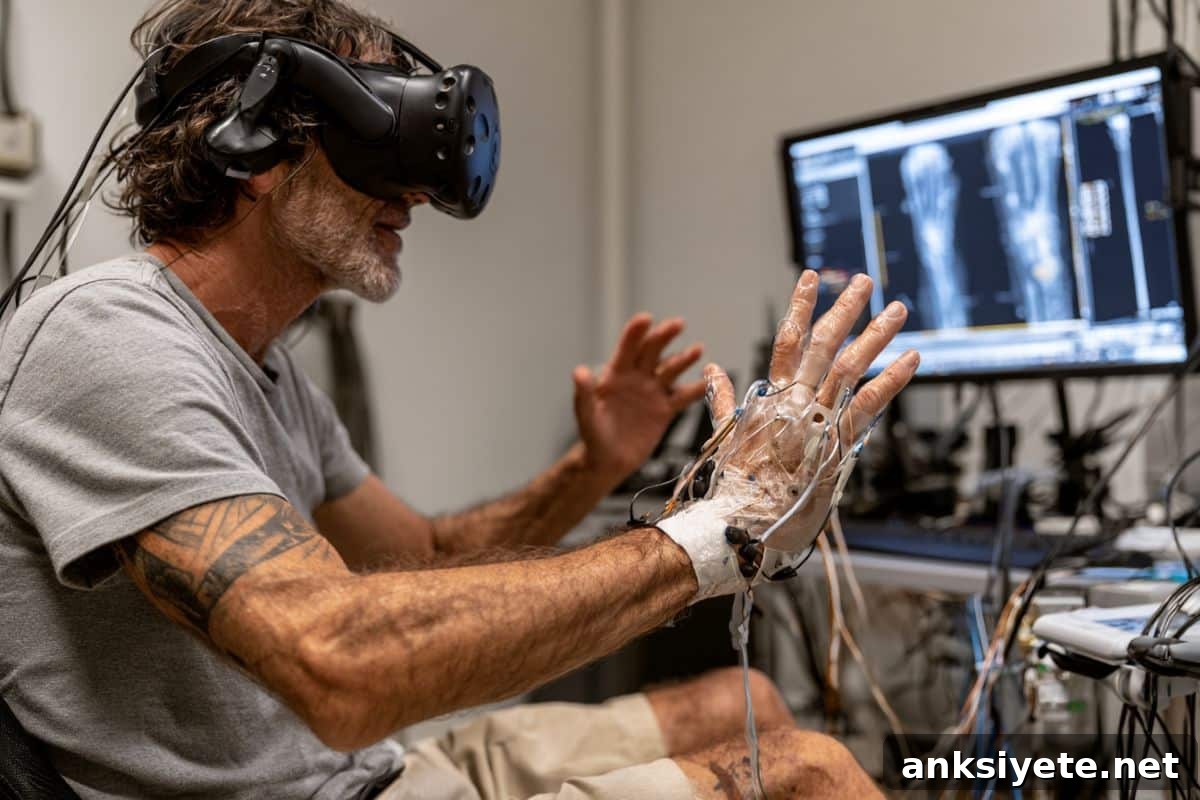
Personalized training in a virtual environment
Led by Stanisa Raspopovic at the Center for Medical Physics and Biomedical Engineering, MedUni Vienna, MultiSensy uses VR scenarios that turn rehabilitation exercises into engaging, goal-directed tasks. Electrode arrays on the skin deliver synchronous neurostimulation that mimics the sensation of touching virtual objects. Task difficulty can be tailored to each patient, allowing progressive, occupation-inspired training that targets specific functional deficits while keeping motivation high.
The platform was evaluated in a study of 34 chronic stroke patients (more than three months after stroke). Participants were randomized: the MultiSensy group trained in VR with synchronous skin stimulation while the control group received standard physiotherapy and occupational therapy. Both groups completed a three-week protocol comprised of twelve training sessions. Clinical assessments were supported by collaborators from the Faculty of Medicine in Belgrade.
Results: improvements in motor function, sensation and body perception
Patients treated with MultiSensy achieved larger gains in arm and hand recovery than those in conventional rehabilitation. On the FMA-UE, the MultiSensy group improved by 13.17 ± 1.30 points versus 7.54 ± 1.48 in controls (P = 0.01). On the ARAT, scores rose 8.25 ± 1.96 versus 2.44 ± 1.08 (P = 0.029). Beyond motor scores, the MultiSensy intervention improved tactile acuity and reduced distortions in body representation, helping participants regain a more accurate sense of limb ownership and spatial configuration.
Because the system logs continuous kinematic data during gameplay, clinicians can access objective markers of movement quality and track recovery trajectories over time. This data-driven capability supports individualized adjustment of therapy intensity and task selection.
The investigators conclude that combining immersive VR with synchronous sensory neurostimulation can enhance sensorimotor rehabilitation, even in the chronic phase. While the technology remains in research and requires larger trials to confirm safety and generalizability, its reliance on portable VR headsets and standard transcutaneous electrodes points toward scalable, potentially home-deliverable rehabilitation solutions.
Key Questions Answered:
A: Stroke disrupts both outgoing motor commands and incoming sensory feedback. Movement-only training leaves the brain without accurate sensory input to recalibrate motor circuits. MultiSensy restores that sensory feedback in real time: when a patient interacts with a virtual object, electrodes recreate the corresponding touch sensation. This synchronized visual, motor and tactile input closes the sensorimotor loop and promotes faster neuroplastic reorganization, accelerating motor recovery.
A: A distorted body schema occurs when the brain’s internal map of the body becomes unreliable after a stroke—patients may feel the limb is numb, heavy, or misshapen. By showing a synchronized, healthy virtual arm that moves with the user’s intent and by providing matching tactile feedback, MultiSensy helps recalibrate the brain’s representation of the limb, restoring a more accurate sense of touch and ownership.
A: MultiSensy is in an advanced research phase but not yet widely available for home deployment. The initial 34-patient trial offers promising proof of concept, but larger trials are necessary to complete safety, efficacy and regulatory validation. Because the system uses portable hardware, the research team aims to scale it into an affordable, home-based telerehabilitation solution in the future.
Editorial Notes:
- This article was edited by a Neuroscience News editor.
- The journal paper was reviewed in full.
- Additional context was provided by editorial staff.
About this stroke and neurotech research news
Author: Karin Kirschbichler
Source: University of Vienna
Contact: Karin Kirschbichler – University of Vienna
Image: Image credited to Neuroscience News
Original Research: Open access. “Immersive virtual reality with synchronous neurostimulation for upper-limb recovery after stroke: a randomized feasibility trial” by Giuseppe Valerio Aurucci, Olivera Djordjevic, Andrea Cimolato, Natalija Secerovic, Tijana Dimkic Tomic, Maria Dolores Ardura Carnicero, Haotian Yao, Ljubica Konstantinovic & Stanisa Raspopovic. Nature Medicine. DOI: 10.1038/s41591-026-04486-4
Abstract
Immersive virtual reality with synchronous neurostimulation for upper-limb recovery after stroke: a randomized feasibility trial
Stroke affects millions worldwide and leaves a substantial number permanently disabled. In the chronic phase (>3 months post-stroke), persistent sensorimotor deficits and altered body representation remain common, while rehabilitation services are often inconsistent. Immersive technologies combined with noninvasive neurostimulation could provide scalable, intensive rehabilitation, but clinical evidence for multimodal approaches with objective assessments has been limited.
This study evaluated the feasibility, clinical efficacy and assessment capabilities of MultiSensy, a multimodal platform integrating VR with synchronous transcutaneous sensory neurostimulation. Thirty-four chronic stroke patients participated in a combined pilot and randomized, 33-day feasibility study comparing MultiSensy to conventional rehabilitation.
Primary endpoints included motor function (FMA-UE and ARAT) and self-body representation (Body Landmark Test). Secondary outcomes included sensory measures and functional independence. The platform also captured continuous kinematic data to derive objective performance markers.
Compared with conventional rehabilitation, MultiSensy produced greater motor gains: FMA-UE improvement averaged 13.17 ± 1.30 versus 7.54 ± 1.48 (P = 0.01), and ARAT improvement averaged 8.25 ± 1.96 versus 2.44 ± 1.08 (P = 0.029). The intervention also enhanced body self-representation and tactile acuity. Continuous performance monitoring allowed extraction of kinematic markers that tracked rehabilitation progress. These results support larger trials and the potential for remote, sensorimotor rehabilitation with reduced reliance on frequent in-person physiotherapy visits.
ClinicalTrials.gov identifier: NCT06400823.