
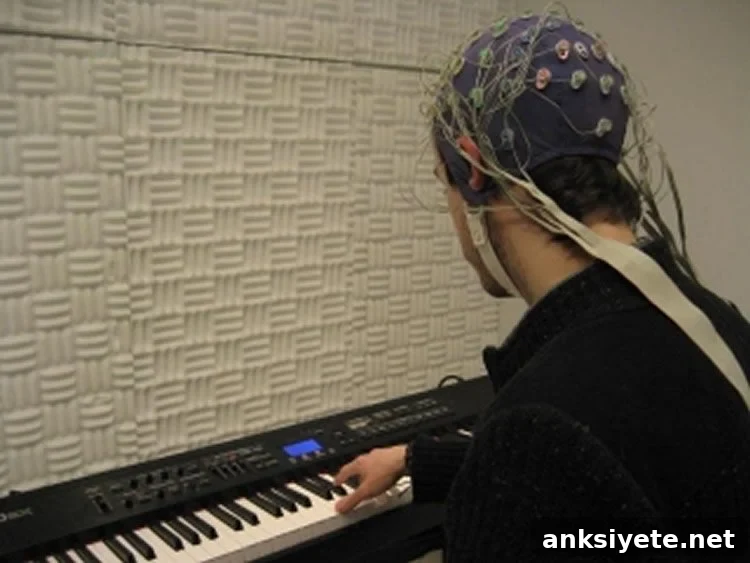
McGill research reveals how motor networks help us know whether we’ve previously heard a tune.
Researchers at McGill University report that the brain’s motor network helps people recognize music they have performed more effectively than music they have only heard. The study, led by Prof. Caroline Palmer of McGill’s Department of Psychology, offers new evidence that sensorimotor learning — the link between action and sound — enhances memory and recognition for melodies. Published in the journal Cerebral Cortex, the work explores the neural basis of the “production effect” and its potential implications for education, rehabilitation, and healthy cognitive aging.
“The memory benefit that comes from performing a melody rather than just listening to it — or saying a word out loud rather than only hearing or reading it — is called the production effect,” explains Prof. Palmer, a Canada Research Chair in Cognitive Neuroscience of Performance. “Researchers have debated whether this advantage is driven by stronger auditory memories or by motor memories that encode how movements feel. Our findings indicate that motor memories contribute to improved recognition of tones people have previously performed.”
To investigate how motor networks support music recognition, the team recruited twenty skilled pianists in Lyon, France. Participants learned a set of simple melodies in two different ways: by repeatedly listening to them or by physically performing them on a piano. After the learning phase, pianists listened to all the melodies again while electroencephalography (EEG) recorded their brain activity. Some versions of the melodies contained deliberately incorrect notes to test recognition and expectation processes.
The study found that pianists were more accurate at detecting pitch errors in melodies they had performed than in melodies they had merely heard, demonstrating a clear behavioral production effect for musical memory. EEG measures revealed that roughly 200 milliseconds after an unexpected or wrong note, brain waves showed greater modulation and signatures of motor-system engagement for previously performed melodies. This rapid neural response suggests the brain quickly compares incoming auditory input with motor memories, helping listeners judge whether a sound sequence is familiar.
Brian Mathias, the study’s first author and a McGill PhD student who conducted the work at the Lyon Neuroscience Research Centre, emphasizes the broader relevance: “These results illuminate experiential learning — learning by doing — and point to how motor networks shape auditory perception and memory.” Co-authors included Drs. Barbara Tillmann and Fabien Perrin. The combined behavioral and EEG evidence supports the idea that action-based learning leaves motor traces that later contribute to faster and more accurate recognition.
Practical implications of the research touch on several areas. In education, integrating performance or enactment into learning strategies could strengthen memory for musical material, spoken words, and other sound-based content. In clinical settings, therapies that harness sensorimotor practice might support rehabilitation of auditory or cognitive functions. The authors also suggest the findings could guide future studies on whether motor learning offers protective benefits against memory decline in aging populations, although additional research is needed to test those possibilities directly.
This project was carried out as part of the Erasmus Mundus Auditory Cognitive Neuroscience exchange program, where North American researchers complete collaborative projects with European laboratories. The peer-reviewed paper, “Sensorimotor Learning Enhances Expectations During Auditory Perception,” appears in Cerebral Cortex and reports the combined behavioral and EEG evidence for sensorimotor contributions to auditory recognition.
Contact: Cynthia Lee – McGill University
Source: McGill University press release
Image Source: Adapted from the McGill University press release
Original Research: Abstract for “Sensorimotor Learning Enhances Expectations During Auditory Perception” by Brian Mathias, Caroline Palmer, Fabien Perrin, and Barbara Tillmann in Cerebral Cortex. Published online March 12, 2014.