
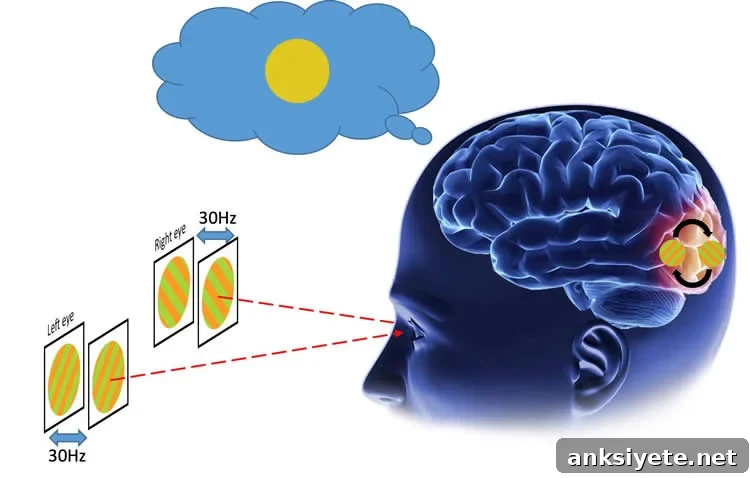
Summary: Researchers find that the brain can engage visual competition even when the conflicting information between the two eyes is not consciously perceived.
Source: Chinese Academy of Sciences
Invisible Conflicts in Vision: How the Early Visual Cortex Resolves Ambiguity
Our visual system constantly receives rich but often ambiguous optical information. When input is incomplete or contradictory, the brain must quickly resolve these ambiguities to produce a coherent and stable perception of the world. Understanding how the brain performs this rapid conflict resolution is a central question in cognitive neuroscience.
A classic way to study perceptual conflict is binocular rivalry. When each eye is presented with a different image at matching retinal locations, observers typically do not see a fused mixture. Instead, perception alternates spontaneously between the two images even though the physical stimuli remain unchanged. This dissociation between constant stimuli and fluctuating conscious experience makes binocular rivalry a powerful tool for investigating the neural mechanisms that underlie perceptual decision-making and conscious awareness.
One crucial question is whether the brain must first consciously detect a conflict to trigger the mechanisms that resolve it. Specifically: does binocular rivalry require that the conflicting features presented to the two eyes be consciously perceived? A team led by Dr. Peng Zhang and Dr. Sheng He at the Institute of Biophysics, Chinese Academy of Sciences, including graduate student Jinyou Zou, addressed this question in a study published in PNAS (June 27, 2016).
Instead of using visibly distinct patterns, the researchers presented red-green chromatic gratings in orthogonal orientations to each eye, but rendered the stripes invisible by counterphase flickering at 30 Hz. At this high flicker rate the red and green components fused perceptually, producing a uniform yellow disc that observers reported without awareness of orientation differences. Despite this apparent uniformity, neuroimaging and psychophysical tests indicated that orientation information was still processed in early visual cortex, whereas parietal and frontal cortical areas showed minimal engagement.
Through a set of carefully designed behavioral experiments, the team demonstrated that invisible orientation conflicts can nonetheless induce rivalry competition. An invisible grating shown to one eye produced suppression of a low-contrast visible grating shown to the other eye. When the display switched from a uniform field to an invisible, perceptually matched grating, observers reported no subjective change, yet interocular suppression began roughly 200 ms after the invisible grating onset. Additional trials using brief monocular probes further revealed sustained rivalry between two simultaneously presented invisible gratings during continuous dichoptic stimulation.
These results indicate that early sensory cortex mechanisms can detect and resolve interocular conflicts without the conflicts ever entering conscious awareness. In other words, visual competition can arise even when the features that generate the conflict are not represented consciously and when higher-order fronto-parietal regions show minimal activation. This finding highlights a dissociation between conflict resolution in the sensory cortex and conscious detection or attention-dependent processing in higher cortical areas.
Summary of findings: Counterphase-flickering chromatic gratings that are perceptually fused still produce orientation-specific responses in early visual cortex and induce binocular rivalry and interocular suppression without conscious awareness or substantial fronto-parietal activation.
Source: Chinese Academy of Sciences
Original research: Jinyou Zou, Sheng He, and Peng Zhang, “Binocular rivalry from invisible patterns,” PNAS. Published online June 27, 2016. DOI: 10.1073/pnas.1604816113
Abstract (Rephrased)
Binocular rivalry typically occurs when the two eyes receive incompatible images. This study asks whether rivalry still arises when the conflicting features are rendered invisible and produce identical conscious interpretations. Using chromatic gratings that counterphase flickered at 30 Hz to render orientation invisible, the researchers found significant orientation-selective adaptation and tilt aftereffects, and measurable BOLD responses in early visual cortex despite minimal parietal and frontal activation. Compared with perceptually matched uniform stimuli, an invisible chromatic grating shown to one eye enhanced rivalry with a low-contrast visible grating in the other eye, and switching from a uniform field to an invisible grating produced interocular suppression about 200 ms after onset. Brief monocular probes provided evidence for sustained rivalry between two invisible gratings during continuous dichoptic presentation. These findings show that perceptually identical stimuli that contain invisible conflicting features can drive rivalry competition in early visual cortex, independent of explicit conscious detection or substantial top-down fronto-parietal feedback.
Research highlights the capacity of the early visual system to resolve ambiguous inputs and maintain competitive interactions without those conflicts reaching conscious awareness, shedding light on the neural separation between sensory conflict resolution and conscious perceptual access.