
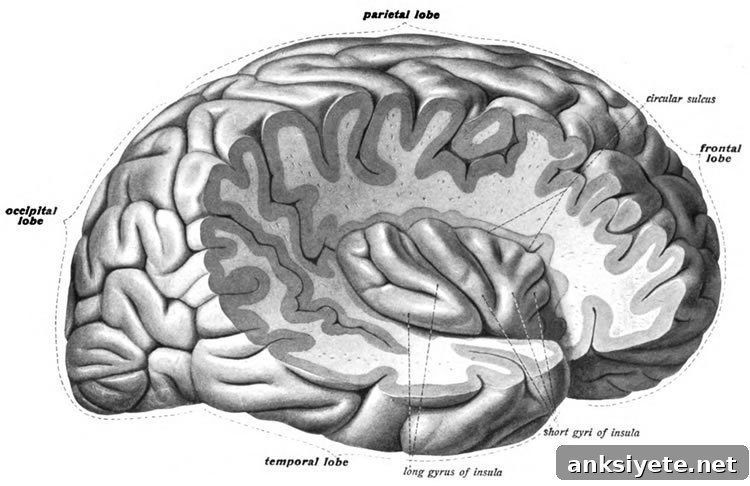
Summary: Researchers identify structural and functional differences in the insular cortex between men and women, with implications for autonomic control and cardiovascular health.
Source: UCLA.
UCLA researchers using functional MRI during controlled blood pressure challenges found opposite responses in a specific anterior region of the right insular cortex in men and women. The insula plays a key role in emotion, self-awareness and autonomic control of heart rate and blood pressure.
The insular cortex is organized into five main gyri (folds), each contributing to different aspects of autonomic and sensory processing. In this study the front-most right gyrus displayed a striking sex difference: men showed the expected higher activation on the right side during blood pressure elevation, while women exhibited a lower response in that same region.
“This is a crucial brain area, and the pronounced difference between men’s and women’s responses was unexpected,” said Paul Macey, the study’s lead author. “The right anterior insula is associated with stress responses and maintaining elevated heart rate and blood pressure. One possibility is that women in the study had already engaged this region through psychological stress before the physical test, limiting further activation during the Valsalva maneuver. Alternatively, the region may be organized differently in men and women.”
“Historically, the view that the right-front insula activates more than other insular areas during tasks that raise blood pressure was based largely on studies in men or male animals,” Macey added. “Our results suggest that what was considered the ‘typical’ pattern actually reflects male physiology. In healthy women, a lower right-sided activation appears to be the normative response.”
Most prior research on sex differences in brain function has emphasized psychological testing or cognitive performance. The UCLA team previously observed sex differences in heart rate and cerebral blood flow responses to blood pressure changes in people with obstructive sleep apnea, prompting a focused investigation of cardiovascular control in healthy men and women.
The researchers at the UCLA School of Nursing used the Valsalva maneuver — instructing participants to exhale forcefully into a small tube to generate a target expiratory pressure — while measuring brain activity with functional MRI. The maneuver produces well-characterized phases of blood pressure and heart rate change, allowing assessment of autonomic brain responses across insular gyri.
“These findings raise important questions about why insular activation patterns differ by sex and whether those differences influence sex-specific risks for cardiovascular and autonomic disorders,” Macey said. Understanding these differences could affect how clinicians assess disease susceptibility, tailor pharmacological treatments, and interpret normal physiological development across sexes.
The researchers emphasize that further study is needed to determine whether observed differences reflect baseline physiological states, transient tonic activation, or distinct wiring of autonomic networks in men and women. Any of these possibilities could help explain why some clinical symptoms and disease courses differ between sexes.
The study was led by Paul M. Macey, associate professor at the UCLA School of Nursing. Funding was provided by the National Institute of Nursing Research (grant NR013693). The original peer-reviewed research article is titled “Sex Differences in Insular Cortex Gyri Responses to the Valsalva Maneuver” and was published in Frontiers in Neurology (published online June 9, 2016).
The study examined sex differences in autonomic organization of the insular cortex by measuring fMRI responses to four 18-second Valsalva maneuvers in 22 healthy women (mean age 50.0 ± 7.9 years) and 36 healthy men (mean age 45.3 ± 9.2 years). All participants achieved the target expiratory pressure (30 mmHg) for each challenge. Heart rate responses followed the expected pattern: increases during the strain (sympathetic-dominant Phase II) and rapid declines after release (parasympathetic-dominant Phase IV). Small but significant sex differences in heart rate percent change were found — women showed smaller increases than men in Phase II and larger undershoots relative to men in Phase IV.
Across insular gyri, fMRI signals generally decreased in response to the Valsalva maneuver, with males exhibiting larger signal decreases than females. Both sexes displayed an anterior–posterior organization during the sympathetic-dominant phase, where anterior gyri responded more strongly than posterior gyri. The notable exception was the right anterior-most gyrus in females: it showed lower responses than the other right gyri and lower responses than its left counterpart. Overall, responses were lateralized with right-sided dominance during Phase II for both sexes, except for that female-specific reduction in the right anterior-most gyrus.
These results confirm an anterior and right-sided dominance of insular sympathetic activity and highlight a specific sex-related difference in the right anterior insula. The authors suggest this difference may reflect a distinct baseline brain state or tonic functional activity between females and males, with potential implications for sex-specific autonomic regulation and clinical presentation of related disorders.
Study authors: Paul M. Macey, Nicholas S. Rieken, Rajesh Kumar, Jennifer A. Ogren, Holly R. Middlekauff, Paula Wu, Mary A. Woo and Ronald M. Harper. Published in Frontiers in Neurology, June 2016.