
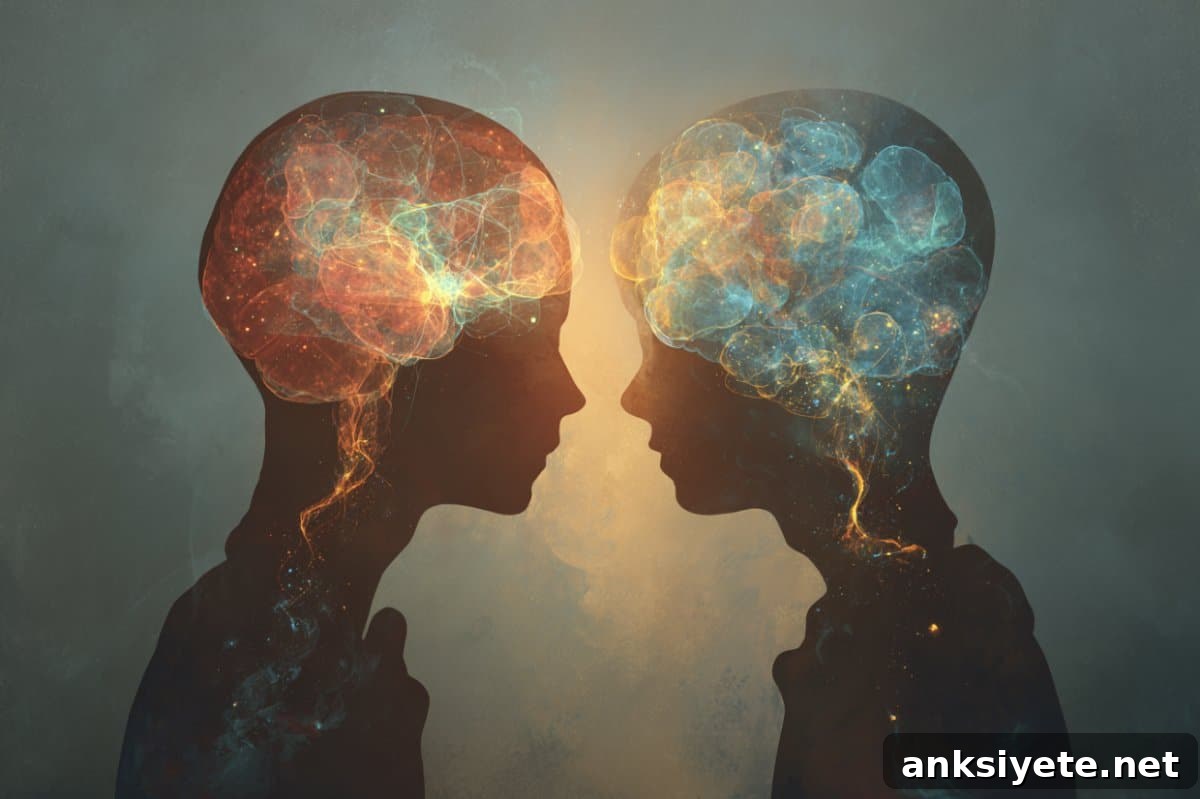
Summary: A new fMRI study shows that the human brain encodes two separate representations when we evaluate others’ emotions: the speaker’s intended emotional intensity and the observer’s conscious inference. Researchers trained machine-learning models on observers’ brain activity to predict both the speaker’s self-reported feelings and the observer’s moment-by-moment judgments, revealing distinct but overlapping neural signatures of intent and inference.
Even when observers misjudged someone’s emotions, their brain activity still contained a latent trace of the speaker’s intended feeling. Greater alignment between these two neural patterns—intent and inference—was associated with higher empathic accuracy, providing new insight into how social understanding succeeds or fails.
Key Facts
- Dual neural signatures: Observers’ brains show separate patterns for the target’s intended emotional intensity and for the observer’s own interpretation.
- Latent recognition: The brain retains a signature of the speaker’s intent even when the observer’s conscious judgment is incorrect.
- Empathic alignment: Stronger alignment between intent and inference patterns predicts better accuracy in reading others’ emotions.
Source: Neuroscience News
New fMRI evidence reveals hidden neural representations of others’ emotions and clarifies why people sometimes misread social signals.
Humans are adept at forming rapid impressions from faces, tone, and behavior. But where and how does the brain transform those social signals into judgments about another person’s inner state? A recent study using functional MRI and machine learning provides a clearer answer: the observer’s brain encodes both the target’s expressed intent and the observer’s inference, as two separable neural patterns.
In the experiment, 100 participants watched videos of people describing meaningful life events and rated, moment by moment, how strongly they believed the speaker was feeling an emotion. The speakers themselves had previously rated their own emotional intensity while recording the videos, creating a reliable “ground truth” of intent to compare against observers’ judgments.
The research team trained two multivariate predictive models on the observers’ fMRI data: one model to predict the speaker’s self-reported emotional intensity (intent), and a separate model to predict the observer’s own ratings (inference). Both models performed above chance and mapped to partly overlapping but distinct brain networks.
The intent-related signature involved brain regions commonly linked with self-referential processing and social cognition, including the precuneus, angular gyrus, and anterior insula. By contrast, the inference-related signature recruited mentalizing and somatosensory areas, consistent with the idea that observers simulate others’ states using their own bodily and emotional memories.
Seeing What’s Really There
A striking finding was that the neural signature of the speaker’s intent was present in observers’ brains even when their conscious inferences were inaccurate. This suggests our brains register more about others’ emotional states than we always report or realize. The latent intent signal appears to be available, but it is not always fully accessed or translated into an accurate judgment.
Using cross-validated predictions on novel test data, the researchers showed that correspondence between the intent and inference models grew when observers were more empathically accurate. In other words, when the two neural patterns aligned within an observer, that person was more likely to correctly perceive the speaker’s emotional intensity.
When Minds Align
Alignment between intent and inference patterns offers a neural explanation for empathic accuracy. When these patterns converge, observers appear to leverage latent information about the speaker’s intended emotion; when they diverge, errors in social judgment are more likely. This supports theoretical views that empathy combines automatic detection of social signals with deliberate, memory-based interpretation.
The automatic component may reflect well-honed social schemas that rapidly pick up on intended meaning, while the deliberate component draws on personal memories, biases, and expectations. Together these processes shape whether an observer’s inference matches the target’s intent.
Why It Matters
These results advance the study of social cognition by using naturalistic, dynamic stimuli—real people telling real stories—rather than static or highly staged cues. That realism helps reveal how the brain operates in everyday social contexts and offers a pathway to test interventions aimed at improving social perception.
Clinically, the distinction between latent intent representations and conscious inference could inform support for individuals with social-processing difficulties, such as those on the autism spectrum or with schizophrenia. Strengthening the link between unconscious recognition of intent and explicit interpretation may improve social functioning and reduce isolation.
A Window Into Empathy
Overall, the study suggests that the brain continually processes socioemotional information at multiple levels, and that empathic success depends on how well automatic, latent representations of others’ feelings are integrated into conscious judgments. Future work will need to explore how to help people better access and use these latent signals to enhance connection and understanding.
About this neuroscience and empathy research news
Author: Neuroscience News Communications
Source: Neuroscience News
Contact: Neuroscience News Communications – Neuroscience News
Image: Image credited to Neuroscience News
Original Research: Open access. “Neural signatures of emotional intent and inference align during social consensus” by Marianne C. Reddan et al., published in Nature Communications.
Abstract
Neural signatures of emotional intent and inference align during social consensus
Humans effortlessly transform dynamic social signals into inferences about other people’s internal states. This study collected fMRI data from 100 participants as they rated the emotional intensity of people describing significant life events. Targets provided self-ratings on the same scale. Two distinct multivariate models of observer brain activity were trained and validated: one predicting targets’ self-ratings (intent) and one predicting observers’ inferences. Correspondence between the models’ predictions increased when observers were more empathically accurate. Crucially, even when observers made inaccurate inferences, the target’s intent could still be predicted from observer brain activity. These findings indicate that observers’ brains contain latent representations of others’ socioemotional intensity, and that combining fMRI models of intent and inference can help predict empathic accuracy.