Summary: A new study shows that the brain processes spoken mathematical expressions and ordinary sentences in distinct yet simultaneous networks. These networks separate naturally when listeners focus on either math or language, offering insight into how we comprehend sentences and perform calculations.
Source: SfN
Separate math and language networks segregate naturally when listeners pay attention to one type over the other, according to research recently published in the Journal of Neuroscience.
Although mathematical language uses many of the same words as everyday speech, the brain recruits distinct circuits to handle arithmetic and general language. Prior work has largely focused on written stimuli; this study instead probes how the brain processes spoken arithmetic and spoken sentences when both are present simultaneously.
Researchers led by Kulasingham used magnetoencephalography (MEG) to record brain activity from participants who listened to audio recordings of short, simple arithmetic equations (for example, “five plus one is six”) and ordinary sentences (for example, “cats drink warm milk”). In a “cocktail party” paradigm, both types of audio played at once, and listeners were instructed to attend to one stream and ignore the other.
The experiment presented words, symbols, sentences and equations at fixed, distinct rates so that neural responses to acoustic features, individual words or symbols, and higher-level sentence or equation structures could be disentangled. This design allowed the researchers to separate low-level auditory processing from higher-level linguistic or arithmetic processing in the brain.
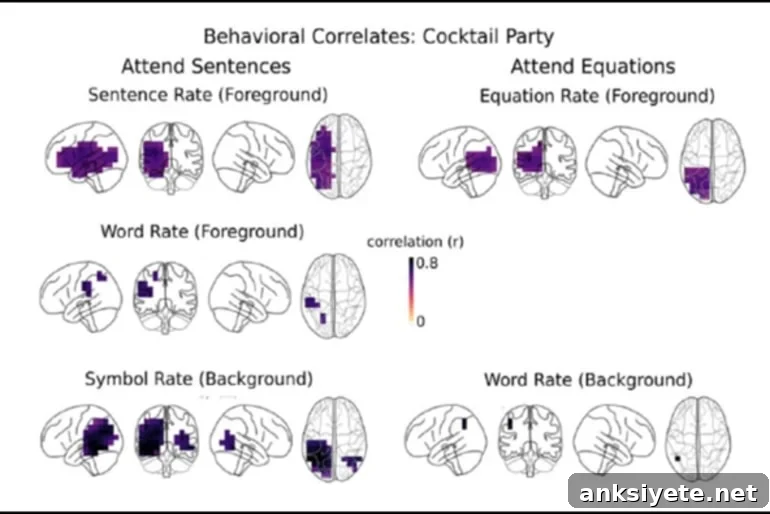
Results show that the auditory cortex tracked the acoustic rhythm of every word and math symbol—whether the listener was attending to that stream or not—indicating that early stages of sound processing operate on both streams simultaneously. In contrast, neural tracking of whole sentences or equations was dominated by the attended stream: when participants focused on sentences, sentence-rate activity emerged most strongly in left temporal regions associated with language; when they focused on equations, equation-rate activity emerged in parietal regions known for number processing.
Source-localized temporal response functions revealed distinct cortical dynamics: sentence processing engaged left temporal areas, while equation processing recruited bilateral temporal regions together with parietal and motor areas. Moreover, these higher-level neural responses correlated with behavioral performance on a task that required detecting occasional deviant items in the attended stream, linking neural segregation to successful comprehension or calculation.
The study also showed that researchers could decode which type of stream a person was attending to from the MEG signals, particularly from activity in left superior parietal regions. Together, the findings indicate that arithmetic and language are processed in partially overlapping but largely separate networks that segregate naturally with selective attention, and that these segregated responses relate to how well listeners understand sentences or perform calculations.
About this language processing research news
Author: Calli McMurray ([email protected])
Source: SfN
Contact: Calli McMurray – SfN
Image: The image is credited to Kulasingham et al., JNeurosci 2021
Original Research: Closed access. “Cortical Processing of Arithmetic and Simple Sentences in an Auditory Attention Task” by Joshua P. Kulasingham, Neha H. Joshi, Mohsen Rezaeizadeh and Jonathan Z. Simon. Journal of Neuroscience.
Abstract
Cortical Processing of Arithmetic and Simple Sentences in an Auditory Attention Task
This study examines how cortical processing for arithmetic and for language rely on both shared and task-specific neural mechanisms, and how these mechanisms can be dissociated independent of the sensory modality used to probe them. Using spoken arithmetic statements and non-mathematical sentences in a cocktail party listening paradigm, the researchers recorded MEG from 22 participants who listened to simultaneous audio mixtures while selectively attending to one stream.
Short sentences and simple equations were presented diotically at fixed and distinct rates for words/symbols and for sentences/equations. That design allowed neural responses to acoustic features and individual words or symbols to be separated from responses to the higher-level sentence and equation structures. Auditory cortex showed concurrent processing of acoustics for both streams, while responses tied to sentences and equations were largely limited to the attended stream. Sentence-related responses originated predominantly in left temporal regions; equation-related responses were strongest in parietal areas.
These neural responses correlated with behavioral performance in a deviant detection task. Source-localized temporal response functions highlighted distinct cortical dynamics for sentences and equations: left temporal activity for sentences and bilateral temporal, parietal, and motor activity for equations. Finally, attentional target could be decoded from MEG signals, especially within left superior parietal cortex. In sum, neural responses to arithmetic and language are well segregated under selective attention, and this segregation is linked to successful comprehension or calculation.
SIGNIFICANCE STATEMENT
Arithmetic processing depends on dedicated, modality-independent cortical networks that are distinct from those supporting general language. Using a simultaneous listening paradigm, this study demonstrates that these networks naturally segregate when listeners selectively focus on math or language. While left temporal cortex responds to both spoken sentences and equations, equations additionally engage bilateral parietal areas consistent with numerical processing. These attention-modulated responses correlate with task behavior, indicating they reflect higher-level processing important for comprehension and accurate calculation. The differing response dynamics also enable reliable decoding of whether a listener is attending to sentences or to equations.