
Summary: An open-source, calcium-based model of synaptic plasticity in the neocortex offers a practical framework to better understand how learning occurs in the brain.
Source: University of Montreal
The human brain is incredibly complex—but the mechanisms behind learning may be more straightforward than assumed.
An international research team that includes scientists from Université de Montréal has developed an advanced, open-source computational model that reproduces synaptic changes in the neocortex believed to underlie learning. This work provides a unified framework for interpreting a wide range of experimental results and for predicting how plasticity operates in intact brain tissue.
The study, published June 1 in Nature Communications, presents a model constrained by empirical data on postsynaptic calcium dynamics and demonstrates its ability to explain diverse long-term potentiation (LTP) and depression (LTD) outcomes across pyramidal cell connections.
“This opens up many new directions for scientific inquiry into how we learn,” said Eilif Muller, an IVADO assistant research professor at UdeM and a Canada CIFAR AI Chair, who co-led the work while at the Blue Brain Project of École polytechnique fédérale de Lausanne (EPFL).
Muller, who established the Architectures of Biological Learning Laboratory at the CHU Sainte-Justine Research Center in collaboration with UdeM and Mila, explained the key insight: “Neurons resemble trees, and synapses are the leaves on their branches. Earlier plasticity models often ignored this branching structure. Now, with realistic computational tools, we can test how interactions along dendritic branches shape learning in vivo.”
The team included researchers from EPFL’s Blue Brain Project, Université de Paris, Hebrew University of Jerusalem, Instituto Cajal (Spain), and Harvard Medical School. Their model links synaptic plasticity rules to postsynaptic calcium signals, cell morphology, local synaptic physiology, and innervation patterns, providing a comprehensive picture of neocortical plasticity.
At the center of the neocortex are pyramidal cells (PCs), which make up 80–90% of cortical neurons and are central to high-level cognitive processing. Experimental studies have characterized long-term synaptic changes only for a few PC types, revealing diverse plasticity behaviors. This limited sampling has made it hard to generalize how PC networks adapt during learning across cortical layers and regions.
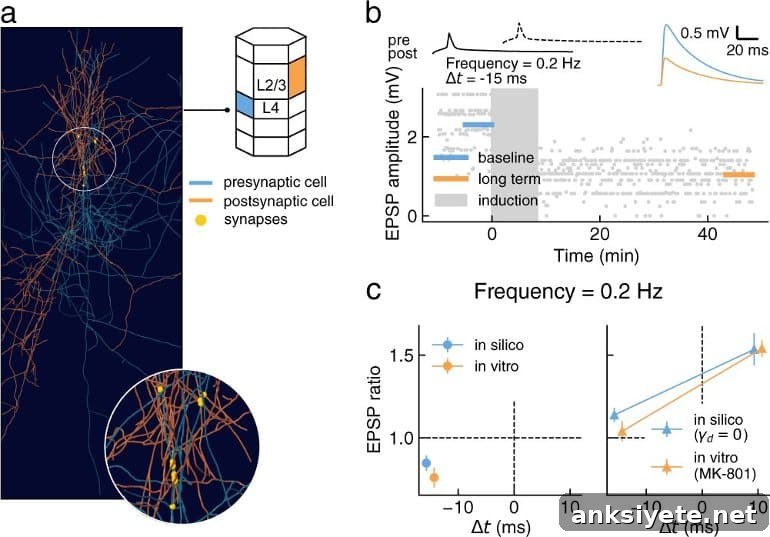
Using their calcium-based plasticity model inside a realistic neocortical microcircuit simulation, the researchers showed that a single set of parameters can reproduce the wide variety of LTP and LTD outcomes observed experimentally across different PC connection types. Rather than requiring distinct plasticity rules for each cell type, the model explains differences as emergent properties of cell-type-specific morphology, synaptic physiology, and innervation patterns.
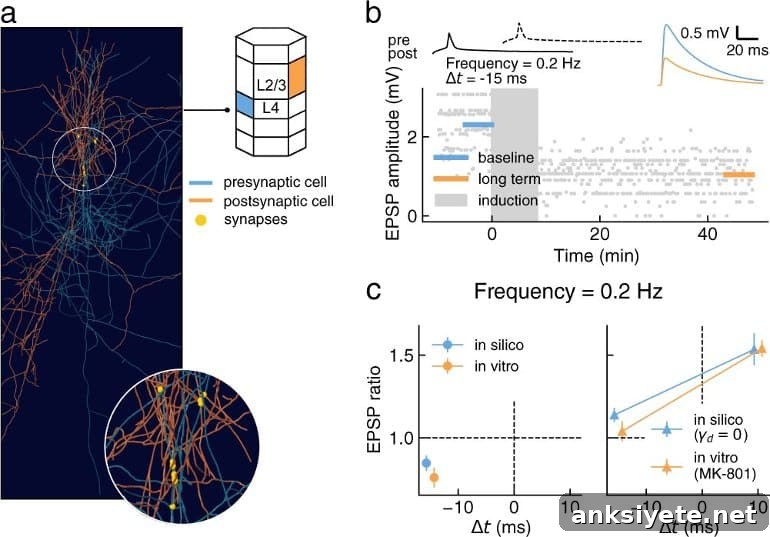
Most experimental plasticity data come from in vitro brain slice experiments in rodents, where calcium concentrations and other physiological conditions differ from those in the intact brain. By adapting their model to in vivo extracellular calcium levels, the authors predict qualitatively different plasticity dynamics than those commonly observed in vitro. If validated experimentally, these predictions would reshape how researchers interpret plasticity experiments and conceptualize learning mechanisms in living brains.
Henry Markram, founder and director of the Blue Brain Project, noted the study’s broader significance: “This work demonstrates that modeling can bridge gaps in experimental knowledge. The model is open source, enabling other researchers to test, extend, and refine it. Sharing these validated components accelerates progress and supports community-driven advances in neuroscience.”
The open-source release includes hundreds of modeled plastic connections among pyramidal cell types and represents one of the most extensively validated plasticity frameworks to date. It offers a robust null model for predicting LTP and LTD across neocortical circuits and a practical platform for developing biologically informed artificial intelligence methods.
About this synaptic plasticity research news
Author: Press Office
Source: University of Montreal
Contact: Press Office – University of Montreal
Image: The image is credited to the researchers
Original Research: Open access. “A calcium-based plasticity model for predicting long-term potentiation and depression in the neocortex” by Giuseppe Chindemi et al., Nature Communications.
Abstract
A calcium-based plasticity model for predicting long-term potentiation and depression in the neocortex
Pyramidal cells form the structural backbone of the neocortex; plasticity at their synapses is widely considered a cellular basis for learning. However, long-term synaptic changes have been experimentally characterized for only a limited set of pyramidal cell types, creating a barrier to understanding learning across cortical circuits.
This study introduces a synaptic plasticity model grounded in postsynaptic calcium dynamics constrained by experimental data. Embedded in a neocortical microcircuit model, a single parameter set reproduces available findings on LTP and LTD across multiple pyramidal cell connection types. The model shows that diverse plasticity outcomes can arise from cell-type-specific synaptic physiology, neuronal morphology, and innervation patterns without invoking distinct plasticity rules for each cell type.
When the model is adjusted to reflect in vivo extracellular calcium concentrations, it predicts plasticity behaviors that differ qualitatively from in vitro observations. Together, these results provide a comprehensive baseline model for neocortical LTP/LTD in vivo and an open framework for further development of cortical plasticity models.