
Summary: Heightened reactivation of negative memory engrams in the hippocampus may be a key cellular mechanism behind the cognitive symptoms of depression.
Source: SfN
Physical traces of negative memories in the hippocampus may help explain cognitive symptoms of depression, according to a mouse study published in Journal of Neuroscience. Targeting these traces could offer a novel treatment avenue.
Memories are believed to be stored as specific ensembles of neurons that become active during an experience; these ensembles are commonly referred to as memory engrams. The hippocampus, a brain region crucial for memory, appears to play an important role in depression: patients and animal models often show weakened recall of positive events and enhanced recall of negative ones. This study examined whether negative memory engrams in the hippocampus contribute to that bias.
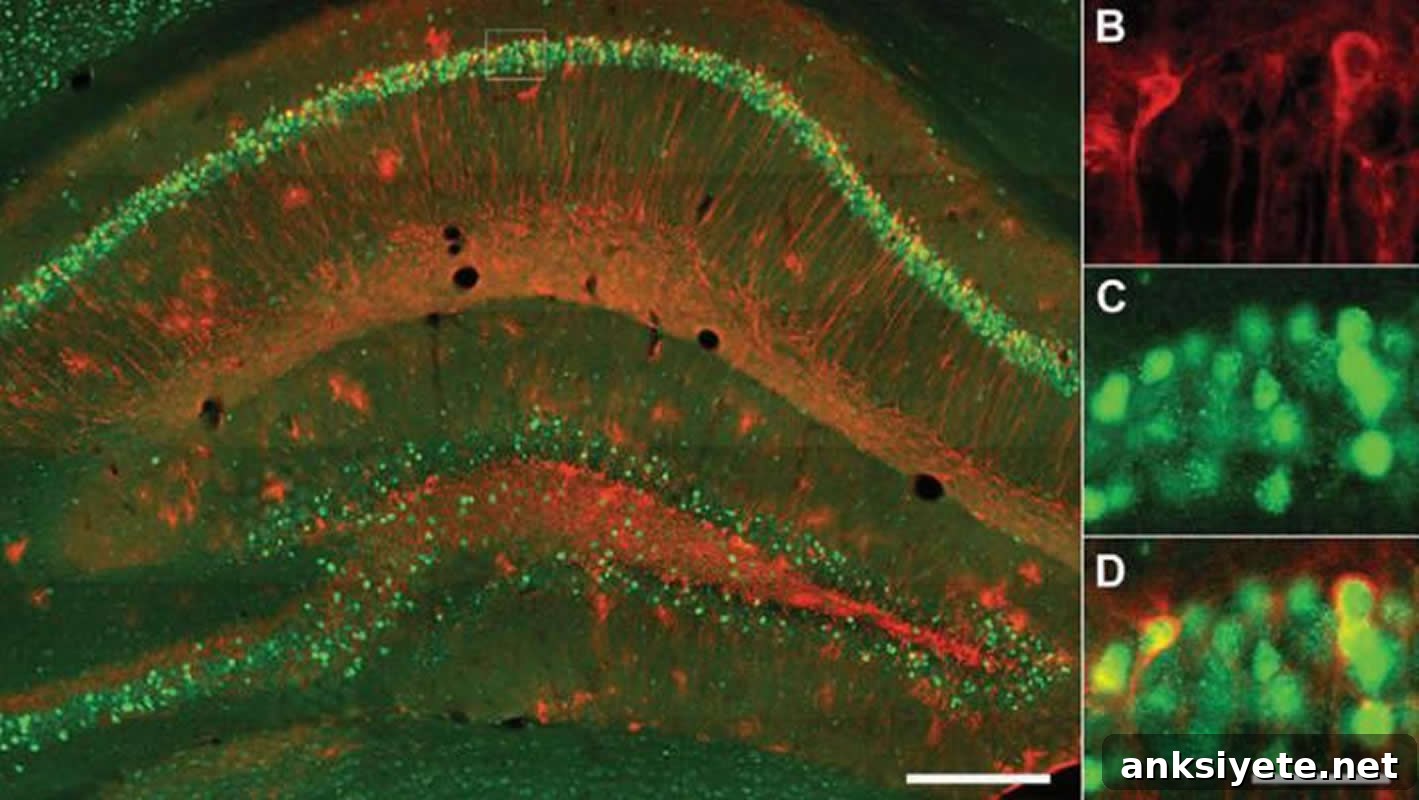
Using a chronic social defeat stress model in mice, Tak Pan Wong and colleagues at Douglas Hospital Research Centre labeled hippocampal neurons that were active after social stress and then tracked those same cells during later behavior. Although every mouse was exposed to the same stressful social experience, only a subset developed depression-like symptoms such as social avoidance. This allowed the researchers to compare animals that were susceptible to the stressor with those that were resilient.
The mice that developed social avoidance—the depression-prone group—showed a higher number and greater density of engram cells in the hippocampal CA1 region compared with resilient animals. Importantly, the density of these reactivated engram cells correlated with the degree of social avoidance: animals with more engram reactivation tended to avoid social interaction more strongly. The researchers also tested whether manipulating those specific cell ensembles could change behavior. Using chemogenetic and optogenetic tools to selectively activate the social-defeat–related CA1 engram cells increased social avoidance, while silencing those same cells reduced avoidance, supporting a causal role for negative memory engrams in driving the behavior.
Source:
SfN
Media Contacts:
Calli McMurray – SfN
Image Source:
The image is credited to Zhang et al., JNeurosci 2019.
Original Research: Closed access
“Negative Memory Engrams in the Hippocampus Enhance the Susceptibility to Chronic Social Defeat Stress”. Tian Rui Zhang, Amanda Larosa, Marie-Eve Di Raddo, Vanessa Wong, Alice S. Wong and Tak Pan Wong. Journal of Neuroscience. doi: 10.1523/JNEUROSCI.1958-18.2019
Abstract (rephrased)
The hippocampus is strongly implicated in the cognitive symptoms of depression. Prior work has linked increased hippocampal activity to the expression and vulnerability of depressive behaviors. The authors hypothesized that hippocampal engrams—groups of neurons that are more active following memory formation—could contribute to those symptoms when they represent negative experiences. They used a chronic social defeat stress (CSDS) protocol and TetTag mice in which neurons activated by the stressful experience can be labeled with LacZ to identify ensembles that formed in response to social defeat. Reactivated LacZ-labeled cells were considered engram cells for the social defeat memory.
Compared with resilient and non-stressed control animals, susceptible mice exhibited greater reactivation of LacZ-labeled social defeat ensembles in both dorsal and ventral CA1 regions of the hippocampus. CA1 engram density tracked with the magnitude of social avoidance. Manipulating these engram cells with designer receptors and light-sensitive proteins demonstrated causality: activating CA1 engram cells increased social avoidance, while inhibiting them reduced avoidance. The increase in engram cells in susceptible mice was specific to CA1 and was not observed in the dentate gyrus. Susceptible animals had more CA1 engram cells related to negative stimuli—but not neutral ones—than resilient mice in the dorsal hippocampus. Notably, only a prolonged, chronic social defeat protocol produced the increase in CA1 engram density; a brief, subthreshold stress exposure did not.
Significance
This study supports the idea that negative memory engrams in hippocampal CA1 contribute to vulnerability and expression of depression-like cognitive symptoms after chronic stress. While other research has shown that activating positive memory engrams can relieve depressive behaviors, these new findings point to a pathological role for reactivated negative memory engrams. Enhanced reactivation of negative memories in the hippocampus may therefore represent a cellular mechanism for biased negative recall in depression and highlight a potential target for interventions aimed at reducing the cognitive burden of the disorder.