
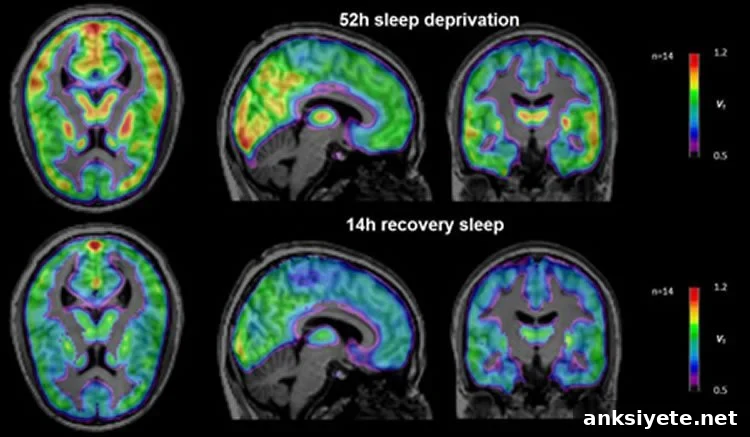
Summary: Sleep deprivation increases the number of available A1 adenosine receptors in the brain, while restorative recovery sleep returns receptor availability to baseline levels, a new study reports.
Source: Forschungszentrum Jülich.
Researchers at Forschungszentrum Jülich, together with partners from the German Aerospace Center (DLR), examined molecular changes in the human brain that occur after prolonged wakefulness. Study participants remained awake for 52 hours and then underwent PET brain scans at Jülich’s PET Centre. Afterward, they slept under scientific supervision at the DLR facility in Cologne for a 14-hour recovery sleep period.
Sleep loss has well-known negative effects on cognitive performance and physical health. The new experiment measured how extended wakefulness changes brain chemistry: the investigators found that A1 adenosine receptor availability increased after prolonged sleep deprivation, and that recovery sleep returned receptor availability to baseline levels, according to PD Dr. David Elmenhorst from Jülich’s Institute of Neuroscience and Medicine (INM-2).
A1 adenosine receptors are membrane proteins that transmit the signal of the chemical messenger adenosine into the cell, reducing cellular activity. Both adenosine itself and the availability of A1 receptors are believed to contribute to the growing drive to sleep that builds with time awake. Adenosine is a basic byproduct of cellular energy metabolism and its concentration fluctuates rapidly. In contrast, the number of free A1 receptors changes more slowly, making receptor availability a plausible substrate for a neural “sleep memory.”
Resilience and variability in response to sleep loss
The alertness-enhancing effect of caffeine is mediated by blocking these same A1 receptors. In this study, participants refrained from coffee and other stimulants. During the 52-hour wakefulness period they completed a battery of cognitive tests, including reaction-time button-press tasks and memory tests to assess performance and lapses in attention. The data revealed large individual differences: while some participants experienced severe, multi-second attention lapses, others showed little measurable decline in performance. Such individual resilience to sleep loss may be advantageous in occupations that demand sustained performance despite sleep curtailment.
“Surprisingly, we observed a substantial increase in measured A1 receptor availability even in those participants who appeared behaviorally resistant to sleep deprivation,” says David Elmenhorst. The PET technique used here quantifies only receptors that are free and available for tracer binding at the time of scanning. Tracer molecules in the bloodstream attach to unblocked receptor sites and are detected by PET when they decay. Therefore, a high PET signal reflects a high number of unoccupied, available receptors rather than an absolute increase in total receptor molecules.
Elmenhorst and colleagues propose that participants who showed higher A1 receptor availability may produce less endogenous adenosine during extended wakefulness. Less adenosine would mean reduced inhibition of neural activity, leaving more receptors unoccupied and thus detectable by PET. This dynamic could explain why some individuals maintain cognitive performance despite prolonged sleep loss.
Implications for depression treatment and wake therapy
These findings carry clinical implications. Total sleep deprivation can offer a rapid, short-lived antidepressant effect for some patients, but benefits typically fade after subsequent sleep. A deeper understanding of how adenosine signaling and A1 receptor regulation relate to mood could help optimize wake-based interventions for depression and extend the duration of therapeutic effects.
Source: Forschungszentrum Jülich.
Image credit: Forschungszentrum Jülich / Ralf-Uwe Limbach.
Original research: The study is titled “Recovery sleep after extended wakefulness restores elevated A1 adenosine receptor availability in the human brain.” Authors: David Elmenhorst, Eva-Maria Elmenhorst, Eva Hennecke, Tina Kroll, Andreas Matusch, Daniel Aeschbach, and Andreas Bauer. Published in Proceedings of the National Academy of Sciences (PNAS), online April 3, 2017. DOI: 10.1073/pnas.1614677114.
Recovery sleep after extended wakefulness restores elevated A1 adenosine receptor availability in the human brain
Adenosine and functional A1 adenosine receptor (A1AR) availability are believed to mediate sleep–wake regulation and cognitive performance. The authors hypothesized that cerebral A1AR availability elevated by extended wakefulness would return to baseline after recovery sleep. Using [18F]CPFPX positron emission tomography, the researchers quantified A1AR availability in 15 healthy male adults after 52 hours of sleep deprivation and again after 14 hours of recovery sleep. Data were compared with baseline A1AR values obtained after a regular 8-hour sleep period in a control dataset. Polysomnography, cognitive testing, and subjective sleepiness measures were recorded. Recovery sleep was associated with a decrease in A1AR availability across several brain regions, ranging from about 11% in the insula to 14% in the striatum. After recovery sleep, A1AR availability did not differ from baseline control values. The magnitude of performance impairment, subjective sleepiness, and homeostatic sleep-pressure response correlated negatively with the decrease in A1AR availability. In other words, sleep deprivation increased A1AR availability, and this increase was reversed by recovery sleep. Individuals who showed a large increase in A1AR availability after sleep loss were more resilient to cognitive decline than those with smaller increases, suggesting that differences in endogenous adenosine regulation and receptor availability may underlie individual differences in vulnerability to sleep deprivation.
This summary is based on the published research listed above and reporting by Forschungszentrum Jülich. The study combines molecular imaging (PET), electrophysiological monitoring (EEG), and cognitive testing to investigate how extended wakefulness and recovery sleep affect A1 adenosine receptor availability and related behavioral outcomes.