
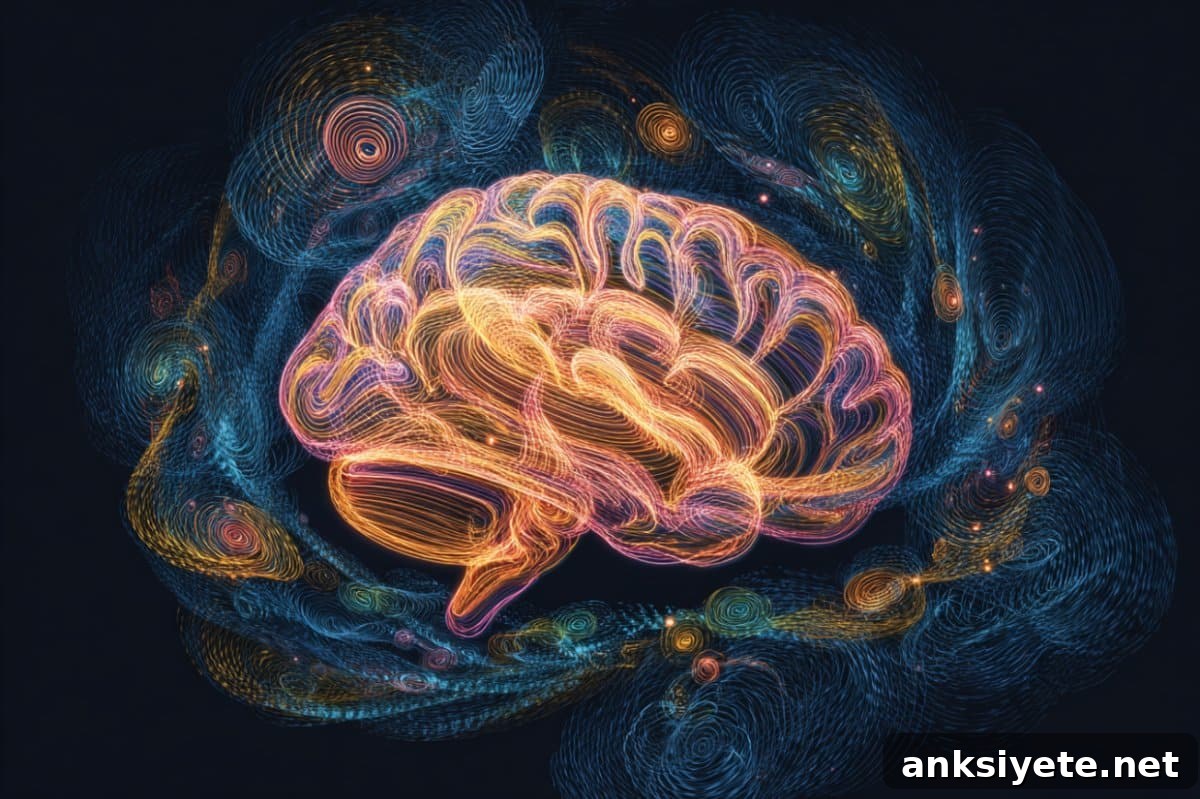
Summary: Neuroscientists have found that when attention is disrupted, coordinated rotating waves of neural activity help the brain recover focus. Electrical recordings in animals show that neurons in the prefrontal cortex align into circular, wave-like patterns—similar to the coordinated motion of starlings in flight—which guide the cortex back to the correct activity state after distraction.
When these rotations completed a full circle the animals performed accurately; when rotations stalled before completing the loop, errors or slowed responses were more likely. The results indicate the brain may use energy-efficient traveling waves—an analog-style computation—to reestablish attention and preserve task performance.
Key Facts
- Rotational Recovery: Rotating neural waves in the prefrontal cortex assist recovery of focus after distraction.
- Predictive Power: Full circular rotations correlate with correct task responses; incomplete rotations predict errors or slower reaction times.
- Analog Efficiency: The findings support the idea that the brain uses analog-like traveling waves as an efficient mechanism for computation and information processing.
Source: Picower Institute at MIT
Restoring focus after distraction
A team at the Picower Institute for Learning and Memory at MIT recorded electrical activity in animals performing a visual working memory task. During the task the animals occasionally experienced one of two types of distractions while trying to remember a visual object. As expected, distractions sometimes caused mistakes or slower responses. By examining hundreds of sessions and monitoring hundreds of neurons in the prefrontal cortex, the researchers uncovered a consistent recovery mechanism: a coordinated, rotating pattern of activity that steers the cortical population back toward the original working-memory state.
Using a mathematical approach called state-space or subspace coding, the researchers visualized how population activity evolved over time. Subspace coding revealed that neurons in the prefrontal cortex display highly coordinated activity patterns that, after a disruption, rotate through a trajectory in this abstract space. The team compared those trajectories across successful and unsuccessful trials and found a clear relationship between rotation completion and behavior.
Senior author Earl K. Miller describes the effect as reminiscent of flocks of birds re-forming after a momentary disturbance: the neural population “circles back” to recover the correct computational trajectory. When that circling completed a full rotation, animals tended to respond correctly. When the trajectory fell short—on average by about 30 degrees—the animals were more likely to make mistakes. Slower rotation speeds were also associated with failed recovery, suggesting timing matters: longer intervals between the distraction and the required response gave the cortex more time to complete the rotation and restore correct performance.
From abstract trajectories to real waves
State-space rotations are an abstract description of coordinated activity, but the researchers also examined direct spatial measurements across the cortical surface. Those measurements revealed traveling waves of spiking activity that rotated across the recorded area of prefrontal cortex. Importantly, the physical wave rotated at the same speed as the trajectory observed in the mathematical subspace, indicating a tight correspondence between the abstract dynamics and real, spatially organized neural activity.
That correspondence suggests these traveling waves are not just a mathematical convenience but may serve as a mechanism for computation in the brain. The authors propose that traveling, rotating waves act as an energy-efficient, analog form of computation that helps realign the cortex after interruption. Given biological systems’ preference for efficiency, this analog strategy could be a naturally favored solution for maintaining reliable cognition in the face of distractions.
The study’s lead author is Picower Institute postdoctoral researcher Tamal Batabyal. Coauthors include Scott Brincat, Jacob Donoghue, Mikael Lundqvist and Meredith Mahnke. Funding came from the Office of Naval Research, the Simons Center for the Social Brain, the Freedom Together Foundation and the Picower Institute for Learning and Memory.
Key Questions Answered:
A: Coordinated rotating waves sweep across the prefrontal cortex, realigning neuronal populations into a focused state that supports working memory and decision-making.
A: When the rotations fully complete, task performance is more accurate and response times are faster; incomplete or slower rotations are linked to errors or delayed reactions.
A: The findings support a model in which emergent dynamics—rotational state-space trajectories and traveling waves—provide an efficient, analog mechanism for recovering attention and performing cortical computations.
About this neuroscience research news
Author: David Orenstein
Source: Picower Institute at MIT
Contact: David Orenstein – Picower Institute at MIT
Image: The image is credited to Neuroscience News
Original Research: Open access. “State–Space Trajectories and Traveling Waves Following Distraction” by Earl K. Miller et al., Journal of Cognitive Neuroscience. DOI: 10.1162/JOCN.a.2410
Abstract
State–Space Trajectories and Traveling Waves Following Distraction
Cortical activity demonstrates the capacity to recover after distractions. We analyzed neural recordings from the prefrontal cortex of monkeys performing working memory tasks that included mid-delay distractions (either a cued gaze shift or an irrelevant visual stimulus). Following distraction, population activity exhibited state-space rotational dynamics that returned spiking patterns to states similar to those before the disruption. Rotations were more complete on correct trials than on error trials. We also observed a correspondence between these abstract state-space rotations and physically measured traveling waves across the surface of prefrontal cortex. These results point to emergent dynamics—rotational trajectories and traveling waves—as mechanisms supporting recovery from distraction and reliable cognitive processing.