
Summary: Adding more robots to a task usually speeds things up—until it doesn’t. In a classic “too many cooks” scenario, robotic swarms can reach a tipping point where agents crowd one another and traffic grinds to a halt. New research shows a simple, counterintuitive remedy: introduce a controlled amount of randomness or “noise” into each robot’s motion. That small amount of wiggle prevents long-lived jams, enables self-organization, and maximizes the swarm’s overall task completion rate.
Key Facts
- The “Averaging” Advantage: Although randomness seems chaotic, high levels of controlled noise permit reliable mathematical averages—average distances, times, and behaviors—so researchers can derive precise formulas for how quickly goals are reached.
- No Central Brain Needed: Coordinated swarm behavior does not require a powerful central computer or complex AI. Simple, local navigation rules combined with a tuned amount of randomness produce efficient, emergent coordination.
- Validated in Hardware: Theoretical predictions and large-scale simulations were confirmed by tabletop experiments using small wheeled robots at Eindhoven University of Technology.
- Self-Organization in Action: This work is an example of active matter—swarms, herds, and crowds—using local interactions and stochastic motion to solve spatial and traffic problems.
- Practical Impact: The findings and derived formulas can inform optimization of robot fleets, automated warehouses, environmental cleanups, and the design of safer, more efficient public spaces.
Source: Harvard
Imagine a futuristic swarm of robots tackling a time-sensitive mission—cleaning an oil spill, restocking an automated warehouse, or assembling a machine. Initially, more robots speeds completion. But past a critical crowding threshold, agents block one another and throughput collapses.
Harvard applied mathematicians propose an elegant fix. Their study combines theoretical analysis, large-scale simulations, and physical robot experiments to show that adding the right level of stochasticity—small random deviations in each agent’s heading—breaks persistent traffic jams and improves overall performance.
The project, led by applied mathematics Ph.D. student Lucy Liu in the lab of L. Mahadevan (Lola England de Valpine Professor of Applied Mathematics, Organismic and Evolutionary Biology, and Physics), demonstrates that a tunable amount of “wiggle” in agent motion produces a beneficial trade-off. Too little randomness leads to persistent, dense jams. Too much randomness eliminates jams but wastes time through aimless wandering. In between lies a Goldilocks zone where brief, local interactions allow agents to slip past one another and maintain steady throughput.
Mathematically, high noise simplifies analysis: averages dominate, enabling analytic expressions for the “goal attainment rate” (the number of goals reached per unit time). Using those expressions, the team computed optimal combinations of agent density and noise level to maximize throughput in a bounded area.
To model realistic operational conditions, the researchers ran simulations where each agent repeatedly navigated from a random start to a random goal; when an agent arrived, it immediately received a new destination. This circular task mirrors cycles faced by robotic fleets or workers in busy facilities. Agents were given an adjustable “noise” term: zero noise produced straight-line motion, while higher noise caused zigzagging. Simulations showed the characteristic transition from gridlock to efficient flow as noise increased into the optimal range.
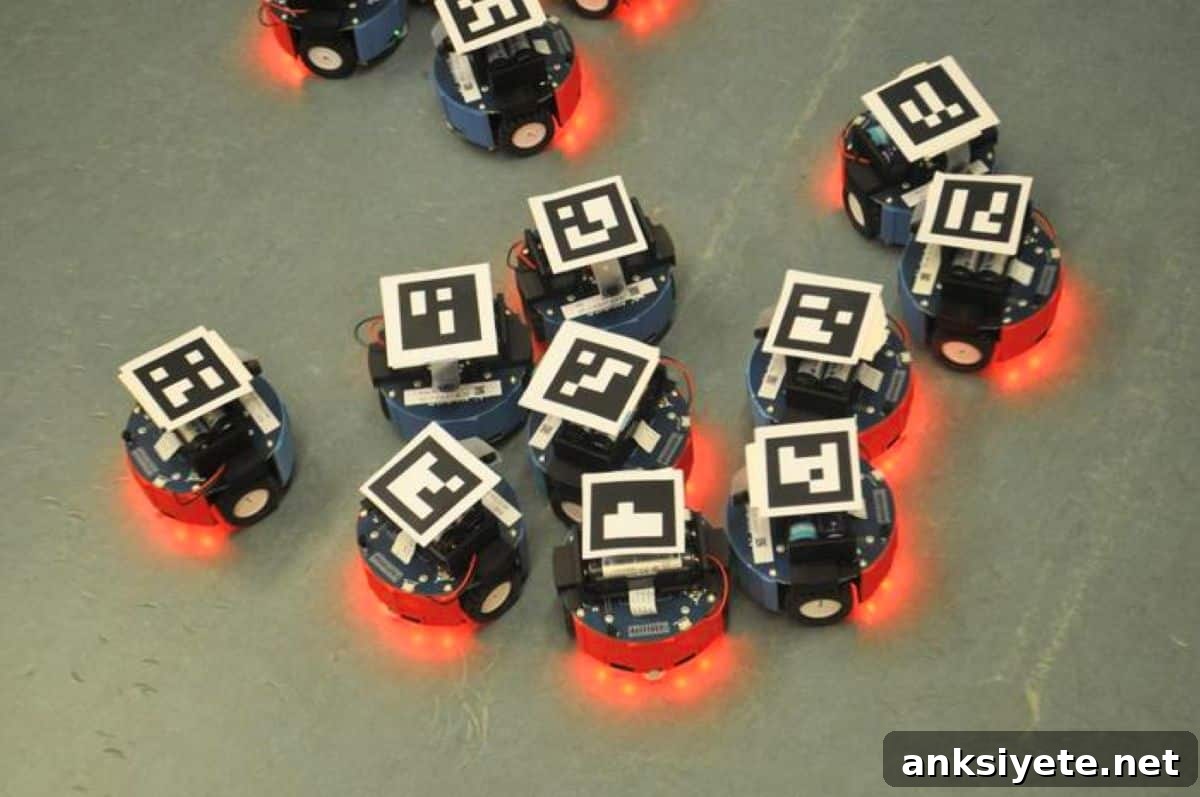
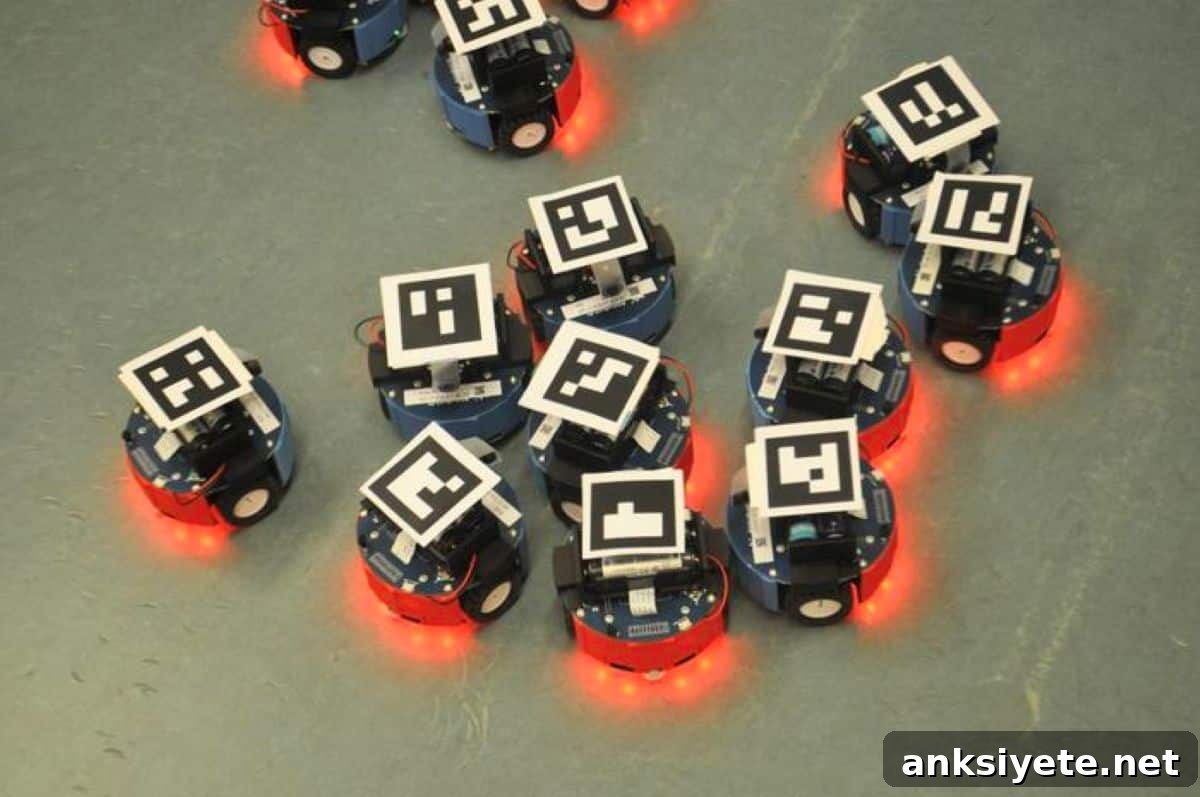
To verify these predictions physically, Liu collaborated with Federico Toschi at Eindhoven University of Technology. In an instrumented lab, swarms of small wheeled robots were tracked by an overhead camera. Each robot carried a QR code so the system could monitor positions and reassign goals. Although the physical robots moved more slowly and had imperfect control compared with simulated agents, the emergent behavior matched the theory: the right amount of stochastic motion reduced long-lived jams and increased task completion rates.
A central implication is practical: decentralized, low-computation local rules with a tuned randomness parameter can rival—or surpass—costly centralized planners up to moderate densities. That suggests scalable, robust approaches to coordination that are computationally efficient and easier to deploy in real-world settings.
“Understanding how active matter—whether a swarm of ants, a herd, or a group of robots—becomes functional and executes tasks in crowded spaces using self-organization is relevant across behavioral ecology and engineering,” said Mahadevan. The study indicates strategies that extend beyond the specific robotic implementation.
Lucy Liu emphasized the relevance for safety and design: mathematically characterizing crowd dynamics and the “wiggle room” that prevents collapses could inform architects, transit planners, and operators seeking to keep people and machines moving smoothly.
Funding: This research was supported by the National Science Foundation Graduate Research Fellowship Program (Grant No. DGE 2140743), the Simons Foundation, and the Henri Seydoux Fund.
Key Questions Answered:
A: It’s not aimlessness but maneuverability. A strictly straight-moving robot behaves like an obstacle to others. A small, controlled amount of lateral randomness lets an agent pivot and slide around neighbors, converting persistent jams into transient encounters and maintaining flow.
A: Largely yes for many applications. The study shows that simple, local navigation rules plus tuned stochastic motion can deliver high performance without a computationally expensive central planner—especially at moderate densities.
A: That is a potential application. Because the underlying mathematics applies to active matter broadly, the same principles could inform design choices that nudge crowds toward densities and behaviors that avoid dangerous crushes and delays.
Editorial Notes:
- This article was edited by a Neuroscience News editor.
- The journal paper was reviewed in full.
- Additional context was added by editorial staff.
About this robotics and neurotech research news
Author: Anne Manning
Source: Harvard
Contact: Anne Manning – Harvard
Image: The image is credited to Lucy Liu / Harvard SEAS
Original Research: Closed access. “Noise-enabled goal attainment in crowded collectives” by Lucy Liu, Justin Werfel, Federico Toschi, and L. Mahadevan. PNAS. DOI:10.1073/pnas.2519032123
Abstract
Noise-enabled goal attainment in crowded collectives
In crowded environments, individuals must navigate around other occupants to reach destinations. Controlling traffic flows in such spaces is relevant for coordinating robot swarms and designing infrastructure for dense populations. Using simulations, theory, and experiments, this work studies how adding stochasticity to agent motion can reduce traffic jams and accelerate travel to prescribed goals. Above a critical noise level, large jams do not persist. From this observation, the authors derive analytic approximations of the swarm’s goal attainment rate, enabling computation of optimal agent density and noise levels for maximal throughput. Robotic experiments corroborate the simulated and theoretical behaviors. A simple reactive navigation scheme performs well up to moderate densities and is far more computationally efficient than a centralized planner, motivating further research into decentralized navigation for crowded environments. Integrating ideas from physics and engineering, the study identifies new directions for emergent traffic research.