
Summary: A new study finds that losing a single night’s sleep can make junk food more appealing.
Source: SfN
One night without sleep raises the appeal of junk food, a study of healthy-weight young men published in the Journal of Neuroscience reports.
Researchers led by Julia Rihm combined behavioral economics, hormonal measurements, and brain imaging to determine how a single night of sleep loss alters food choices. The study recruited healthy young men of normal weight and used a within-subjects design: each participant came to the laboratory on two separate occasions. On both visits they received a standardized evening meal. After that meal, on one visit they went home to sleep normally, and on the other visit they stayed in the lab and were kept awake through the night. The morning after each condition, researchers measured participants’ subjective desire for a variety of snack items, recorded brain activity using neuroimaging, and sampled hormones related to appetite and metabolism.
By holding the evening meal constant and testing the same individuals in both sleep and sleep-deprived conditions, the study isolated the immediate effects of a single night of sleep loss on decision-making about food. Participants completed tasks that quantified how much they valued different food and non-food items, allowing researchers to compare changes in preference and subjective value after sleep deprivation versus normal sleep. Hormone levels were assessed to evaluate whether shifts in circulating appetite hormones could fully explain any changes in food desirability.
The main behavioral finding was a reliable increase in the subjective value of food items—especially calorie-dense, palatable snacks—after a night without sleep. This effect was specific to food compared with non-food items and could not be fully accounted for by measured changes in circulating appetite hormones. In other words, while hormones that regulate hunger and satiety were monitored, they did not explain the entire increase in how desirable foods appeared after sleep loss.
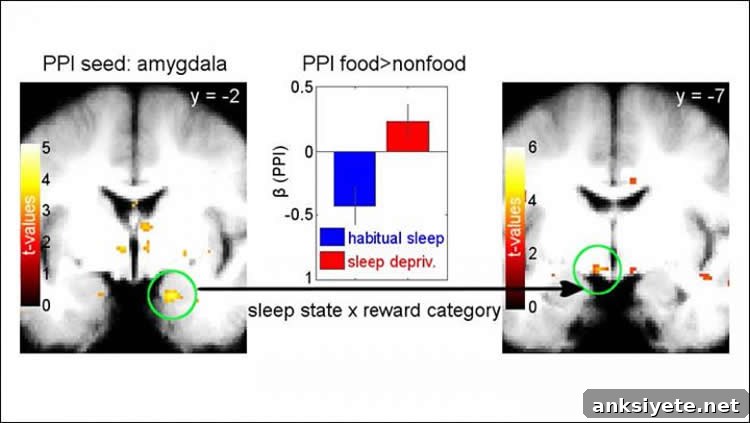
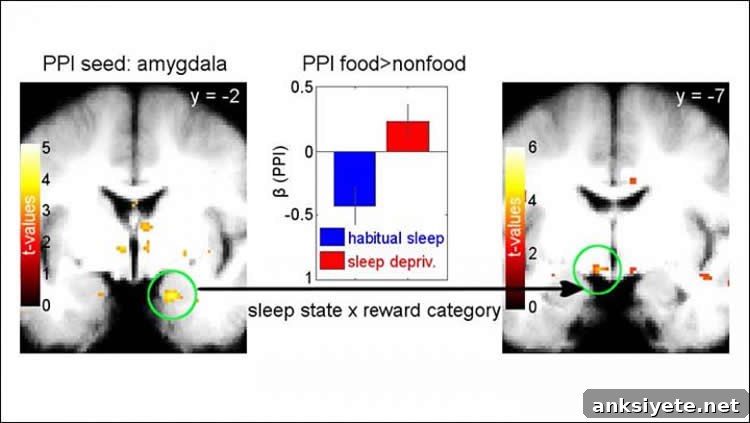
Neuroimaging provided complementary evidence about the brain mechanisms behind this shift. After sleep deprivation, the study observed heightened activity and connectivity in a neural circuit involving the amygdala and the hypothalamus when participants viewed or considered food items. The amygdala is involved in emotional and motivational processing, while the hypothalamus plays a central role in energy balance and appetite regulation. Stronger coupling between these regions after sleep loss suggests that sleep deprivation may amplify emotional and homeostatic signals that make high-calorie foods more tempting.
Taken together, the behavioral and neuroimaging results indicate that even a single night of missed sleep can bias decision-making toward more rewarding, calorie-rich foods through changes in brain function as well as subjective valuation. These findings help explain one pathway by which insufficient sleep could contribute to overeating and increased obesity risk in everyday life. The results emphasize that short-term sleep disruption can alter food-related choices independently of measurable hormonal shifts, highlighting the role of cognitive and neural processes in the link between sleep and eating behavior.
Funding: The study was supported by the Deutsche Forschungsgemeinschaft.
Source: David Barnstone — SfN
Publisher: Organized by Neuroscience News
Image credit: Image credited to Rihm et al., JNeurosci (2018).
Original research: Results reported will appear in the Journal of Neuroscience.
This summary reports the study design, core findings, and implications without additional interpretation beyond the authors’ results. The research focused on healthy-weight young men and used controlled laboratory conditions; further work is required to determine how these findings generalize across ages, sexes, and real-world settings.