
Researchers have found that different kinds of memory shape the way we direct attention in future situations. Their work shows that separate brain systems that support distinct memory types also steer attention when we encounter new visual environments.
“We have long known that memory is not a single unified process, but these findings clarify how those different memory systems can guide attention later on,” says Elizabeth Goldfarb, the study’s lead author and a doctoral candidate in New York University’s Department of Psychology.
Memory comes in multiple forms. Episodic memory captures contextual details of past events—such as the layout of a familiar room or the locations of objects—while habitual or stimulus-response memory is more rigid and automatic, steering our behavior through repeated cues. A common everyday example of habitual memory is turning right at a familiar stop sign on the way to work out of habit, even when your destination this time does not require that turn.
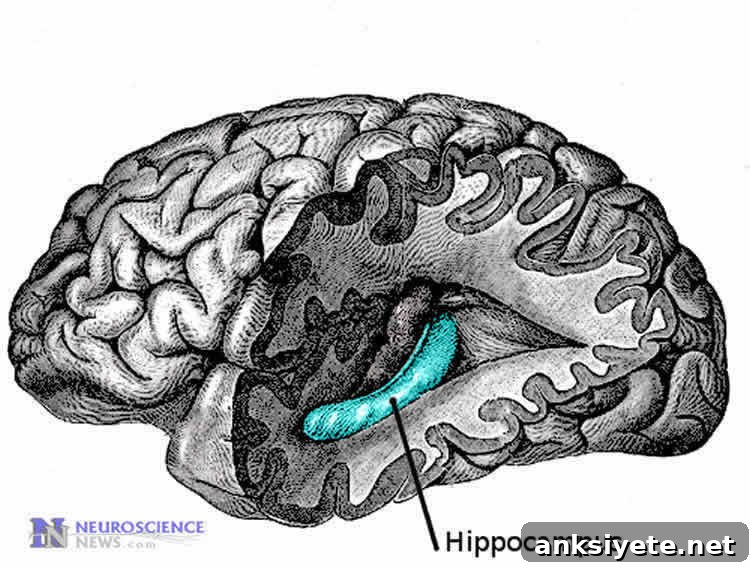
Prior work has linked these memory systems to distinct brain structures: the hippocampus supports episodic, context-dependent memory, whereas the striatum is central to stimulus-response and habitual learning. What was less clear, however, was how those separate memory systems independently influence attention when people face new, unfamiliar situations.
To investigate how different memories guide attention, the researchers designed a series of behavioral experiments combined with functional magnetic resonance imaging (fMRI). The tasks were built so that attention could be influenced either by implicit contextual memory or by learned stimulus-response associations, allowing the team to observe which brain regions predicted attention benefits in each case.
In the context-based trials—drawing on what is often called contextual cueing—participants searched for a rotated “T” among distractor shapes on a computer screen and indicated its orientation with a button press. Unknown to them, some screen layouts reappeared across trials, and participants came to find the target more quickly in those repeated layouts. This advantage reflects implicit context memory: a memory for the display configuration that speeds visual search in familiar contexts. fMRI recordings showed that attention benefits linked to repeated contexts correlated with activity in the hippocampus, consistent with its established role in representing contextual details.
In the stimulus-response trials, the same search items appeared but were presented in particular colors that served as cues. Over repeated trials, subjects learned that a specific color predicted the target’s likely location and the correct response, forming a stimulus-response association. This kind of learning models habitual memory: repeated pairing of a stimulus (the color) with a response. Here, improvements in search behavior were associated with activity in the striatum, revealing that this region contributes to directing attention based on learned stimulus-response relationships.
These results demonstrate a clear neural dissociation: the hippocampus predicted trial-by-trial attention benefits when context memory was available, while the striatum predicted attention facilitation when rewarded or reinforced stimulus-response associations were at play. In other words, distinct memory systems operate concurrently and implicitly to shape how attention is allocated, and each system leaves its own signature in the brain.
Goldfarb emphasizes that participants were often unaware they had formed these memories, yet their performance improved when contextual or habitual cues were present. “Even without explicit awareness, memory can guide attention and behavior. Our data show that different memory systems make separable contributions to that guidance,” she says.
The study, published in the journal Neuron, lists Elizabeth Phelps, a professor in NYU’s Department of Psychology, and Marvin Chun, a professor in Yale University’s Department of Psychology, as co-authors alongside Goldfarb.
Funding: Research support included a grant from the National Institutes of Health (1R01MH097085) and a National Science Foundation Graduate Research Fellowship.
Source: James Devitt – NYU
Image Source: The image is in the public domain
Original Research: Abstract for “Memory-Guided Attention: Independent Contributions of the Hippocampus and Striatum” by Elizabeth V. Goldfarb, Marvin M. Chun, and Elizabeth A. Phelps, published in Neuron. Published online January 14, 2016. doi:10.1016/j.neuron.2015.12.014
Abstract
Memory-Guided Attention: Independent Contributions of the Hippocampus and Striatum
Highlights
• Multiple memory systems can concurrently and implicitly direct attention.
• The striatum predicts attention benefits resulting from reinforcement learning and stimulus–response associations.
• The hippocampus predicts attention benefits arising from implicit context memory and contextual cueing.
• The hippocampus can rapidly guide attention through context representations, while striatal contributions may emerge more gradually.
Summary
Memory strongly influences how attention is deployed during new encounters. While medial temporal lobe-dependent memory has been shown to steer attention, less was known about how other memory systems might also enhance attention in parallel. This study demonstrates that both context memory and reinforcement-based stimulus–response learning facilitate visual search. Using fMRI, the authors dissociate mechanisms underlying these effects: on a trial-by-trial basis, hippocampal activity predicted attention benefits from contextual memory, whereas striatal activity predicted attention benefits from rewarded stimulus–response associations. Individual differences in the strength of each memory type correlated with responses in the respective brain regions. These findings provide novel evidence that the striatum helps guide attention independently from hippocampus-dependent contextual memory.
“Memory-Guided Attention: Independent Contributions of the Hippocampus and Striatum” by Elizabeth V. Goldfarb, Marvin M. Chun, and Elizabeth A. Phelps in Neuron. Published online January 14, 2016. doi:10.1016/j.neuron.2015.12.014