
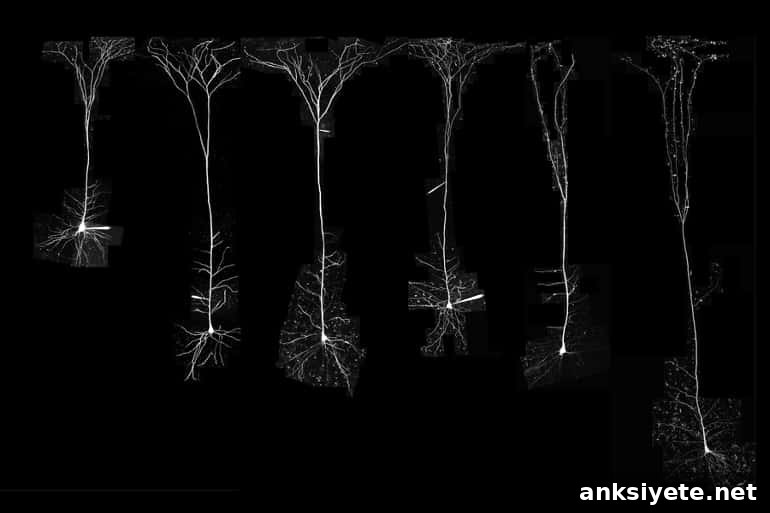
Summary: Human neurons contain fewer ion channels than those of many other mammals. Researchers say this reduced channel density may allow the human brain to redirect energy toward other demanding neural processes.
Source: MIT
Neurons communicate through electrical impulses generated by ion channels that regulate the flow of ions such as potassium and sodium. In a notable new finding, neuroscientists at MIT report that human neurons have far fewer of these channels than expected when compared with neurons from other mammals.
The researchers propose that a lower ion channel density in human neurons could be an evolutionary adaptation that conserves energy. That saved energy may then be available for other metabolically costly neural functions that support higher cognitive abilities.
“If the brain can save energy by reducing the density of ion channels, it can spend that energy on other neuronal or circuit processes,” says Mark Harnett, associate professor of brain and cognitive sciences, a member of MIT’s McGovern Institute for Brain Research, and the senior author of the study.
Harnett and his colleagues compared electrophysiological properties of neurons from 10 mammalian species in what they describe as the most extensive study of its kind. They discovered a consistent structural rule across species — a “building plan” — in which channel density generally rises with neuron size. Human neurons, however, are a striking exception to that pattern.
“Previous comparative studies established that the human brain is built like other mammalian brains, so we were surprised to find strong evidence that human neurons are special,” says Lou Beaulieu-Laroche, lead author of the study and a former MIT graduate student.
The study appears in Nature.
A building plan
Within the mammalian cortex, individual neurons receive electrical input from thousands of other cells. That input is integrated in dendrites — branched structures that act like antennas — and determines whether a neuron will fire an action potential. In prior work, Harnett and Beaulieu-Laroche reported differences between human and rat neurons, especially in dendritic processing. One surprising observation then was that human neurons had a lower ion channel density than rat neurons, contradicting the assumption that channel density is constant across species.
To probe this further, the team examined specific ion channels in layer 5 pyramidal neurons — a principal excitatory cell type in the cortex. They measured two types of voltage-gated potassium channels and the HCN channel, which carries both potassium and sodium currents.
The researchers obtained tissue from 10 mammalian species: Etruscan shrews, gerbils, mice, rats, guinea pigs, ferrets, rabbits, marmosets, macaques, and human surgical specimens from epilepsy patients. This range allowed them to sample across wide variation in cortical thickness and neuron size.
Across nine nonhuman species, they observed a clear trend: as neuron size increases, membrane ion channel conductance per cell surface area also increases. That scaling produced a roughly constant number of ion channels per unit volume of cortex across these species. In other words, smaller neurons are more numerous per volume but have lower conductance per cell, while larger neurons are fewer per volume but have higher conductance per cell, balancing conductance per cortical volume.
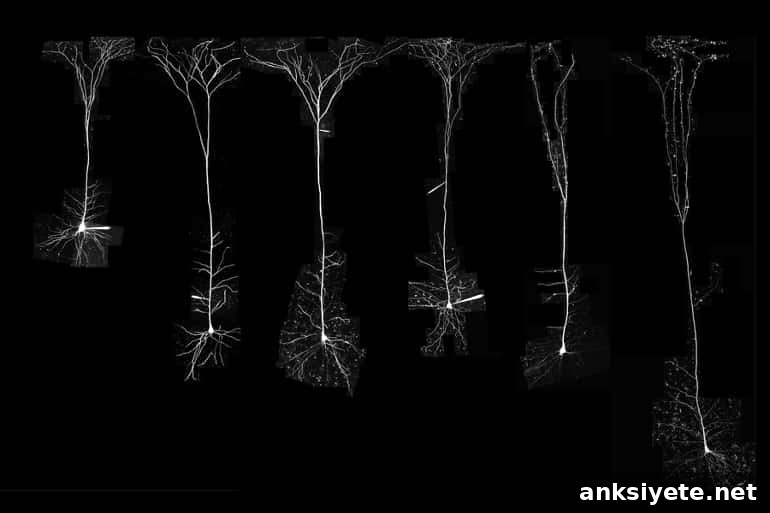
“This building plan is consistent across nine different mammalian species,” Harnett explains. “What it looks like the cortex is trying to do is keep the number of ion channels per unit volume roughly the same across species. That suggests a conserved energetic cost for ion channel maintenance per cortical volume.”
Energy efficiency
Human cortex diverges from that conserved rule. Instead of matching the predicted increase in channel density with increasing neuron size, human neurons exhibit substantially lower densities of the measured ion channels. That results in fewer ion channels per unit volume of cortex than the pattern observed across the other mammals.
Because maintaining and operating ion channels consumes ATP — energy used to pump ions back across the membrane after electrical signaling — a lower channel density could reduce the energy cost of ion regulation. The authors suggest that these energy savings may be reallocated to other energetically expensive processes, such as building more complex synaptic networks, supporting larger-scale neuronal activity, or sustaining high-frequency firing patterns associated with complex cognition.
“We think that humans have evolved out of this building plan that was previously restricting the size of cortex, and they figured out a way to become more energetically efficient, so you spend less ATP per volume compared to other species,” Harnett says.
Future work will investigate where the conserved energy is being redirected and whether specific genetic changes underlie the reduced ion channel density in humans. The team also plans to examine closer primate relatives to determine whether similar adaptations are present in other species more closely related to humans.
Funding: The study received support from the Natural Sciences and Engineering Research Council of Canada, a Friends of the McGovern Institute Fellowship, the National Institute of General Medical Sciences, the Paul and Daisy Soros Fellows Program, the Dana Foundation David Mahoney Neuroimaging Grant Program, the National Institutes of Health, the Harvard-MIT Joint Research Grants Program in Basic Neuroscience, and Susan Haar.
Other authors include Norma Brown (MIT technical associate); Marissa Hansen (former post-baccalaureate scholar); Enrique Toloza (graduate student at MIT and Harvard Medical School); Jitendra Sharma (MIT research scientist); Ziv Williams (associate professor of neurosurgery, Harvard Medical School); Matthew Frosch (associate professor of pathology and health sciences and technology, Harvard Medical School); Garth Rees Cosgrove (director of epilepsy and functional neurosurgery at Brigham and Women’s Hospital); and Sydney Cash (assistant professor of neurology, Harvard Medical School and Massachusetts General Hospital).
About this neuroscience research news
Author: Anne Trafton
Source: MIT
Contact: Anne Trafton – MIT
Image: The image is credited to the researchers
Original Research: Closed access. “Allometric rules for mammalian cortical layer 5 neuron biophysics” by Lou Beaulieu-Laroche et al. Nature
Abstract
Allometric rules for mammalian cortical layer 5 neuron biophysics
Neuronal biophysical properties form the basis for computation in the brain. Neuron size significantly influences input–output characteristics and varies widely across species. It has been unclear whether species-scale adaptations preserve single-neuron information processing.
This study characterizes layer 5 cortical pyramidal neurons across 10 mammalian species to define allometric relationships that govern how neuronal biophysics scale with cell size.
In nine of the ten species examined, conserved rules control the conductance of voltage-gated potassium and HCN channels: species with larger neurons (and a reduced surface-to-volume ratio) exhibit higher membrane ionic conductances. That scaling yields a conserved conductance per unit brain volume and predictable changes in somatic and dendritic integration. Human neurons, however, deviate from these allometric rules, showing much lower voltage-gated potassium and HCN conductances.
Overall, these results reveal conserved evolutionary principles for neuronal biophysics across mammals while highlighting distinctive features of human cortical neurons.