
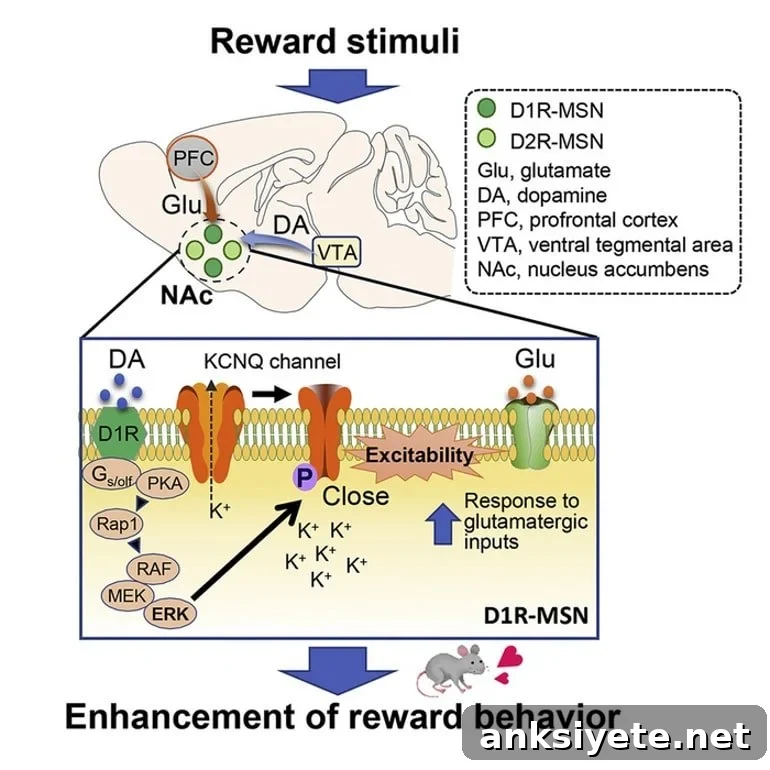
Summary: ERK directly phosphorylates the KCNQ2 potassium channel downstream of dopamine signaling in the nucleus accumbens, altering neuronal excitability and promoting reward-related behavior in mice.
Source: Fujita Health University
The nucleus accumbens (NAc), a key component of the basal ganglia, is populated largely by medium spiny neurons (MSNs). These MSNs express dopamine D1 and D2 receptors and are regulated by the neurotransmitters dopamine and glutamate.
Dopamine is a central neuromodulator involved in learning and memory, motor control, motivation and reward, and emotional behavior. When dopamine increases the excitability of D1 receptor–expressing MSNs (D1R-MSNs), it potentiates glutamate-driven responses and facilitates reward-related behaviors—feelings of pleasure and accomplishment that arise from completing certain tasks.
Previous work has shown that these reward-related effects of dopamine involve a signaling cascade that raises phosphorylation of protein kinase A (PKA) substrates. Extracellular signal-regulated kinase (ERK), acting downstream of PKA, is known to modulate D1R-MSN excitability and thereby influence reward behavior, but the precise molecular effectors were not fully defined.
A research team led by Assistant Professor Daisuke Tsuboi and Professor Kozo Kaibuchi at Fujita Health University, together with Dr. Atsushi Nambu and Dr. Hiromi Sano at the National Institute of Physiological Sciences, has identified the voltage-gated potassium channel subunit KCNQ2 as an ERK phospho-substrate in the NAc. Although KCNQ2 channels had been implicated in MSN excitability before, the mechanism connecting dopamine signaling, ERK activity, and KCNQ2 modulation was previously unresolved.
In experiments using mouse NAc slices, the investigators found that activating D1R with the agonist SKF81297 suppressed KCNQ-mediated currents and increased firing rates of D1R-MSNs. Blocking ERK activity prevented this D1R agonist effect, indicating ERK is required for the modulation of KCNQ currents by dopamine signaling.
Biochemical analyses revealed that ERK phosphorylates KCNQ2 directly at specific serine residues (Ser414 and Ser476) in vitro, and KCNQ2 is phosphorylated downstream of dopamine signaling in NAc slices in vivo. Functionally, phosphorylation of KCNQ2 by ERK reduced the channel’s activity, which in turn increased neuronal excitability.
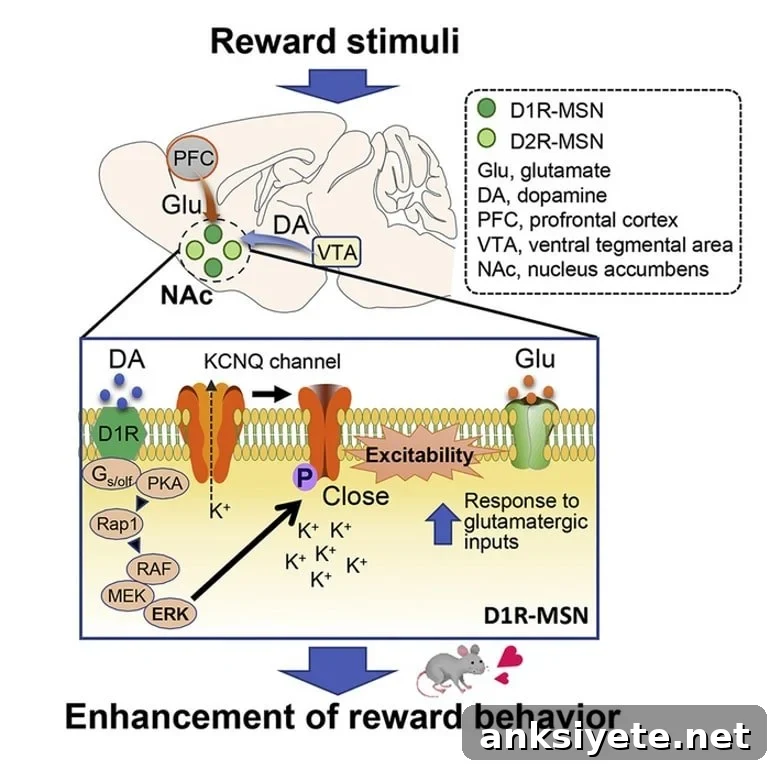
The team used conditional genetics to delete Kcnq2 selectively in D1R-MSNs. Loss of KCNQ2 reduced the ability of the D1R agonist to inhibit KCNQ currents, increased MSN excitability, and enhanced cocaine-induced reward behavior. Reintroducing wild-type KCNQ2 restored normal responses, whereas a phospho-deficient KCNQ2 mutant failed to rescue the phenotype. These findings indicate that phosphorylation of KCNQ2 is a necessary step by which dopamine signaling suppresses KCNQ currents and increases neuronal firing.
Putting these results together, the authors propose a mechanism in which dopamine activates D1Rs on MSNs, engaging a PKA–Rap1–ERK pathway that phosphorylates KCNQ2. Phosphorylated KCNQ2 has lower channel activity, causing membrane depolarization and elevated firing in response to glutamatergic input. This increase in excitability contributes to reward-related behaviors.
Beyond the basic mechanistic insight, the work has potential clinical relevance. Dysfunctional dopamine signaling and impaired reward circuits are features of psychiatric and neurological disorders such as addiction, depression, and schizophrenia. Targeting the dopamine–ERK–KCNQ2 axis could therefore offer new therapeutic avenues to normalize reward-circuit function and treat related conditions. The authors highlight KCNQ2 as a candidate molecular target for interventions aimed at disorders involving altered reward processing.
About this dopamine research news
Author: Hisatsugu Koshimizu
Source: Fujita Health University
Contact: Hisatsugu Koshimizu – Fujita Health University
Image: Credit to Dr. Kozo Kaibuchi and Dr. Daisuke Tsuboi, Fujita Health University
Original Research: Open access. “Dopamine drives neuronal excitability via KCNQ channel phosphorylation for reward behavior” by Daisuke Tsuboi et al., published in Cell Reports.
Abstract
Dopamine drives neuronal excitability via KCNQ channel phosphorylation for reward behavior
Highlights
- Activation of the D1R/PKA/ERK signaling cascade increases phosphorylation of KCNQ2.
- D1R signaling reduces KCNQ currents through ERK-dependent phosphorylation of KCNQ2.
- KCNQ2 phosphorylation in D1R-MSNs elevates neuronal excitability.
- Conditional loss of KCNQ2 in D1R-MSNs enhances cocaine-induced reward behavior.
Summary
Dysregulated dopamine signaling contributes to multiple neuropsychiatric disorders. Earlier work showed that dopamine increases excitability and firing of D1R-expressing MSNs in the nucleus accumbens via a PKA–Rap1–ERK pathway to promote reward behavior. The present study demonstrates that D1R activation with SKF81297 suppresses KCNQ-mediated currents and boosts D1R-MSN firing rates in mouse NAc slices; these effects require ERK activity.
ERK phosphorylates KCNQ2 at Ser414 and Ser476 in vitro, and KCNQ2 phosphorylation occurs downstream of dopamine signaling in NAc tissue. Conditional deletion of Kcnq2 in D1R-MSNs blunts SKF81297-mediated inhibition of KCNQ currents, increases neuronal excitability, and facilitates cocaine-reward behavior. Wild-type KCNQ2 restores normal function, while a phospho-deficient KCNQ2 mutant does not. These results identify KCNQ2 phosphorylation as a key step by which D1R–ERK signaling regulates MSN excitability and reward-related behavior, positioning KCNQ2 as a potential therapeutic target for disorders involving dysfunctional reward circuits.