
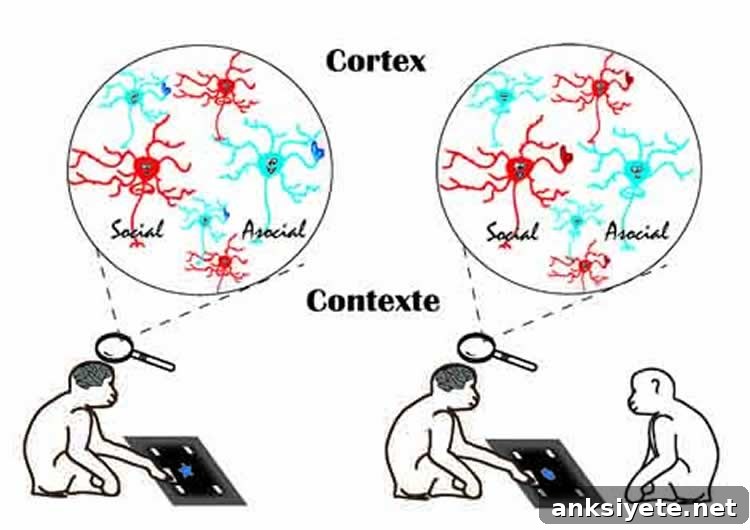
Summary: Scientists identify distinct “social” and “asocial” neurons in the prefrontal cortex that change their activity depending on whether another individual is present.
Source: CNRS.
Researchers at the Institut de neurosciences des systèmes (Aix-Marseille University / INSERM), the Laboratoire de psychologie sociale et cognitive (Université Clermont Auvergne / CNRS), and the Institut de neurosciences de la Timone (Aix-Marseille University / CNRS) have demonstrated the existence of two classes of neurons in the prefrontal cortex that respond selectively to social context. Experiments in macaque monkeys show that performing the same visuomotor task produces different patterns of neuronal activity depending on whether a conspecific is present. Published in Social Cognitive and Affective Neuroscience, these results broaden our understanding of the social brain and provide a neuronal account for social facilitation.
Understanding how the brain operates in social contexts is a core challenge for neuroscience. In a multidisciplinary collaboration combining primate neurophysiology and experimental social psychology, the team recorded single-neuron activity in the prefrontal cortex as monkeys performed a touchscreen task either alone or in the presence of another monkey. Although the visuomotor task itself does not require dedicated social brain areas, the researchers found that most prefrontal neurons they recorded were strongly influenced by social context.
In the task, a monkey matched a target image displayed on a touchscreen with one of four items located at the screen corners. The task engages prefrontal processing related to perception, decision and action, but it is not inherently social. Over multiple daily sessions, neuronal activity was monitored in two prefrontal regions while subjects performed the task both with and without a nearby conspecific. The recordings revealed that many neurons traditionally associated with task execution nonetheless showed clear sensitivity to the mere presence or absence of another monkey.
Two distinct populations emerged. “Social neurons” were strongly active when a conspecific was present and showed little response when the animal was alone. Conversely, “asocial neurons” increased their activity when the subject performed the task in isolation and were less active in the presence of another monkey. Importantly, activity in these neuron populations correlated with behavioral performance, but only in their preferred context: higher activity in social neurons predicted better performance when another monkey was present, while higher activity in asocial neurons predicted improved performance when the subject was alone.
This context-dependent correlation provides a plausible neuronal mechanism for social facilitation—the well-known behavioral effect in which the mere presence of others improves an individual’s performance on certain tasks. The experiments further showed that when neuronal activation patterns did not match context (for instance, social neurons active when no conspecific was present), performance was poorer. In other words, the brain appears to recruit different neural ensembles for the same task depending on whether the social environment includes another individual.
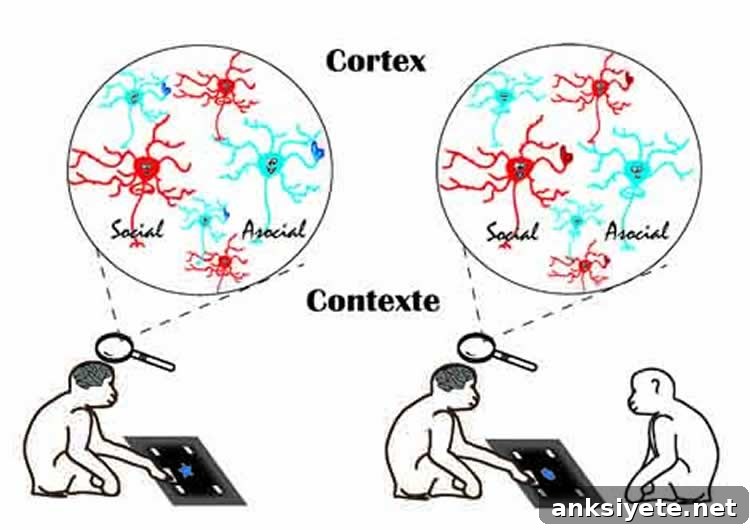
The study highlights a fundamental principle: identical tasks can recruit different neuronal circuits depending on social context. Rather than being confined to specialized “social” brain regions, social neurons may be widely distributed across cortical areas and influence a range of behaviors, including tasks that are not explicitly social. This distributed sensitivity to social context suggests a more flexible neural architecture for social cognition than models that locate social processing in a single, dedicated network.
Beyond advancing basic knowledge of social neuroscience, these findings may have clinical relevance. Context-sensitive neuronal recruitment could help explain aspects of behavioral differences seen in conditions such as autism spectrum disorders and schizophrenia, where social interactions and context processing are often altered. By identifying neurons whose activity and behavioral impact depend on social presence, the work offers a new angle for investigating how social environment interacts with brain function in health and disease.
Source: CNRS
Image source: Image credited to the researchers.
Original research: Full open access research published in Social Cognitive and Affective Neuroscience: “Social and asocial prefrontal cortex neurons: a new look at social facilitation and the social brain” by Marie Demolliens, Faiçal Isbaine, Sylvain Takerkart, Pascal Huguet, and Driss Boussaoud. Published online April 11, 2017. DOI: 10.1093/scan/nsx053.
CNRS (2017). From Context to Cortex: Discovering Social Neurons. Neuroscience news summary, May 25, 2017.
Abstract
Social and asocial prefrontal cortex neurons: a new look at social facilitation and the social brain
Social facilitation—the tendency for performance to improve in the mere presence of conspecifics—is widespread across animal species, but its neuronal basis has been unclear. The authors recorded single-neuron activity from two prefrontal regions, the dorsolateral prefrontal cortex (PFdl) and the anterior cingulate cortex (ACC), while monkeys performed a visuomotor task either in the presence of a conspecific or alone. Monkeys showed improved performance in the presence condition, and analysis of outcome-related activity in 342 prefrontal neurons revealed that 86% were sensitive to social context. Two neuronal populations were identified: social neurons, preferentially active with social presence, and asocial neurons, preferentially active under isolation. Each population’s activity correlated positively with performance only in its preferred context, suggesting a neural substrate for social facilitation. The finding that identical tasks recruit different neuronal ensembles depending on social context offers a new perspective on the social brain hypothesis.