
New research shows making a Lower Paleolithic hand axe requires sophisticated cognitive control in the prefrontal cortex, including the “central executive” component of working memory.
PLOS ONE published the study’s findings, which challenge the long-standing notion that Stone Age hand axes were simple products of low-level motor skills alone and did not engage higher-order executive brain functions.
“For the first time, we demonstrate a direct relationship between prefrontal brain activity, the ability to make informed technological judgments, and actual success in producing stone tools,” says Dietrich Stout, an experimental archaeologist at Emory University and lead author of the study. “These results inform debates about the origins of modern human cognition and how technological and social complexity may have driven brain evolution.”
Stout emphasizes that producing a hand axe is more complex than many assume. “It’s not just early humans randomly striking rocks. The skill is nuanced and requires planning and judgment—Stone Age toolmakers deserve respect.”
The research team included Bruce Bradley (University of Exeter), Thierry Chaminade (Aix-Marseille University), and Emory colleagues Erin Hecht and Nada Khreisheh.
Stone tools—made by striking a stone “core” with bone, antler, or another stone—form one of the richest and most continuous records of behavioral change in human evolution. The simple Oldowan flake tools date back about 2.6 million years, while the more refined Acheulean hand axe appears around 500,000 years ago. Oldowan flake production is comparatively easy to learn; Acheulean hand axes are more difficult because they require shaping a core into a symmetrical, lens-shaped form with carefully controlled edges.
“We sought to separate which brain systems support basic motor control from those that support strategic thinking during stone tool technologies,” Stout explains. The team wanted to know whether strategic, future-oriented decision-making—often associated with the prefrontal cortex—plays a key role in making Acheulean hand axes.
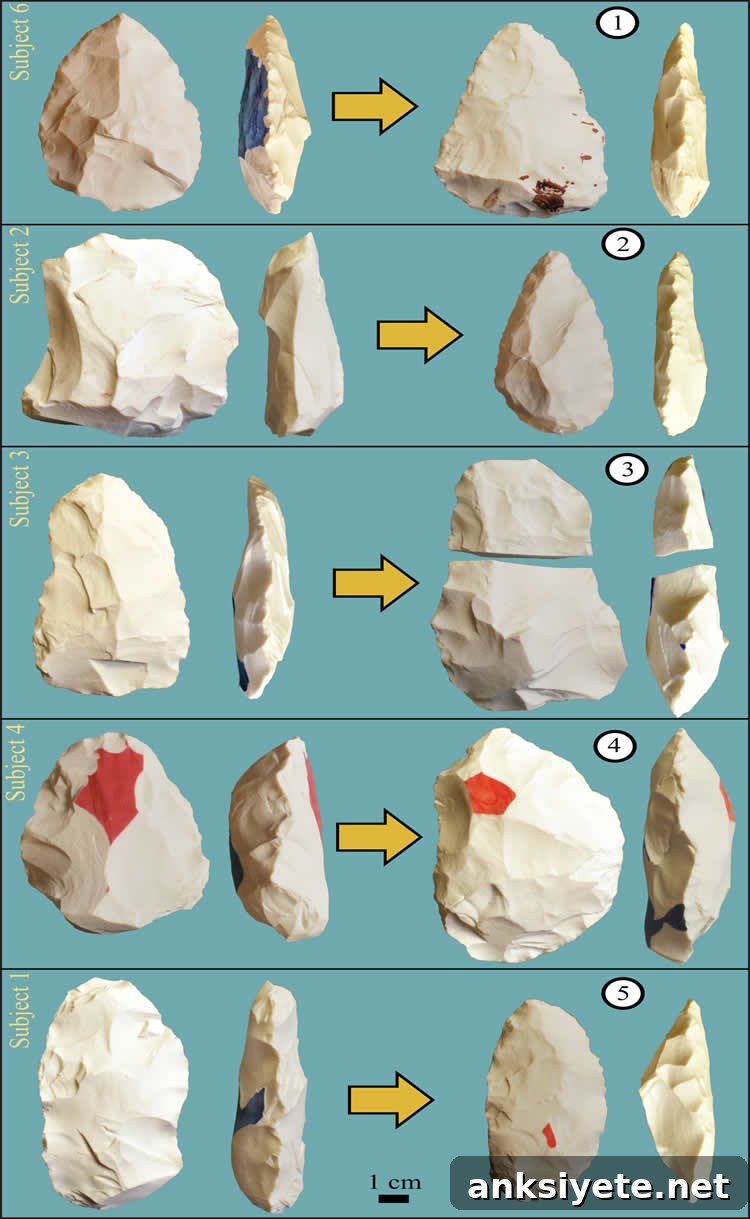
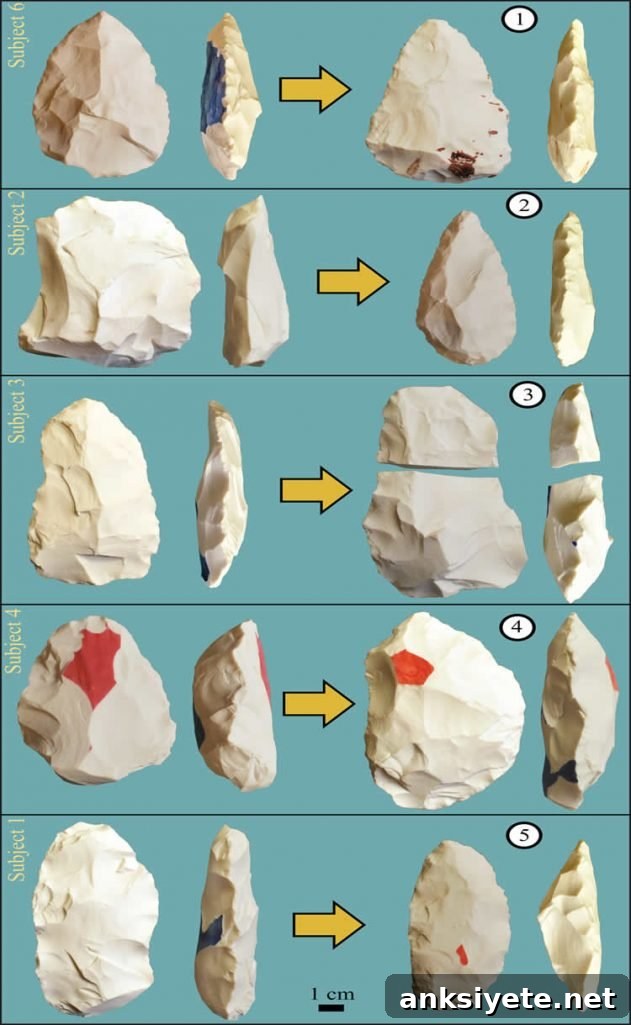
Six archaeology students from the University of Exeter trained in stone tool production, a practice known as knapping. Over an 18-month period, their toolmaking abilities were assessed before and after training. In Oldowan trials participants detached five flakes from a flint core; in Acheulean trials they shaped a standardized porcelain core into a hand axe.
At three time points—early, middle, and late in the training—subjects underwent functional magnetic resonance imaging (fMRI) and diffusion tensor imaging (DTI) while watching videos of rotating stone cores annotated with visual cues. A red dot marked a proposed point of impact and a white shaded area showed the flake predicted from that strike. Participants answered two questions by pressing “yes” or “no”: (1) If the core were struck at the indicated point, would the predicted flake result? and (2) Is striking that point appropriate given the technological objective?
The first question—predicting how a rock will fracture from a specific strike—relies more on perceptual and motor-related, posterior brain regions and reflexive sensorimotor knowledge, similar to the automatic coordination involved in a practiced golf swing or driving. The second question—judging whether a particular strike is strategically appropriate—requires executive control: retrieving stored knowledge, simulating future outcomes, and making decisions about multi-step goals. This form of planning and projection is associated with the prefrontal cortex and the “central executive” component of working memory.
The researchers matched each subject’s performance on the video judgments to their brain imaging data and their measured success in producing stone tools. They found that higher skill levels in toolmaking correlated with greater accuracy on the strategic (second) judgment, and that better strategic judgment correlated with increased activity in dorsal prefrontal cortex. Importantly, accuracy on strategic judgments predicted success in Acheulean hand-axe production but not in Oldowan flake making.
“These findings indicate that Acheulean hand-axe manufacture engages complex cognitive control rather than being a simple, autopilot activity,” Stout says. The study links higher-order executive processes—monitoring information, manipulating mental representations, and planning future steps—with real-world success in a demanding prehistoric technology.
While the modern participants improved over time, most of the hand axes they produced did not meet the highest archaeological standards from half a million years ago, illustrating the skill and experience of ancient knappers.
Earlier work by the same group showed that learning stone toolmaking produces structural changes in white-matter tracts connecting parietal and frontal brain regions, and that such anatomical changes correspond to improved performance. “Training appears to strengthen the connections between these areas,” Stout notes, reinforcing the idea that stone tool technology and brain systems co-evolved.
Building on these findings, Stout has launched the Language of Technology project, a larger three-year experiment in which 20 participants will each complete 100 hours of hand-axe training and undergo repeated MRI scans. The project aims to test whether the neural systems that sequence words to form sentences overlap with those that sequence coordinated physical actions to achieve complex technological goals.
Source: Megan McRainey, Emory Health Sciences
Image credit: Stout et al., PLOS ONE
Original research: Dietrich Stout, Erin Hecht, Nada Khreisheh, Bruce Bradley, and Thierry Chaminade, “Cognitive Demands of Lower Paleolithic Toolmaking,” PLOS ONE. Published online April 15, 2015. doi:10.1371/journal.pone.0121804
Abstract
Cognitive Demands of Lower Paleolithic Toolmaking
Stone tools are among the most continuous and detailed records of behavioral change in human evolution, yet their cognitive implications remain debated. This study trained modern participants in Oldowan and Acheulean methods and collected structural and functional brain imaging while they made technical judgments—predicting outcomes and evaluating strategic appropriateness—on planned actions applied to partially completed tools. Results show that these judgment tasks modulate activity and functional connectivity in dorsal prefrontal cortex, and that the magnitude of these effects correlates with the frequency of correct strategic judgments. Critically, correct strategic judgments predict success in Acheulean but not Oldowan toolmaking. The results support the hypothesis that Acheulean toolmaking imposes cognitive control demands, including information monitoring and manipulation functions associated with the central executive of working memory. More broadly, the methods developed here allow empirical assessment of the cognitive demands of Paleolithic technologies and expand the testable evolutionary hypotheses that can be derived from the archaeological record.