
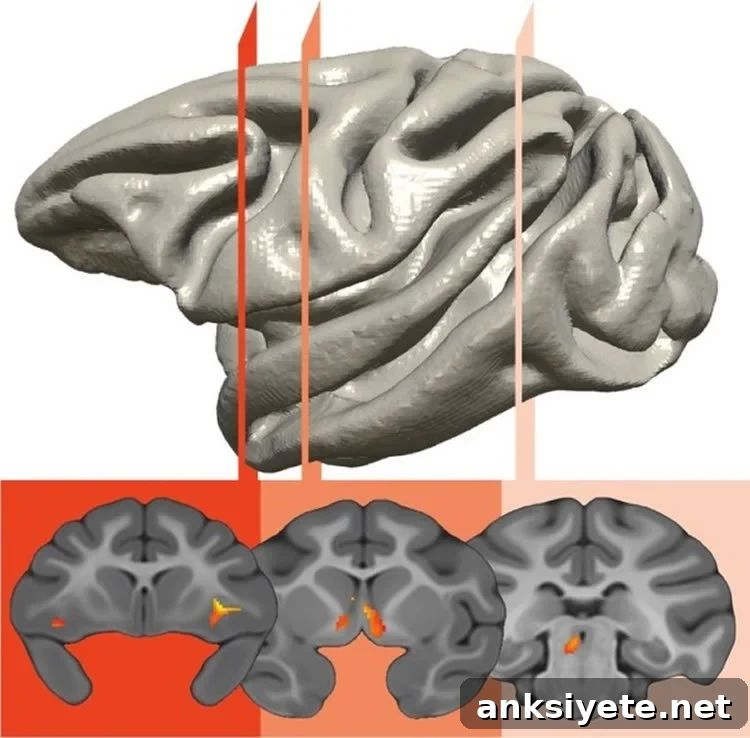
In rhesus monkey families — just as in human families — anxious parents are more likely to have anxious offspring.
A new study of an extended rhesus monkey pedigree offers important insights into how the risk for anxiety and depression can be transmitted from one generation to the next. Researchers at the University of Wisconsin–Madison Department of Psychiatry and the HealthEmotions Research Institute identified an overactive brain circuit spanning three key regions that appears to mediate inherited risk for an anxious temperament.
The work, published in the Proceedings of the National Academy of Sciences (PNAS), shows that elevated activity in a prefrontal–limbic–midbrain circuit is associated with early-life anxious temperament and likely contributes to a biological pathway linking genes to later risk for anxiety and depressive disorders.
“Overactivity of these three brain regions represents inherited alterations that are directly linked to later life risk for anxiety and depression,” says Ned Kalin, chair of psychiatry at the UW School of Medicine and Public Health and senior author on the study. “This finding is a significant step toward understanding the neural basis of inherited anxiety and points to more selective targets for intervention.”
Previous work from Kalin’s group established that anxious temperament is heritable and identified relevant neural circuits. About half of children who display extreme early anxiety will later develop stress-related psychiatric disorders. Like humans, rhesus monkeys exhibit stable individual differences in temperament, and those differences can be passed down through families.
To quantify how family history shapes anxiety-like tendencies, the team studied nearly 600 young rhesus monkeys drawn from a large multigenerational pedigree. By analyzing behavior alongside high-resolution functional and structural brain imaging, they estimated that roughly 35 percent of variation in anxiety-like behavior in this sample is explained by family history.
Behavioral testing used a mild, developmentally relevant stressor: the presence of a stranger who avoided eye contact, a situation comparable to a mildly threatening social encounter a child might experience. During this test, investigators measured brain metabolism using positron emission tomography (PET), a human-applicable imaging method, to identify regions where increased metabolic activity predicted each animal’s level of anxious temperament.
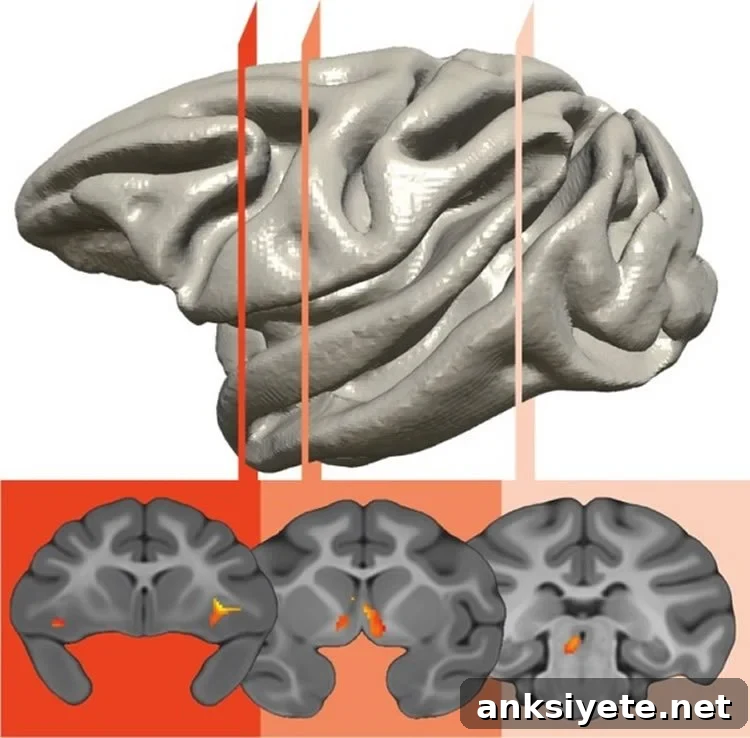
Using a genetic-correlation approach that traces how individual differences in brain function and behavior cosegregate across the family tree, the researchers identified the neural systems that account for parent-to-child transmission of anxiety-related behavior. This analysis revealed a tripartite circuit—brain stem, amygdala, and prefrontal cortex—where metabolism and early-life anxious temperament likely share a genetic basis.
These three regions serve distinct survival-related roles: the brain stem (a primitive neural center involved in basic arousal and physiological regulation), the amygdala (a limbic hub centrally involved in fear and emotional processing), and the prefrontal cortex (a higher-order region for regulation and decision-making that is well developed in primates). When metabolism in this circuit is elevated, young animals show higher levels of anxious temperament.
“From an evolutionary perspective, some level of anxiety is adaptive because it helps an individual detect and avoid danger,” Kalin explains. “But when these circuits are overactive, anxiety becomes excessive and can lead to clinical anxiety and depressive disorders.”
Importantly, the study found that functional activity—brain metabolism—rather than structural size, mediates the inherited risk. While brain volume measures are highly heritable early in life, they did not account for the transmission of anxious temperament. Instead, variations in regional metabolic activity are the critical intermediary linking genetic factors to childhood risk for stress-related psychopathology.
These findings narrow the search for molecular mechanisms by pointing to specific functional alterations within a defined neural circuit. This makes it possible to focus future research on the molecular and cellular changes that produce elevated metabolism in these brain regions, and to develop interventions that target the activity of this circuit rather than its gross anatomy.
Knowing where to look for molecular contributors to anxiety-related brain function provides a clearer path for designing treatments that could reduce the likelihood that children with an anxious temperament will develop full-blown anxiety or depressive disorders.
Funding: The research was funded by the National Institute of Mental Health (NIMH).
Source: University of Wisconsin–Madison
Image credit: Kalin Lab
Original research: “Intergenerational Neural Mediators of Early-Life Anxious Temperament” by Andrew S. Fox, Jonathan A. Oler, Alexander J. Shackman, Steven E. Shelton, Muthuswamy Raveendran, D. Reese McKay, Alexander K. Converse, Andrew Alexander, Richard J. Davidson, John Blangero, Jeffrey Rogers, and Ned H. Kalin. Published online July 6, 2015 in Proceedings of the National Academy of Sciences (PNAS), doi:10.1073/pnas.1508593112
Abstract
Intergenerational Neural Mediators of Early-Life Anxious Temperament
Identifying heritable neural systems is not, by itself, sufficient to declare them intergenerational mediators of psychopathology. By examining how individual differences in neural phenotypes and anxious temperament cosegregate within an extended family tree, the study pinpoints brain systems that underlie parent-to-child transmission of risk. In a sample of 592 young rhesus monkeys from a multigenerational pedigree, the authors show that metabolism within a prefrontal–limbic–midbrain circuit mediates part of the inborn risk for anxiety and depression. Crucially, although brain volume is highly heritable in early life, brain metabolism—not structure—serves as the key intermediary between genetic variation and childhood risk for stress-related psychopathology.