
Stuttering and the Brain: Right-Hemisphere Stop Signals Disrupt Speech Flow
Summary: New research from the Max Planck Institute shows stronger activity and connectivity in right-hemisphere brain regions in adults who stutter, suggesting that overactive inhibitory networks interfere with the initiation and smooth flow of speech.
One percent of adults and about five percent of children experience persistent difficulties speaking fluently. For these individuals, everyday phrases can become interrupted by repeated sounds or prolonged blocks — for example, “G-g-g-g-g-ood morning” or getting stuck on a syllable such as “Ja” instead of “January,” even though the speaker knows exactly what they want to say.
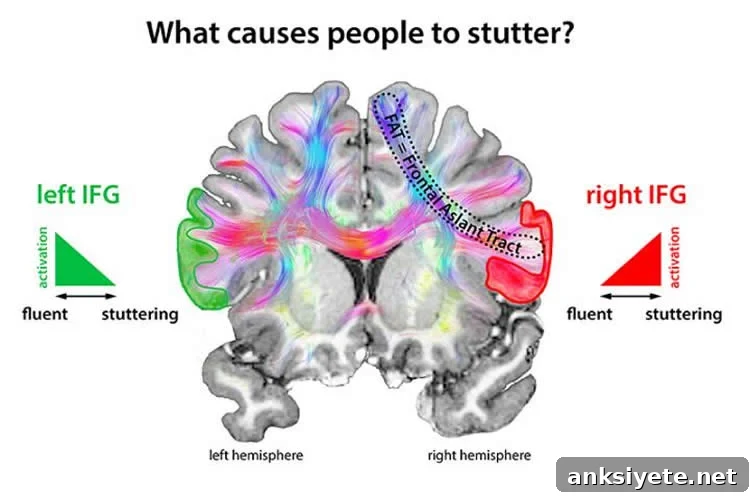
Researchers have long observed an imbalance in brain activity between the left and right hemispheres of people who stutter. Typically, regions in the left frontal cortex that plan and execute speech are less active, while corresponding regions on the right show increased activity. What remained unclear until now was whether the left hemisphere’s reduced activity is the primary problem with the right hemisphere compensating for it, or whether the right hemisphere’s heightened activity actively suppresses left-hemisphere speech areas and causes disfluency.
Scientists at the Max Planck Institute for Human Cognitive and Brain Sciences in Leipzig, together with collaborators at the University Medical Center Göttingen, report evidence that the hyperactivity in specific right-hemisphere regions plays a key role. Nicole Neef, neuroscientist at MPI CBS and lead author of the study, explains that parts of the right inferior frontal gyrus (right IFG) are normally involved in stopping or inhibiting actions, including stopping planned hand or speech movements. When this stopping network is overactive, it can interfere with the brain systems responsible for initiating and carrying out movements. In people who stutter, speech motor regions appear particularly affected by this excessive inhibition.
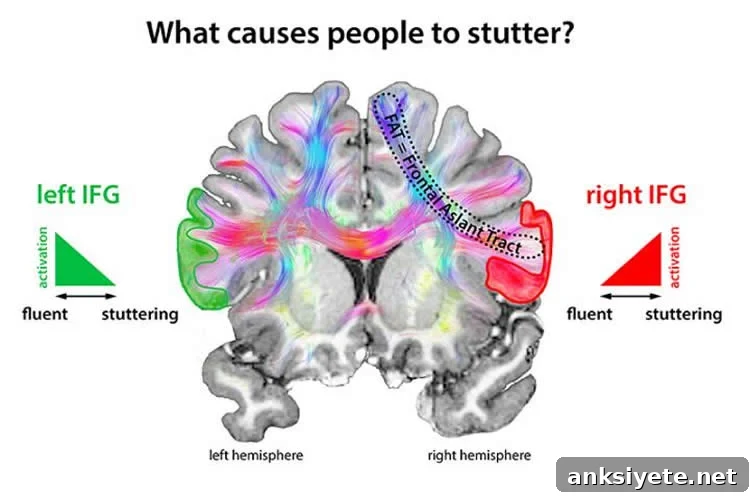
Two left-hemisphere regions central to fluent speech are the left inferior frontal gyrus (IFG), which plans speech movements, and the left motor cortex, which executes them. When activity in these areas is intermittently suppressed, a person can lose the smooth sequencing of speech, producing repetitions, prolongations, or blocks.
To investigate the interplay between hyperactive right-hemisphere areas and the speech motor system, the researchers used magnetic resonance imaging (MRI) techniques in adults with persistent developmental stuttering and matched control participants. During scanning, participants were asked to imagine saying the names of the months. Imagined speech was used to avoid contamination of the MRI signal by actual vocal movements while still engaging speech planning processes. The team combined functional imaging to identify hyperactive right frontal regions with diffusion-weighted imaging to examine structural white-matter pathways originating from those regions.
The study revealed a notable finding: a specific white-matter pathway in the hyperactive right frontal network — the right frontal aslant tract (FAT) — was stronger in people who stutter than in fluent speakers. Importantly, the degree of structural strengthening in this tract correlated with stuttering severity. As Nicole Neef notes, “The stronger the frontal aslant tract, the more pronounced the stuttering.” The FAT is implicated in fine-tuning inhibitory signals that can halt or modulate movements, and its enhanced connectivity in stuttering suggests that excessive neural inhibition of speech movements contributes to disrupted fluency.
Source: Verena Müller, Max Planck Institute for Human Cognitive and Brain Sciences
Publisher: NeuroscienceNews summary of MPI CBS research
Image credit: Max Planck Institute for Human Cognitive and Brain Sciences (MPI CBS)
Abstract (Paraphrased)
The study, titled “Structural connectivity of right frontal hyperactive areas scales with stuttering severity,” examined how the connection strength of hyperactive right frontal regions relates to the degree of speech motor deficits in adults who stutter. Diffusion-weighted and functional MRI data were collected from 31 adults who stutter and 34 control participants. Voxel-wise correlation analyses within tract volumes seeded from functionally hyperactive right frontal regions showed that greater stuttering severity was associated with increased connection strength in the right frontal aslant tract, the right anterior thalamic radiation, and short U-shaped projections beneath the right precentral sulcus. Conversely, some right-hemisphere pathways, like the uncinate fasciculus, showed increased connection strength with less severe speech motor deficits. Group comparisons also confirmed previously reported reductions in white-matter integrity in the superior longitudinal fasciculus. Overall, the findings suggest that right fronto-temporal networks may serve a compensatory, fluency-enhancing role, while increased subcortical–cortical connectivity may reflect an overactive global response suppression mechanism that contributes to stuttering. The combined functional and structural imaging results help disentangle distinct networks involved in the neural basis of persistent developmental stuttering.
Study citation: Nicole E. Neef, Alfred Anwander, Christoph Bütfering, Carsten Schmidt-Samoa, Angela D. Friederici, Walter Paulus, and Martin Sommer. Structural connectivity of right frontal hyperactive areas scales with stuttering severity. Published in Brain (online December 8, 2017).
This summary highlights the role of right-hemisphere inhibitory networks, particularly the frontal aslant tract and right inferior frontal gyrus, in disrupting speech motor control in people who stutter. The findings point toward neural inhibition as an important factor in stuttering and suggest targets for future research into therapeutic interventions and neuromodulation approaches.