
Similar wiring diagrams may exist elsewhere in the brain.
Eating, like breathing and sleeping, is a fundamental biological function—but the act of chewing depends on a precise, coordinated interaction between the tongue and jaw. The tongue must position food between the teeth and then withdraw each time the jaw closes to grind the bite. Without tight coordination, a chewer could easily injure their tongue.
Researchers at Duke University applied an advanced neural tracing method in mice to chart the brain circuits that make chewing smooth and safe. Published June 3 in eLife, the study maps premotor circuitry that coordinates jaw and tongue muscles and may help explain a range of human behaviors, from nocturnal teeth grinding to facial expressions and complex vocalizations.
“Chewing can be voluntarily controlled, but when you stop paying attention, interconnected neurons in the brain carry out the behavior automatically,” said Edward Stanek IV, lead author and a graduate student at Duke University School of Medicine. “To understand how this happens, the first step was to find where these neurons are located and how they connect.”
Earlier attempts to map the circuits that control chewing produced an incomplete picture. It is known that motoneurons directly govern jaw and tongue muscles, and that premotor neurons provide input to those motoneurons. What remained unclear was which premotor populations connect to which motoneurons, and whether some premotor neurons coordinate multiple muscles.
Under the guidance of senior author Fan Wang, Ph.D., associate professor of neurobiology and member of the Duke Institute for Brain Sciences, Stanek used a genetically modified rabies virus as a tracing tool. The modified virus travels backward across synapses in a controlled way and is tagged with fluorescent markers so researchers can follow its path.
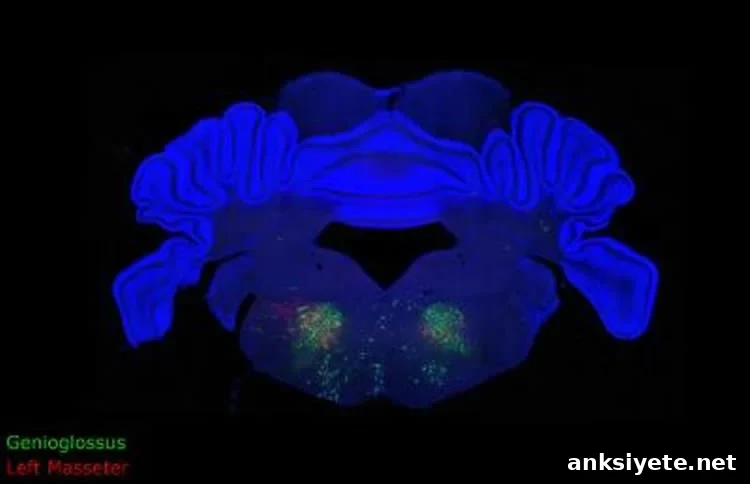
Unlike the natural rabies virus, which spreads broadly, the engineered version could only move from muscles to motoneurons and then back one synaptic step to premotor neurons. The virus carried either a green or red fluorescent label, allowing the team to identify premotor neurons connected to specific muscles.
Stanek injected these labeled viruses into two key muscles: the genioglossus, which protrudes the tongue, and the masseter, a major jaw-closing muscle. The mapping revealed that some premotor neurons connect simultaneously to motoneurons that open the jaw and to those that push the tongue forward. Another premotor population links the motoneurons responsible for jaw closure with those that retract the tongue. These shared premotor connections offer a straightforward neural mechanism to coordinate tongue and jaw movements and to protect the tongue from being bitten.
“Finding premotor neurons that target multiple downstream motor pools suggests a general strategy the motor system uses to coordinate muscles,” Stanek said. “It also means individual neurons can influence several motor outputs, which is important for interpreting other brain-mapping studies.”
The team plans to extend this approach to trace circuits farther back in the brain, ultimately aiming to connect these premotor networks to higher centers such as the cortex. Their immediate next step is to examine in greater detail how premotor neurons communicate with motoneurons and to include additional muscles involved in orofacial behaviors.
“This work is an early but important step toward understanding control of facial and oral movements,” Stanek added. “We studied only two muscles here, while chewing, drinking, and speech involve at least ten more. Mapping those additional muscles will be necessary to assemble a complete picture of how the network coordinates these behaviors.”
The research received support from the National Institutes of Health (grants NS077986 and DE019440).
Contact: Karl Bates – Duke University
Source: Duke University press release
Image Source: Image credited to Fan Wang Lab, Duke University and adapted from the press release.
Original Research: Full open-access research paper “Monosynaptic premotor circuit tracing reveals neural substrates for oro-motor coordination” by Edward Stanek, Steven Cheng, Jun Takatoh, Bao-Xia Han, and Fan Wang in eLife. Published online April 30, 2014 (doi:10.7554/eLife.02511)
Monosynaptic premotor circuit tracing reveals neural substrates for oro-motor coordination
Coordinated feeding behaviors require precisely timed activation across jaw, tongue, and facial muscles, yet the anatomical neural substrates that enable this coordination have been unclear. This study tested whether premotor circuits supplying jaw and tongue motoneurons contain elements designed for coordinated control. Using a modified monosynaptic rabies virus tracing strategy, the authors systematically mapped premotor neurons that innervate the jaw-closing masseter and the tongue-protruding genioglossus muscles. The resulting maps showed premotor populations distributed in brain regions associated with rhythm generation, descending motor control, and sensory feedback. Crucially, the study identified premotor connection patterns well suited to coordinate bilaterally symmetric jaw movements and to enable co-activation of selected jaw, tongue, and facial muscles. These findings support the idea that shared premotor neurons that form specific multi-target connections with chosen motoneurons provide a simple and general solution for orofacial coordination.
“Monosynaptic premotor circuit tracing reveals neural substrates for oro-motor coordination” by Edward Stanek, Steven Cheng, Jun Takatoh, Bao-Xia Han, and Fan Wang in eLife, April 30, 2014 (doi:10.7554/eLife.02511)