
How Axons Convert Chemical Cues into Mechanical Force
Summary: Researchers report that polarized phosphorylation of shootin1 within growth cones is essential for directional axon guidance in response to netrin-1 gradients.
While modern technology moves rapidly toward wireless solutions, the nervous system still relies on precise, physical connections between neurons. Those connections form when one neuron extends an axon to contact another. Axon extension and steering depend on chemical guidance cues that are translated into directional mechanical forces within the growth cone. Although many guidance molecules have been identified, how these chemical signals are converted into the mechanical traction that steers axons has been less clear. A collaborative study by researchers in Japan and the United States, published in eLife, identifies the brain-specific protein shootin1 as a key mechano-effector that links netrin-1 signaling to directional axon growth.
Naoyuki Inagaki, Professor at the Nara Institute of Science and Technology (NAIST) and senior author of the study, explains that two classes of molecules play central roles in guided axon growth. Netrin-1 is a well-characterized secreted guidance cue that forms extracellular gradients. Shootin1 is a brain-enriched intracellular protein that promotes axon outgrowth and now appears to act as a molecular bridge between chemical signals and mechanical output within the growth cone.
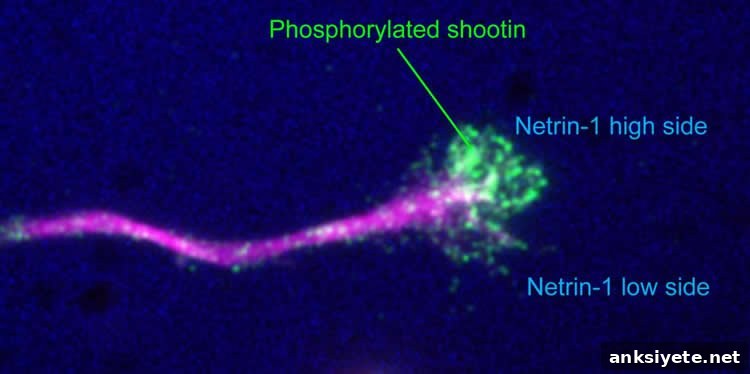
In carefully controlled experiments, the team exposed neuronal growth cones to very shallow netrin-1 gradients and monitored the intracellular response. Dr. Kentarou Baba, the study’s first author, reports an unexpectedly high level of sensitivity: “A slight concentration gradient in netrin-1 of only 0.4% induces a 71% difference in shootin1 phosphorylation within growth cones.” In other words, even a sub-1% difference in extracellular netrin-1 concentration across the width of a growth cone produced a strongly polarized intracellular response. Most phosphorylated shootin1 accumulated on the side of the growth cone facing higher netrin-1, providing a robust internal asymmetry that could bias protrusive activity and steering.
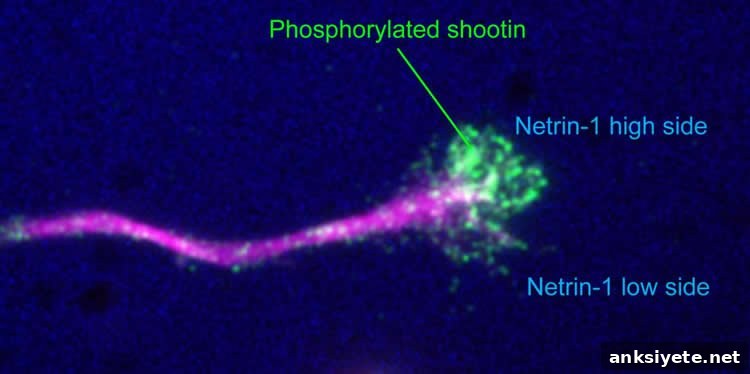
The phosphorylation event is mediated by Pak1 and markedly increases shootin1’s affinity for the cell adhesion molecule L1-CAM. Inagaki likens L1-CAM to the “wheels” of the axon: it links the actin cytoskeleton to the substrate, allowing the growth cone to generate traction. When shootin1 binds more effectively to L1-CAM following phosphorylation, F-actin–adhesion coupling strengthens and the growth cone produces directed traction forces. Disruption of the shootin1–L1-CAM interaction did not completely abolish axon extension—axons could still grow, albeit more slowly—but it did prevent the axons from turning toward the netrin-1 source. This indicates that shootin1-mediated coupling is specifically required for directional steering rather than basic motility.
Genetic evidence supports this mechanistic model. Shootin1 knockout mice exhibit abnormal forebrain commissural axon projections, a phenotype that resembles defects seen when netrin-1 signaling is impaired. Together, the biochemical, cellular, and genetic data indicate that shootin1 functions as a chemo-mechanical transducer: it reads a shallow extracellular gradient of netrin-1, converts that spatial information into locally biased phosphorylation, and thereby drives asymmetric adhesion–cytoskeleton coupling and force generation for directed growth cone migration.
Significance and conclusions
This work defines a concrete mechano-effector downstream of netrin-1 signaling and identifies polarized shootin1 phosphorylation as a critical intracellular readout of guidance cues. The high sensitivity of the system—where tiny extracellular differences are amplified into large intracellular asymmetries—helps explain how growth cones make reliable directional decisions in complex, noisy environments during neural development. By linking gradient sensing to adhesion dynamics and force generation, the study connects molecular signaling events to mechanical outputs that underlie axon pathfinding.
Funding and acknowledgements
Funding for this study was provided by the Japan Society for the Promotion of Science, the Japan Agency for Medical Research and Development, the Osaka Medical Research Foundation for Incurable Diseases, and the Takeda Science Foundation. The work was carried out by a collaborative team that includes Kentarou Baba, Wataru Yoshida, Michinori Toriyama, Tadayuki Shimada, Colleen F. Manning, Michiko Saito, Kenji Kohno, James S. Trimmer, Rikiya Watanabe, and Naoyuki Inagaki.
Source and original research
Source: Takahito Shikano, NARA (Nara Institute of Science and Technology). Publisher: Organized by NeuroscienceNews.com. Image credit: Naoyuki Inagaki.
Original research (open access): “Gradient-reading and mechano-effector machinery for netrin-1-induced axon guidance,” eLife. DOI: 10.7554/eLife.34593. Published August 7, 2018.
Abstract (condensed)
Growth cones navigate axonal projections in response to extracellular guidance cues, but how they translate spatial chemical information into directional protrusive forces has been unclear. The study demonstrates that knockout of shootin1 causes forebrain commissural axon projection defects similar to netrin-1 loss. Shallow netrin-1 gradients trigger highly polarized Pak1-mediated phosphorylation of shootin1 in growth cones. Phosphorylated shootin1 binds more strongly to L1-CAM, enhancing F-actin–adhesion coupling and generating traction forces that drive directed growth cone movement. Spatially regulated shootin1 phosphorylation is required for axon turning induced by netrin-1 gradients, identifying shootin1 as a mechano-effector that converts netrin-1 signals into a directional mechanical response for axon guidance.
Feel free to share this summary of the neuroscience findings.