
Full Detonation in the Hippocampus: Plasticity-Dependent Switch at Mossy Fiber–CA3 Synapses
Summary: Researchers demonstrate that altering short-term synaptic plasticity can flip a hippocampal synapse from a conditional to a full “detonator” mode, enabling a single presynaptic action potential to trigger firing in the postsynaptic CA3 neuron.
Source: IST Austria
Overview: Synapses are the communication points between neurons, and the strength of a synapse determines how information travels through neural circuits. Some synapses in the nervous system are intrinsically strong—so-called full detonators—so that a single presynaptic action potential reliably triggers the postsynaptic cell. Classic examples include the neuromuscular junction and the calyx of Held in the auditory brainstem. Whether similar full detonator synapses exist and can be dynamically induced in the hippocampus has been a long-standing question.
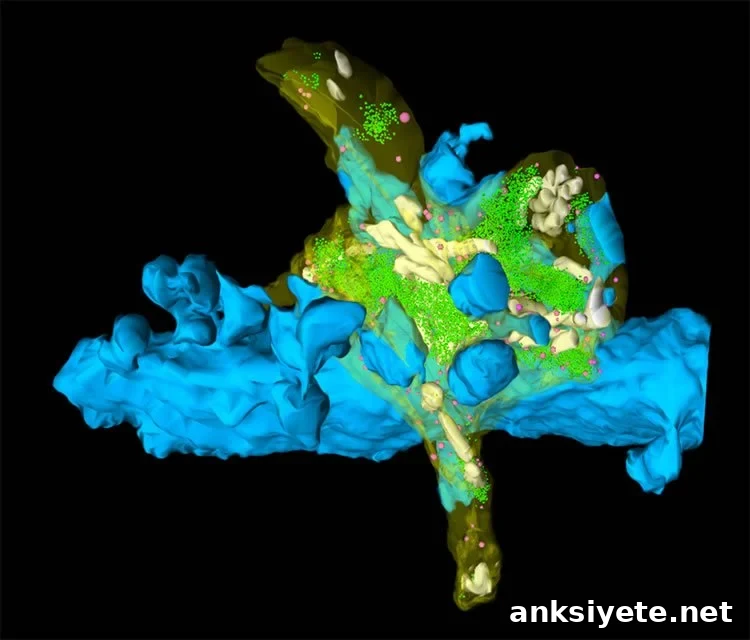
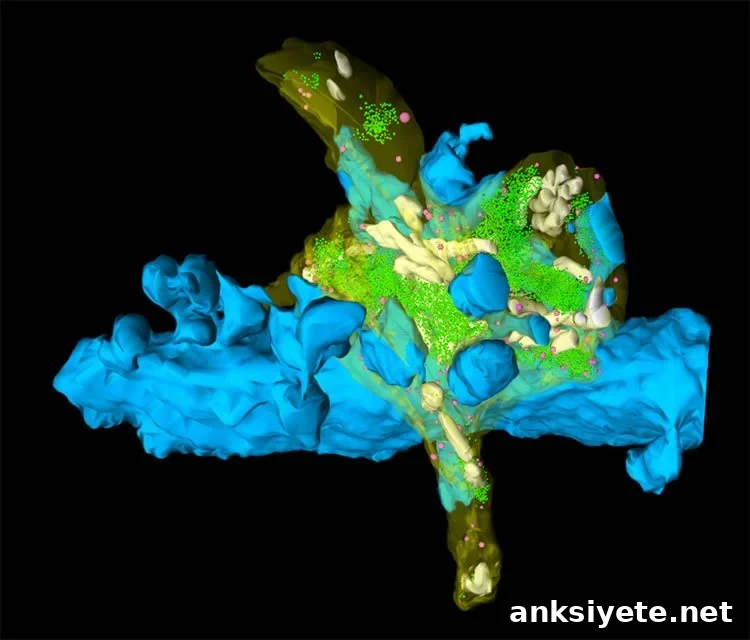
In a study led by Nicholas Vyleta (formerly a postdoc at IST Austria, now at Oregon Health & Science University), Carolina Borges-Merjane (postdoc at IST Austria), and Peter Jonas (Professor at IST Austria), researchers probed the synapse formed by dentate gyrus granule cells (mossy fibers) onto CA3 pyramidal neurons. Using a method that selectively stimulates an individual presynaptic terminal while recording from its connected postsynaptic CA3 neuron, they examined how short-term presynaptic plasticity affects synaptic output and postsynaptic firing.
Under baseline conditions, single unitary excitatory postsynaptic potentials (EPSPs) from a granule cell do not typically induce action potentials in CA3 pyramidal neurons. Instead, these mossy fiber synapses behave as “conditional detonators”: they require bursts of action potentials in the presynaptic cell to reliably drive the postsynaptic neuron. The new experiments show, however, that this computational mode is not fixed.
The investigators induced a brief, high-frequency presynaptic activation—one second of rapid firing—at a single mossy fiber terminal to evoke post-tetanic potentiation (PTP), a form of short-term plasticity that transiently increases transmitter release probability. After this brief conditioning, a striking change emerged: the same single presynaptic action potential that was previously subthreshold now consistently produced spikes in the postsynaptic CA3 neuron. In other words, PTP converted the mossy fiber synapse from a subdetonator state into a full detonator for tens of seconds.
This plasticity-dependent switch has important functional implications. Peter Jonas notes that the study challenges the conventional view that individual cortical synapses are always weak and require integration of many inputs to drive postsynaptic firing. Instead, the results demonstrate that synaptic strength and computational role can be rapidly and transiently modified by activity, creating time windows during which single, highly specific granule cell inputs can dominate downstream CA3 activity.
Nicholas Vyleta highlights the potential role of this mechanism for hippocampal information processing: a transiently potentiated mossy fiber synapse could transmit a single, precise piece of information from the dentate gyrus through the CA3 region, supporting processes such as pattern separation, encoding, and recall. The tens-of-seconds duration of PTP could provide meaningful temporal windows for routing, storage, or retrieval of information in hippocampal networks.
Methods and key findings
The study employed selective stimulation of individual presynaptic terminals in acute rat brain slices combined with postsynaptic whole-cell recordings from CA3 pyramidal neurons. Under control conditions, unitary EPSPs rarely generated action potentials. After inducing PTP via brief high-frequency presynaptic activation, unitary EPSPs reliably triggered spikes. The potentiation and resultant detonation persisted for tens of seconds before decaying back to the baseline conditional detonator state.
Implications
These findings underscore how short-term presynaptic plasticity can dynamically reconfigure the computational role of single synapses, enabling transient, high-impact signaling within neural circuits. Such activity-dependent detonation may be a mechanism by which the hippocampus selectively routes salient information, enhances signal-to-noise for specific inputs, and supports mnemonic functions that rely on brief but strong synaptic transmission.
Publication and credits
The work was published in the open-access journal eLife on October 25, 2016, by Nicholas P. Vyleta, Carolina Borges-Merjane, and Peter Jonas. The research was reported by IST Austria. The original research article is titled “Plasticity-dependent, full detonation at hippocampal mossy fiber–CA3 pyramidal neuron synapses,” DOI: 10.7554/eLife.17977.
Source: IST Austria
Image credit: researchers / IST Austria
Original research: “Plasticity-dependent, full detonation at hippocampal mossy fiber–CA3 pyramidal neuron synapses” by Nicholas P. Vyleta, Carolina Borges-Merjane, and Peter Jonas. Published in eLife, October 25, 2016. DOI: 10.7554/eLife.17977.