
Encountering a wall corrects ‘GPS’ cells in mouse brains, study finds.
Researchers at Stanford University School of Medicine analyzed activity in the brain’s internal navigation system and discovered that the neural “GPS” used by mice gradually accumulates error, but these errors are reset when the animal contacts a boundary such as a wall. The study provides direct evidence that grid cells—neurons that encode location—rely on self-motion signals to track position and depend on environmental borders to correct accumulated drift.
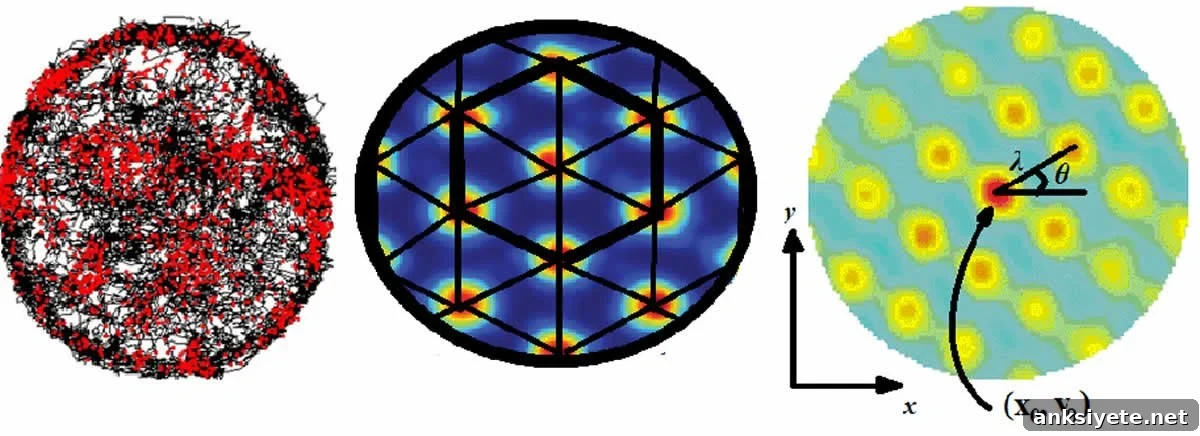
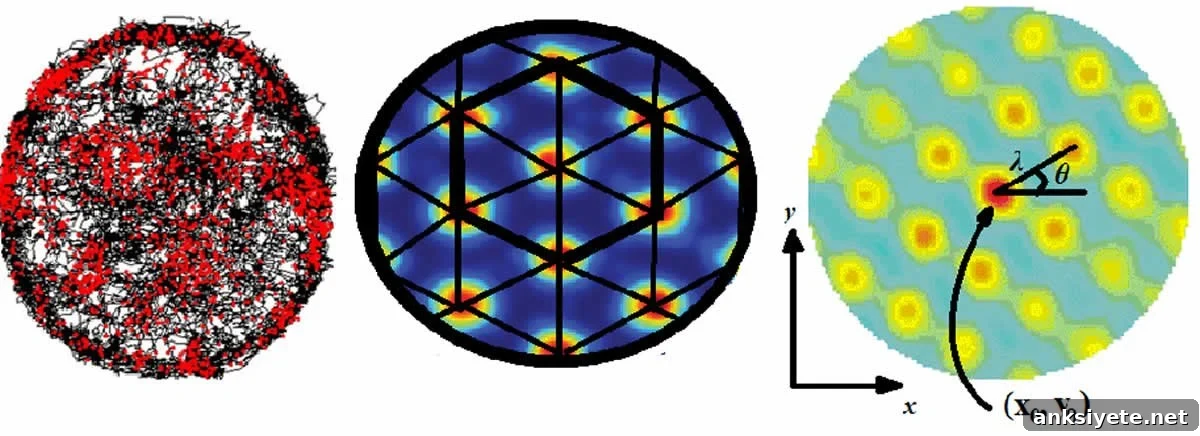
Grid cells form a hexagonal, periodic representation of space and are thought to underlie path-integration navigation, using perceived speed and heading to estimate current location. This mechanism explains how you can navigate a familiar room in the dark: your nervous system keeps track of steps and turns so you avoid obstacles. However, unlike a perfect instrument, this internal calculation slowly drifts. The Stanford team shows that when the animal encounters a wall, nearby border-responsive neurons can realign the grid cell representation and restore positional accuracy.
The study, published April 16 in Neuron, was led by graduate student Kiah Hardcastle with senior author Lisa Giocomo, PhD, assistant professor of neurobiology at Stanford. The experimental work was carried out in collaboration with Surya Ganguli, PhD, assistant professor of applied physics, whose theory lab contributed modeling and interpretation of the data.
Background and experimental approach
Grid cells were first discovered a decade ago in the medial entorhinal cortex by May-Britt Moser and Edvard Moser, researchers who received a Nobel Prize for work on neural systems for spatial navigation. Those studies showed individual grid cells fire at multiple locations arranged in a triangular lattice across a space, forming an internal coordinate system that signals location to the hippocampus.
To study how stable these internal maps remain when animals navigate without rich visual cues, Giocomo’s team recorded neuronal activity from 11 mice preparing long, dark exploration sessions. Each mouse carried a surgically implanted microdrive containing multiple electrodes that recorded spikes from many neurons simultaneously. During 40- to 50-minute sessions in a one-square-meter dark arena, the researchers tracked how sets of grid cells fired as the animals moved through different parts of the enclosure.
When Hardcastle examined stretches of the mice’s trajectories that took them far from boundaries, she observed that the grid pattern gradually drifted: cells began firing at locations different from their original preferred sites. Over time the offset grew larger, meaning the internal estimate of position diverged from the animal’s true location. Crucially, when the mouse encountered a wall the grid pattern snapped back into alignment, indicating that boundary contacts correct accumulated error.
Rapid accumulation of positional errors
One surprising result was how quickly error accumulated. The team found measurable drift within minutes—often within two minutes—rather than over tens of minutes. This fast drift supports models in which path integration is inherently noisy: small misestimates of distance traveled or of turning can compound rapidly into larger positional errors. The observed pattern of failures is consistent with grid cells computing location from speed and direction and then relying on external cues to keep that computation anchored to the real world.
Hardcastle and colleagues interpret the results as strong evidence that border cells—neurons that respond to environmental boundaries—provide a corrective signal. When a mouse encounters a wall, sensory input from touch, vision, or other modalities can be used to recalibrate the grid representation, reducing the offset produced by noisy self-motion cues. The correction is direction-dependent, consistent with border-cell activity providing a vector-like adjustment to grid firing.
Neuroscientist Ila Fiete, PhD, who was not involved in the study, described the work as an important advance in understanding how external spatial cues influence internal neural representations of space.
Next steps and broader implications
Giocomo’s group is expanding these investigations using larger datasets collected at Stanford and plans to examine grid-cell dynamics in rats as well as mice. Rats tend to explore more of the open field and are less inclined to stay close to walls, which could reveal additional details about how diverse sensory cues—visual, tactile, and olfactory—contribute to error correction. The team also aims to sample more neurons simultaneously to better characterize interactions between grid cells, border cells, and other spatially tuned cell types.
Funding: This research was supported by grants from the Burroughs-Wellcome Fund, the James S. McDonnell Foundation, the Simons Foundation, the Alfred P. Sloan Foundation and Stanford’s Bio-X Interdisciplinary Initiatives Program.
Written by: KIM SMUGA-OTTO
Source: Stanford University School of Medicine
Image credit: Hafting Torkel, Fyhn Marianne, Molden Sturla, Menno P. Witter, Moser May‑Britt, and Moser Edvard I. (licensed under Creative Commons Attribution 4.0 International). The image is for illustration and is not directly from the present study.
Original research: Hardcastle K., Ganguli S., and Giocomo L. M., “Environmental Boundaries as an Error Correction Mechanism for Grid Cells,” Neuron. Published online April 16, 2015. doi:10.1016/j.neuron.2015.03.039
Abstract
Environmental Boundaries as an Error Correction Mechanism for Grid Cells
Highlights
• Grid cells accumulate error over time and with distance traveled.
• Encounters with environmental boundaries correct error in the grid code.
• Grid drift is systematic and corrected in a direction-dependent way.
• Border cells offer a plausible neural mechanism for error correction.
Summary
Medial entorhinal grid cells exhibit periodic, hexagonal firing fields and support path-integration-based navigation. Because path integration is recursive, small errors can accumulate and degrade the internal position estimate unless corrected by external landmarks. Recording grid-cell activity during long trajectories across an open arena, the authors show that error grows with time and distance away from the last boundary contact and that interactions with boundaries produce coherent, direction-dependent corrections. Combined with computational modeling of attractor network dynamics, these findings demonstrate that environmental landmarks are essential for maintaining stable grid representations.
“Environmental Boundaries as an Error Correction Mechanism for Grid Cells,” by Kiah Hardcastle, Surya Ganguli, and Lisa M. Giocomo, Neuron, published online April 16, 2015. doi:10.1016/j.neuron.2015.03.039