
Summary: Researchers have identified genetic factors that may protect against the progression of episodic migraine into chronic migraine.
Source: Kazan Federal University
Migraine affects a large portion of the global population, with estimates around 15% worldwide and up to 20% in Russia. Current diagnostic and treatment approaches remain primarily clinical, relying on patients’ reported symptoms rather than genetic or molecular markers.
Researchers from Kazan Federal University’s Neurobiology Laboratory and the Gene and Cell Technologies Laboratory led a two-year pilot study to search for genetic markers linked to migraine and its chronification. The study involved collaboration with colleagues from Saint Petersburg and Kazan State Medical University.
Neurologist and junior research associate Aliya Yakubova explains the motivation: “Chronic migraine is a much more severe condition than episodic migraine. Because episodic migraine can progress to a chronic form, identifying individuals at higher risk is important so preventive therapies can be offered early. In this study we identified genetic factors that appear to protect against migraine chronification.”
The pilot study analyzed DNA from 96 volunteers: 46 patients diagnosed with migraine (27 with episodic migraine and 19 with chronic migraine) and 50 healthy control participants. Blood samples were used for DNA sequencing to test for a specific single-nucleotide polymorphism (SNP) in the TRPV1 pain receptor gene. The polymorphism studied is 1911A>G (rs8065080), a change that results in an amino acid substitution (Ile585Val) in the TRPV1 protein, which is known to be involved in nociceptive signaling and sensitivity to heat and capsaicin.
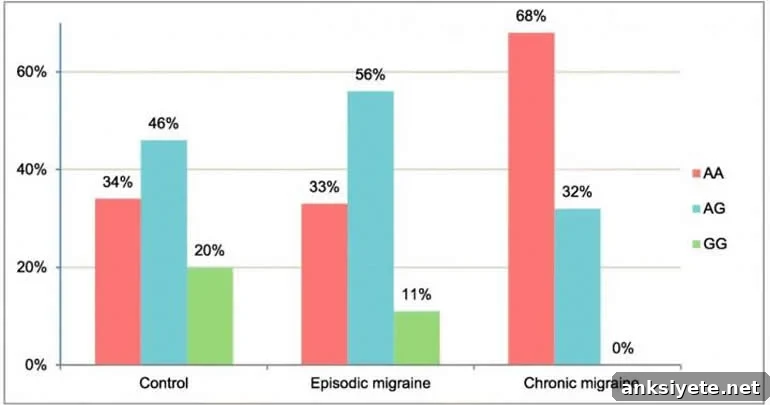
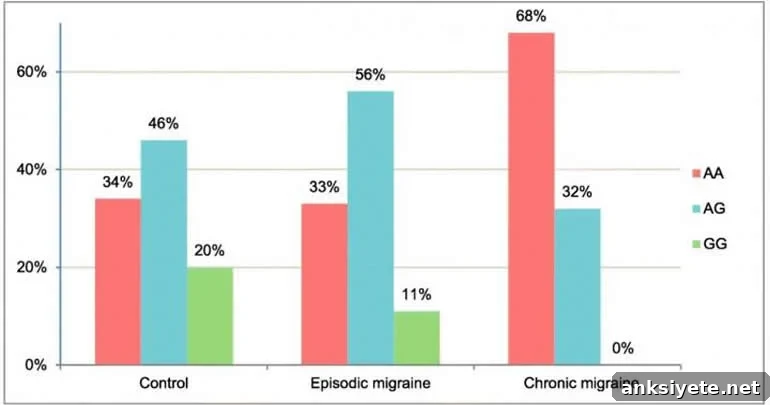
The genotype distribution for the TRPV1 1911A>G SNP differed notably between groups. In episodic migraine and control groups the frequencies of AA, AG, and GG genotypes were similar, while the chronic migraine group showed a markedly different pattern with a higher proportion of AA genotypes, fewer AG genotypes, and an absence of the GG genotype. These preliminary results suggest that the GG genotype may be associated with a lower risk of migraine chronification, whereas AA and AG genotypes may be linked to greater risk of progression and therefore could indicate candidates for long-term preventive therapy.
Yakubova adds, “If these findings hold up in larger samples, genotyping could be introduced into clinical practice. Patients with AA or AG genotypes, which do not appear to offer protection against chronification, could be considered for sustained preventive treatment. Patients with the GG genotype are less likely to progress to chronic migraine and may only require symptomatic therapy.”
The research team emphasizes that these are pilot findings that require validation in a larger and more diverse cohort. Patient recruitment will continue and will include individuals with both chronic and episodic migraine to strengthen statistical power and confirm whether genotype-guided risk stratification is robust. The team is also pursuing patent protection for the testing approach.
This study highlights a potential genetic component to migraine chronification and supports the idea that genetic testing of the TRPV1 1911A>G variant could contribute to personalized migraine management—identifying who might benefit from preventive therapies and who might be adequately managed with symptom relief alone.
About this migraine research article
Source:
Kazan Federal University
Contacts:
Yury Nurmeev – Kazan Federal University
Image Source:
Image credited to Kazan Federal University.
Original Research:
“Searching for Predictors of Migraine Chronification: a Pilot Study of 1911A>G Polymorphism of TRPV1 Gene in Episodic Versus Chronic Migraine” by Aliya Yakubova, Yuriy Davidyuk, Jussi Tohka, Olga Khayrutdinova, Igor Kudryavtsev, Dilyara Nurkhametova, Alexei Kamshilin, Rashid Giniatullin & Albert Rizvanov. Journal of Molecular Neuroscience. (Closed access)
Abstract
Searching for Predictors of Migraine Chronification: a Pilot Study of 1911A>G Polymorphism of TRPV1 Gene in Episodic Versus Chronic Migraine
The TRPV1 receptor, which responds to heat and capsaicin, is expressed in trigeminal nociceptive neurons and has been implicated in migraine pain mechanisms. A specific single-nucleotide polymorphism (SNP) in the TRPV1 gene, 1911A>G (rs8065080), causes an Ile585Val amino acid substitution and has been associated with altered receptor function and with various pain conditions. This pilot study examined the distribution of AA, AG, and GG genotypes of the TRPV1 1911A>G SNP in patients with episodic and chronic migraine compared with healthy controls. The cohort included 46 migraine patients (27 episodic, 19 chronic) and 50 controls. Genotyping was performed using allele-specific PCR and gel electrophoresis on DNA from peripheral blood. Genotype frequencies in episodic migraine were similar to controls (episodic: AA 33%, AG 56%, GG 11%; controls: AA 34%, AG 46%, GG 20%). In contrast, chronic migraine patients displayed a significantly different distribution (AA 68%, AG 32%, GG 0%; p < 0.05). These initial observations suggest a distinct genotype pattern in chronic migraine patients and raise the possibility that absence of the GG genotype may represent a genetic risk marker for progression from episodic to chronic migraine. Further studies with larger samples are warranted to validate these findings and to explore their clinical utility in predicting and preventing migraine chronification.