
Researchers identify a dietary connection essential for healthy prenatal and early postnatal neural growth.
While recent studies have questioned whether fish oil supplements improve heart health, researchers at UC Irvine emphasize that the long-chain fatty acids found in fish remain essential for brain development. Their new findings show that a lack of these nutrients during pregnancy and early life can impair neuronal growth and synaptic connectivity.
Published in the Journal of Neuroscience, the study led by Susana Cohen-Cory, professor of neurobiology and behavior, documents how dietary shortages of n-3 polyunsaturated fatty acids (n-3 PUFAs) alter molecular pathways in the developing brain and limit the growth and branching of neurons as well as the formation of synapses.
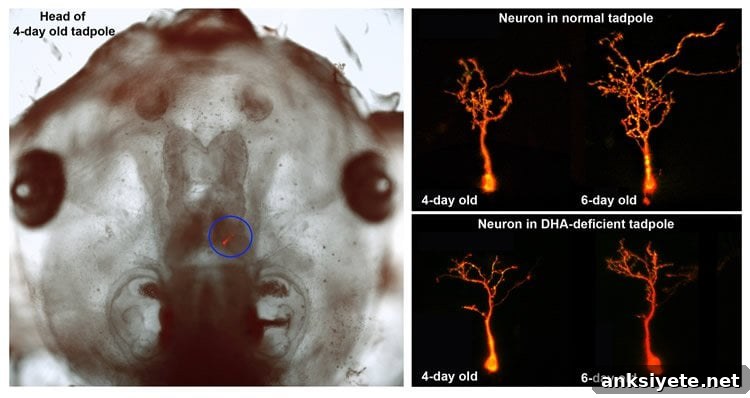
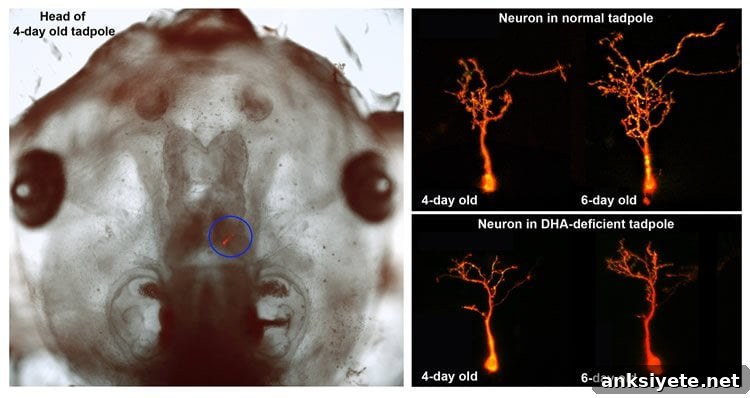
These dietary fats are precursors of docosahexaenoic acid (DHA), a critical structural component of the central nervous system. Using a model system of African clawed frogs (Xenopus laevis) and their tadpoles, the research team observed that tissues lacking adequate DHA produced simpler neurons with fewer synaptic connections—changes that can undermine neural circuit function.
Cohen-Cory notes that restoring DHA to the mothers’ diet reversed these deficits: “When we changed the diets of DHA-deficient mothers to include sufficient n-3 PUFAs, neuronal and synaptic growth recovered in the next generation of tadpoles.” This recovery highlights the value of maternal nutrition for offspring brain maturation.
DHA accumulates in the brain and retina: it comprises roughly 10–15 percent of total lipids in the cerebral cortex and can make up to half of the lipid content in light-sensitive retinal cells. Because of its concentration in these tissues, DHA plays a central role in visual system development and in establishing healthy neural architecture during late gestation and early infancy.
Dietary DHA is found primarily in animal sources. Oily fish such as mackerel, herring, salmon, trout and sardines provide the highest amounts—often ten to a hundred times the levels found in plant-based foods like nuts, seeds, whole grains, or leafy green vegetables. DHA is also present in breast milk, and it has been added to infant formulas and given as a supplement to premature infants to support early mental and visual development.
The UCI investigators used Xenopus laevis because frog embryos develop externally and are transparent, allowing direct, longitudinal observation of neuronal development from fertilization through the formation of functional neural circuits. This model enabled the team to follow how a maternal n-3 PUFA deficiency propagates into structural and molecular changes in the offspring’s brain.
Researchers concentrated on the visual system, a well-characterized neural circuit known to depend on fatty acids for proper maturation and function. Live imaging of individual optic tectal neurons revealed that tadpoles from n-3 PUFA–deficient mothers developed simpler dendritic arbors, with fewer branches and reduced overall dendritic length when compared to tadpoles from mothers receiving adequate n-3 PUFAs.
Contributors to the study include Miki Igarashi and Rommel Santos of UC Irvine.
Funding: This research was supported by the National Eye Institute (grant EY-011912).
Source: UC Irvine
Image Source: Cohen-Cory lab / UC Irvine
Original Research: Abstract for “Impact of Maternal n-3 Polyunsaturated Fatty Acid Deficiency on Dendritic Arbor Morphology and Connectivity of Developing Xenopus laevis Central Neurons In Vivo” by Miki Igarashi, Rommel A. Santos, and Susana Cohen-Cory in Journal of Neuroscience. Published online April 15, 2015. doi:10.1523/JNEUROSCI.4102-14.2015
Abstract
Impact of Maternal n-3 Polyunsaturated Fatty Acid Deficiency on Dendritic Arbor Morphology and Connectivity of Developing Xenopus laevis Central Neurons In Vivo
Docosahexaenoic acid (DHA, 22:6n-3) is an essential component of nervous tissue, and maternal n-3 polyunsaturated fatty acids provide a crucial source of DHA for brain development. This study examined DHA’s role in central neuron development using an in vivo Xenopus laevis model. Adult female frogs were maintained on n-3 PUFA–adequate or n-3 PUFA–deficient diets and were analyzed over a period extending up to 60 weeks. Lipid analyses showed that DHA levels fell significantly in oocytes and tadpoles after prolonged dietary deprivation, with brain DHA reduced by 57% at the 60-week mark. In vivo imaging of single optic tectal neurons coexpressing tdTomato and PSD-95-GFP demonstrated that neurons from the deficient group were morphologically simpler: they displayed fewer dendritic branches, shorter arbors over a 48-hour imaging period, and lower numbers and density of postsynaptic clusters.
The morphological deficits correlated with a roughly 40% decrease in brain levels of BDNF mRNA and mature BDNF protein, while TrkB levels were not altered. Importantly, switching deprived frogs to a fish oil–supplemented diet restored DHA in embryos within 20 weeks and largely reversed the developmental impairments observed in tectal neurons of stage 45 tadpoles. These results indicate that DHA supports dendritic maturation and synaptic connectivity in the developing brain, potentially through effects on neurotrophic support such as BDNF.
“Impact of Maternal n-3 Polyunsaturated Fatty Acid Deficiency on Dendritic Arbor Morphology and Connectivity of Developing Xenopus laevis Central Neurons In Vivo” by Miki Igarashi, Rommel A. Santos, and Susana Cohen-Cory. Journal of Neuroscience. Published online April 15, 2015. doi:10.1523/JNEUROSCI.4102-14.2015