
Summary: A new study indicates that dopamine influences foraging behavior in red harvester ants. Ants treated with dopamine made more foraging trips and showed increased sensitivity to humidity.
Source: Cell Press
Dopamine affects ant foraging behavior and humidity sensitivity
Collecting food is one of the most critical tasks in an ant colony, yet desert conditions create substantial challenges for foragers. A study published in iScience on September 27 investigates how dopamine alters the behavior of red harvester ant (Pogonomyrmex barbatus) foragers in the Arizona desert, revealing links between brain chemistry, individual risk-taking, and collective colony decisions.
“If there’s one thing you can say about an individual ant’s behavior, it’s that it’s doing it for the colony,” says Daniel Friedman, the study’s first author and a biology PhD candidate at Stanford University. “An ant colony behaves much like a multicellular organism; the colony is the evolutionary unit. We wanted to test whether differences in collective foraging across colonies were associated with differences in individual forager brain chemistry.”
Friedman and colleagues began by collecting foragers from six previously studied colonies of red harvester ants in Arizona. These colonies differed naturally in their response to dry weather: some continued foraging even when humidity was low, while others kept their foragers home on drier days. The researchers dissected the brains of these foragers and performed RNA sequencing to measure gene expression patterns. They found that colonies that varied in foraging activity also differed in the expression of genes related to neurotransmitter signaling and metabolism, including pathways linked to biogenic amines such as dopamine.
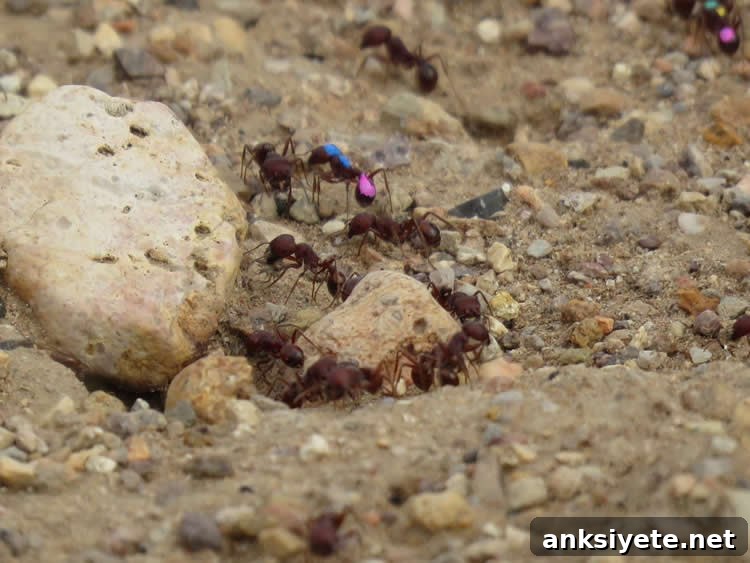
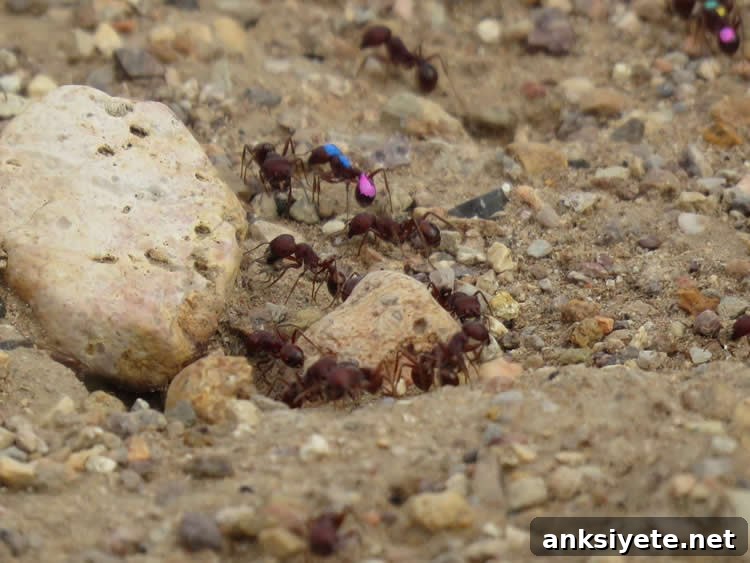
To test whether changing brain dopamine levels would alter foraging decisions in the field, the team ran controlled experiments on an additional nine colonies. Foragers were collected shortly after leaving the nest, gently cooled to slow their activity, and painted with color codes so researchers could track treatment groups. Some ants received a dopamine solution, while others were given a control solution; the ants were then returned to their colonies the same day.
The following day, the researchers observed clear behavioral effects: ants treated with dopamine embarked on more foraging trips compared with their control-treated nest-mates. Furthermore, colonies that were naturally more responsive to humidity—those that foraged more on muggier days and stayed home when conditions were drier—showed a stronger stimulatory response to exogenous dopamine.
To confirm that dopamine was responsible for the behavior change, the team repeated the field trials and included a third group treated with 3-iodo-tyrosine, a compound that inhibits dopamine synthesis. Ants treated with this inhibitor made fewer foraging trips, producing the opposite effect to dopamine administration. These results support a causal relationship: increasing dopamine in individual forager brains increased their likelihood of foraging, while blocking dopamine synthesis reduced foraging activity.
“The increases in forager brain dopamine seemed to increase individual ant foraging,” Friedman explains. “This supports the idea that behavioral differences among nest-mates may be linked to differences in brain dopamine levels. Individual risk-taking by foragers contributes to the colony’s collective decision-making, but there is much more to learn about how these mechanisms operate across environments and genetic backgrounds.”
The researchers also measured natural variation in brain biogenic amine content across colonies and found significant differences. Such neurophysiological variation may underlie colony-level sensitivity to humidity and reflect heritable molecular differences that natural selection can act upon to shape collective regulation of foraging.
Future work by Friedman’s team will examine molecules related to dopamine to determine whether the observed effects are specific to dopamine or involve broader neuromodulatory pathways. They also plan to study more colonies across diverse habitats to understand how environmental conditions interact with neurophysiology to influence foraging decisions.
“It’s particularly rewarding to test these predictions in the field rather than only in the laboratory,” Friedman adds. “Observing ants in their evolved habitat provides critical insight, even if it means long drives to Arizona and meticulous fieldwork.”
Funding: This research was supported by the Stanford Urbanek Family Graduate Fellowship, the Lewis & Clark Explorers Grant from the American Philosophical Association, the Theodore Roosevelt grant from the American Museum of Natural History, and a grant from the Stanford Neurosciences Institute.
Source and publisher: Erin Kohnke, Cell Press. Organized by NeuroscienceNews.com. Image credit: Becca Nelson.
Original research: “The Role of Dopamine in the Collective Regulation of Foraging in Harvester Ants” by Daniel A. Friedman, Anna Pilko, Dorota Skowronska-Krawczyk, Karolina Krasinska, Jacqueline W. Parker, Jay Hirsh, and Deborah M. Gordon. Published in iScience, September 27, 2018. DOI: 10.1016/j.isci.2018.09.001
The Role of Dopamine in the Collective Regulation of Foraging in Harvester Ants
Colonies of the red harvester ant (Pogonomyrmex barbatus) differ in how they adjust collective foraging activity in response to changes in humidity. The authors used transcriptomic, physiological, and pharmacological approaches to investigate the molecular basis of this ecologically important variation. RNA sequencing of forager brain tissue revealed associations between colony foraging activity and differential expression of transcripts related to biogenic amine and neurohormonal metabolism and signaling. Field experiments showed that pharmacological increases in forager brain dopamine caused significant increases in foraging activity, and colonies naturally most sensitive to humidity were more responsive to exogenous dopamine. Forager brain tissue varied among colonies in biogenic amine content, suggesting that neurophysiological variation among colonies, linked to individual sensitivity to humidity, may reflect heritable molecular differences that natural selection can shape to influence collective foraging regulation.
Feel free to share this article on the neuroscience of dopamine and ant foraging behavior. Cite the original research and credit the authors when using this summary.