
Summary: When university students watched short educational videos they found most appealing, their brain activity patterns were more alike. The results suggest that neuroscience measures can help content creators design more engaging instructional materials.
Source: SfN
The most engaging educational videos produce similar brain responses across learners, a new EEG study in young adults reports.
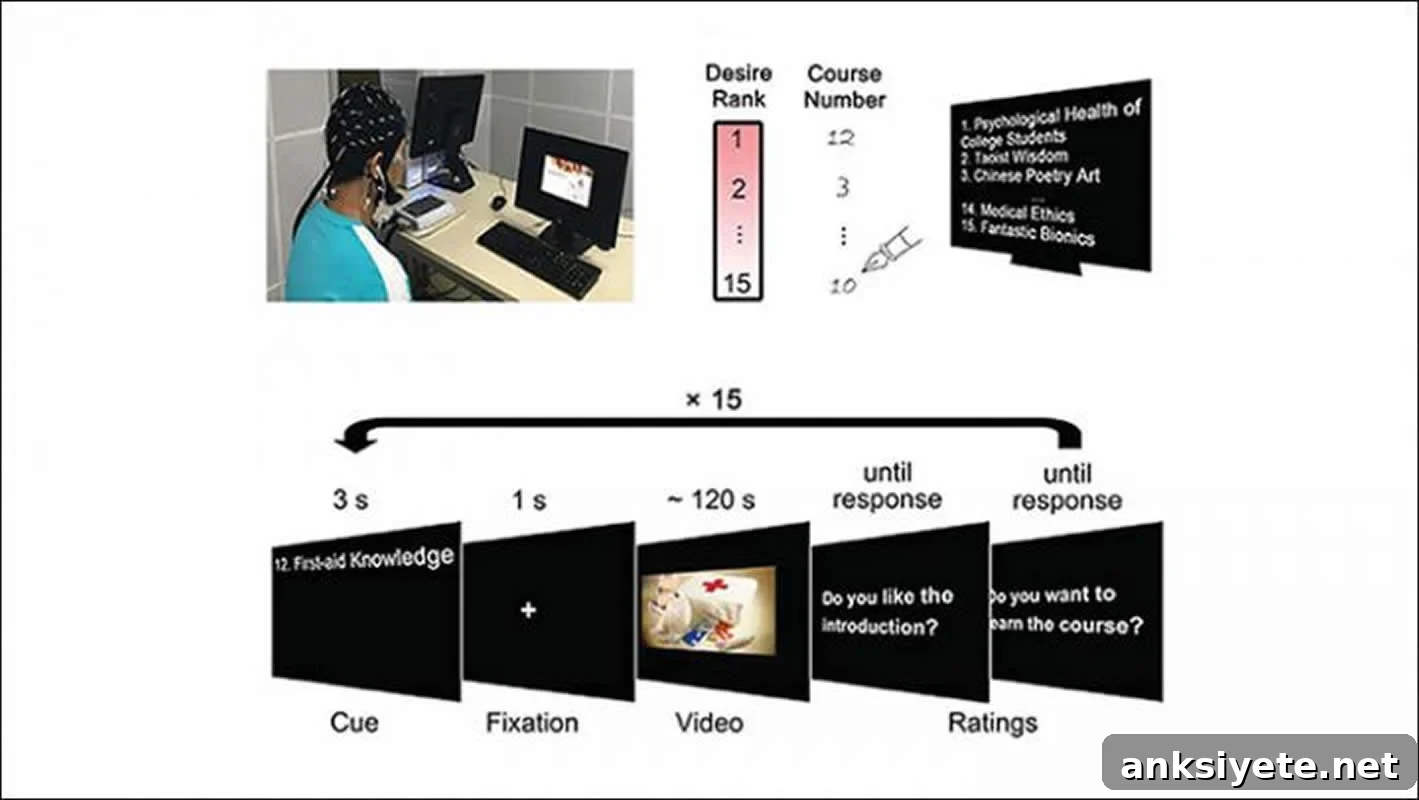
Researchers led by Yi Hu at East China Normal University examined how naturalistic online course clips engage learners’ brains and influence their desire to study a subject. University students viewed 15 two-minute introductory course videos while their neural activity was recorded with electroencephalography (EEG). After watching all clips, each student ranked the courses by how much they would like to learn the material and indicated whether their interest was driven by perceived value or by curiosity and interest.
The study found that the videos ranked highest for motivating learning produced the most similar brain activity across participants. Videos that received low motivation rankings showed much greater variability in neural responses. In other words, the clips that most students found appealing evoked convergent patterns of brain activity, while unpopular clips produced divergent neural signals.
Importantly, the researchers showed that this neural similarity was linked specifically to interest-driven motivation rather than value-driven reasons. Students chose high-ranked clips mainly because they found them interesting, not simply because they judged the course content useful. The association between neural synchrony and learning desire became robust after about 80 seconds of viewing, indicating that temporal accumulation of neural processing contributes to predicting motivational impact.
These findings add to previous research showing that persuasive speeches and effective public messages also elicit similar neural responses among listeners. Together, the results suggest that some audiovisual features reliably capture attention and align brain processing across people—a valuable insight for designers of online courses and educational media.
Source:
SfN (Society for Neuroscience)
Media Contacts:
Calli McMurray – SfN
Image Source:
Illustration credited to Zhu et al., eNeuro 2019.
Original Research: Closed access
“Learning Desire Is Predicted by Similar Neural Processing of Naturalistic Educational Materials.” Yi Zhu, Yafeng Pan, and Yi Hu. eNeuro. DOI: 10.1523/ENEURO.0083-19.2019
Abstract (concise)
The study investigated how short, naturalistic audiovisual course clips engage learners and drive learning desire. Fifteen two-minute clips were shown to university students while EEG recorded their brain responses. Researchers computed inter-subject correlation (ISC), a measure of neural similarity between each participant and others, and compared ISC values across clips ranked high, medium, or low in motivating potential. High-motivational clips produced larger ISC than low-motivational ones, and the ISC difference correlated with differences in reported learning desire. The neural similarity predicted interest-based motivation more strongly than value-based motivation, with reliable effects emerging after roughly 80 seconds of viewing.
Significance
This research demonstrates that naturalistic educational materials that effectively motivate learners produce more synchronized neural responses across viewers. The EEG-derived inter-subject correlation approach offers a promising neurophysiological tool to evaluate and refine audiovisual instructional content. By identifying features that reliably align attention and engagement across learners, educators and instructional designers can craft materials that are more likely to spark curiosity and encourage continued study.