
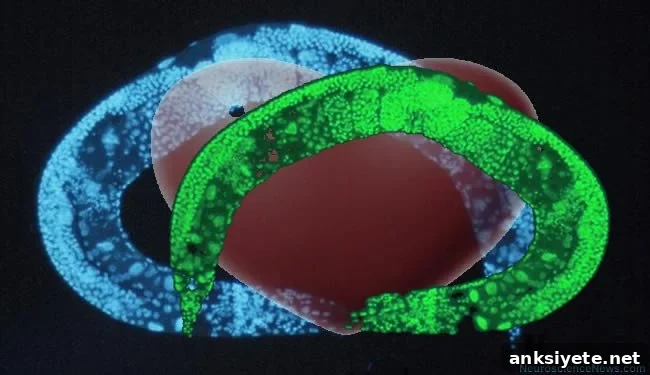
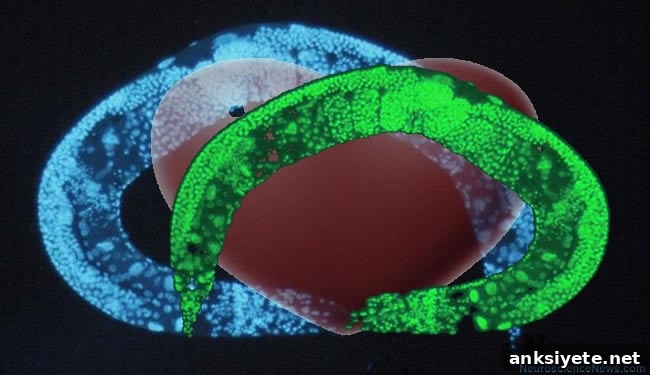
Researchers at Albert Einstein College of Medicine of Yeshiva University have mapped the complete wiring diagram for the section of the nervous system that controls mating in the male roundworm Caenorhabditis elegans, according to a study published today in Science.
This work marks a significant advance in connectomics — the scientific effort to map the full set of neural connections (the “connectome”) within a brain, brain region or entire nervous system. By identifying the specific circuits responsible for a defined behavior, connectomics aims to reveal how neural wiring generates complex actions and decisions. One long-term objective of the field is to contribute to an eventual map of the human connectome.
Because C. elegans is tiny (adult worms measure about one millimeter in length) and composed of only 959 cells, its nervous system is unusually compact. The worm’s 302 neurons make it an attractive model for researchers seeking fundamental principles of neural organization that may scale to larger, more complex brains.
The Einstein team reconstructed the male worm’s neural mating circuit by developing specialized software to analyze serial electron micrographs of the relevant region. Their analysis showed that male mating depends on 144 neurons — nearly half of the worm’s total neuronal complement — and characterized the connections between those 144 neurons and 64 muscles. The full circuit described in the study contains approximately 8,000 synapses, the junctions where neurons transmit electrical or chemical signals to other neurons or to muscles.
“Establishing the complete structure of the synaptic network governing mating behavior in the male roundworm has been highly revealing,” said Scott Emmons, Ph.D., the senior author of the paper and a professor in the department of genetics and the Dominick P. Purpura Department of Neuroscience at Albert Einstein College of Medicine. “The spatial organization and connectivity patterns we observed help explain how this network exerts neural control over the multi-step decision-making process involved in mating.”
Beyond mapping which cells connect to which, the researchers estimated connection strengths — often described as synaptic weights — providing the first accurate measurements of how strongly individual neurons and muscles communicate within this behavioral circuit. These quantitative estimates of synaptic strength add an important functional dimension to the anatomical map and make the connectome more useful for modeling and predicting circuit behavior.
The complete wiring diagram of this decision-making network provides a foundation for understanding how sensory inputs, motor outputs and internal states are integrated to produce a coordinated mating sequence. By revealing how neurons are arranged, which pathways are dominant, and where information flows within the circuit, the connectome enables researchers to generate and test hypotheses about the neural basis of each step in the behavior.
Results from this work contribute to a growing collection of connectomic datasets from model organisms and demonstrate methods that can be applied to other neural systems. The combination of high-resolution electron microscopy, rigorous image analysis, and custom software permitted a level of detail and quantitation that was previously difficult to achieve in more complex nervous systems.
Notes about this neural network and connectome research
This research received support from the Medical Research Council (U.K.); the National Institute of Mental Health (grant R21MH63223) and the Office of Behavioral and Social Sciences Research (OD010943), both components of the National Institutes of Health; and the G. Harold and Leila Y. Mathers Charitable Foundation.
Contact: Deirdre Branley – Albert Einstein College of Medicine
Source: Albert Einstein College of Medicine of Yeshiva University press release
Image source: C. elegans image was created using public domain material and is provided for reuse without restriction.
Original research: “The Connectome of a Decision-Making Neural Network” by Travis A. Jarrell, Yi Wang, Adam E. Bloniarz, Christopher A. Brittin, Meng Xu, J. Nichol Thomson, Donna G. Albertson, David H. Hall, and Scott W. Emmons; Science, 27 July 2012, Vol. 337 no. 6093, pp. 437–444, DOI: 10.1126/science.1221762.