
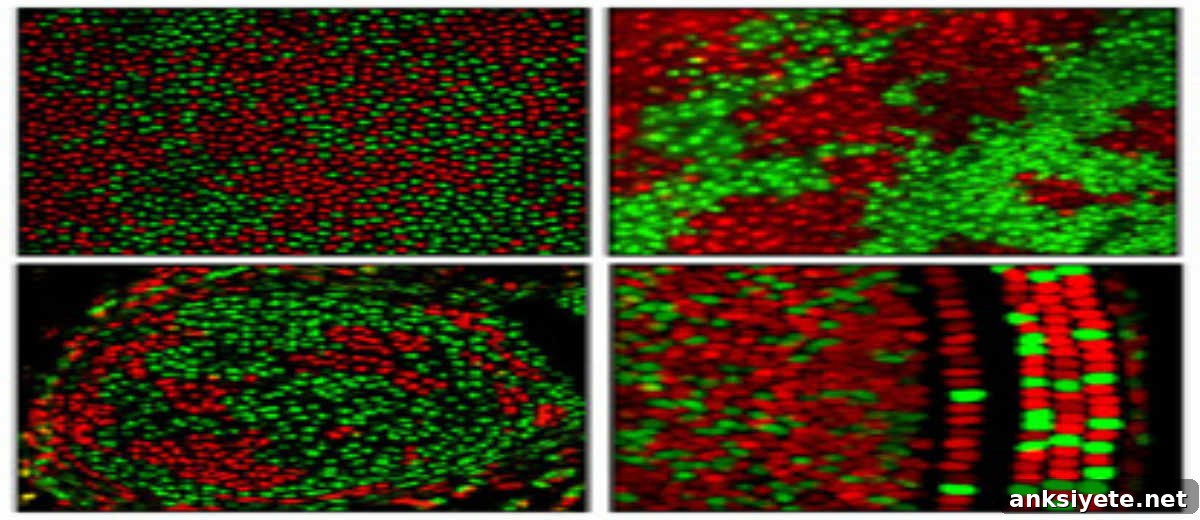
Johns Hopkins researchers have created brightly speckled red-and-green images of many tissues by color-coding cells in female mice to reveal which X chromosome is inactive in each cell.
X chromosome inactivation is a normal process in female mammals, who carry two X chromosomes in every cell. Early in embryonic development, when the embryo comprises only a few hundred to a few thousand cells, each cell randomly inactivates one of its two X chromosomes. As those cells divide, their descendants inherit the same inactive X, producing patches of cells that share the same active X chromosome. This process, known as X chromosome inactivation or XCI, can have important consequences when one X carries a normal gene and the other carries a mutated version.
To visualize this process across tissues, the Johns Hopkins team genetically tagged the two X chromosomes with genes encoding green or red fluorescent proteins. By breeding females that carried green fluorescent protein on both X chromosomes with males carrying red fluorescent protein on their single X chromosome, the researchers produced female offspring whose cells glow red or green depending on which parental X chromosome was silenced. The scientists also restricted color labeling to specific cell types in each mouse so that individual cells and distinct tissue patterns could be clearly resolved.
Published January 8 in the journal Neuron, the study maps X chromosome inactivation at cellular resolution and reports extensive variation in inactivation patterns: within a single tissue, between left and right sides of a centrally organized organ, among different tissue types, between paired organs, and among individual animals. These cellular-resolution maps reveal how tissue development and cellular behavior shape the mosaic pattern of active and inactive X chromosomes.
The structure of each tissue—how many founder cells give rise to it and how much movement those cells undergo during development—largely determines the pattern of XCI. Tissues derived from a small number of founder cells tend to display coarse patches of one color, whereas tissues with many founders and extensive cell mixing show a fine-grained intermingling of red and green cells. For example, blood cells mix extensively and display a finely interspersed mosaic, while skin tends to form larger uniform patches derived from single progenitors.
This color-coding approach has immediate applications for studying X-linked genetic variation, because the X chromosome carries many important genes. X-linked disorders—such as hemophilia and some forms of color blindness—affect males more severely because males have a single X chromosome and lack a second copy to compensate for a mutation. Females often act as carriers, usually unaffected because some cells express the healthy gene from the other X. However, carrier females can display tissue-specific disease manifestations when a significant local population of cells has inactivated the X carrying the healthy gene.
The Johns Hopkins team demonstrated this effect in carrier mice for Norrie disease, a disorder caused by mutations on the X chromosome that affect retinal blood vessel formation. In female carrier mice, areas where the X chromosome with the normal Norrie gene was silenced failed to support normal vessel development, whereas regions where the normal copy remained active showed proper vascular formation. This localized correspondence between XCI pattern and tissue phenotype illustrates how mosaicism can influence disease severity and even cause asymmetry between paired organs.
Beyond disease modeling, these cellular-resolution XCI maps offer a new tool for exploring how X chromosome inactivation contributes to neural development and brain asymmetry. The technique will help researchers investigate differences between the left and right sides of the female brain, sex-specific brain structure and function, and individual variation among females, including identical twins.
Notes about this neuroscience and neurogenetics research
Other authors of the report include Hao Wu, Junjie Luo, Huimin Yu, Amir Rattner, Alisa Mo, Yanshu Wang, Philip Smallwood, Bracha Erlanger and Sarah Wheelan of the Johns Hopkins University School of Medicine.
This work was supported by grants from the National Cancer Institute (P30 CA006973), the Human Frontier Science Program, the Howard Hughes Medical Institute and Johns Hopkins’ Brain Science Institute.
Contact: Catherine Kolf – Johns Hopkins Medicine
Source: Johns Hopkins Medicine press release
Image Source: The image is credited to Hao Wu / Neuron and adapted from the Johns Hopkins Medicine press release.
Original Research: Abstract for “Cellular Resolution Maps of X Chromosome Inactivation: Implications for Neural Development, Function, and Disease” by Hao Wu, Junjie Luo, Huimin Yu, Amir Rattner, Alisa Mo, Yanshu Wang, Philip M. Smallwood, Bracha Erlanger, Sarah J. Wheelan, and Jeremy Nathans in Neuron. Published online January 8, 2014. DOI: 10.1016/j.neuron.2013.10.051
Keywords: X chromosome inactivation, XCI, color-coded cells, genetic mosaicism, female mice, neurogenetics, retina, Norrie disease, Johns Hopkins, Neuron.