
Summary: A new computational method could help guide surgeons during brain operations by predicting organ deformation in real time.
Source: University of Luxembourg
A new simulation tool for brain surgeons
Researchers at the University of Luxembourg, in collaboration with the University of Strasbourg, have developed a computational approach intended to assist surgeons during brain surgery. The method produces fast, controllable simulations of how brain tissue deforms during an operation, offering actionable information about the current position of targets and vulnerable structures.
During neurosurgery, clinicians routinely work with limited visual access: only the brain surface is directly visible while internal structures remain hidden. Preoperative imaging such as MRI provides detailed maps before surgery, but once the procedure begins the brain shifts and deforms, causing planned targets and critical areas to move. Surgeons typically depend on experience and intraoperative judgement to navigate instruments and avoid damage to healthy tissue and key blood vessels. The new computational method aims to reduce that uncertainty by predicting tissue movement and updating estimates of where important anatomical features currently lie.
Professor Stéphane Bordas, Chair in Computational Mechanics at the Faculty of Science, Technology and Communication of the University of Luxembourg, leads the team that created the approach. Their work focuses on mathematical models and numerical algorithms that can simulate soft tissue deformation quickly enough to be useful during surgery, while also providing a reliable estimate of the simulation error. That combination allows practitioners to rehearse procedures virtually and to concentrate computational resources on regions where precision is most critical.
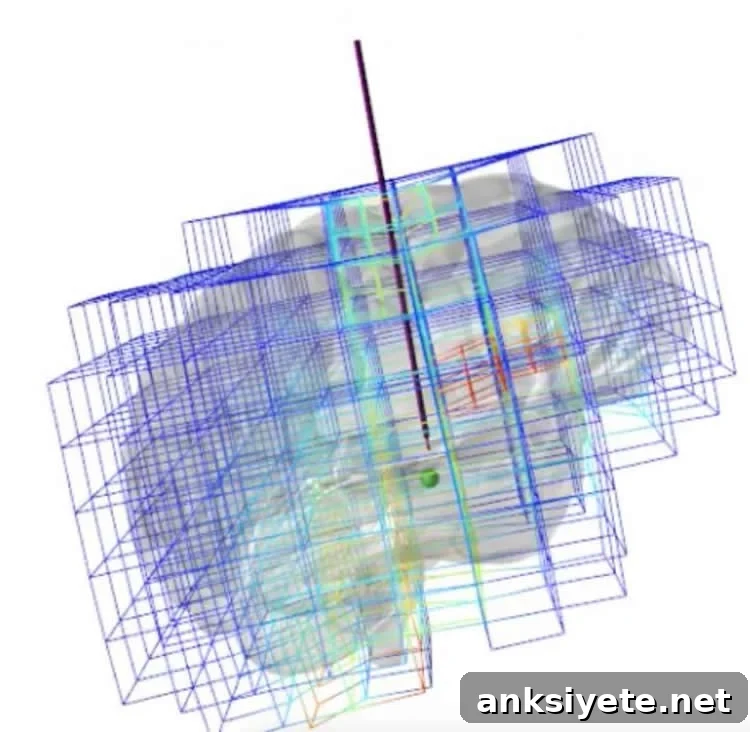
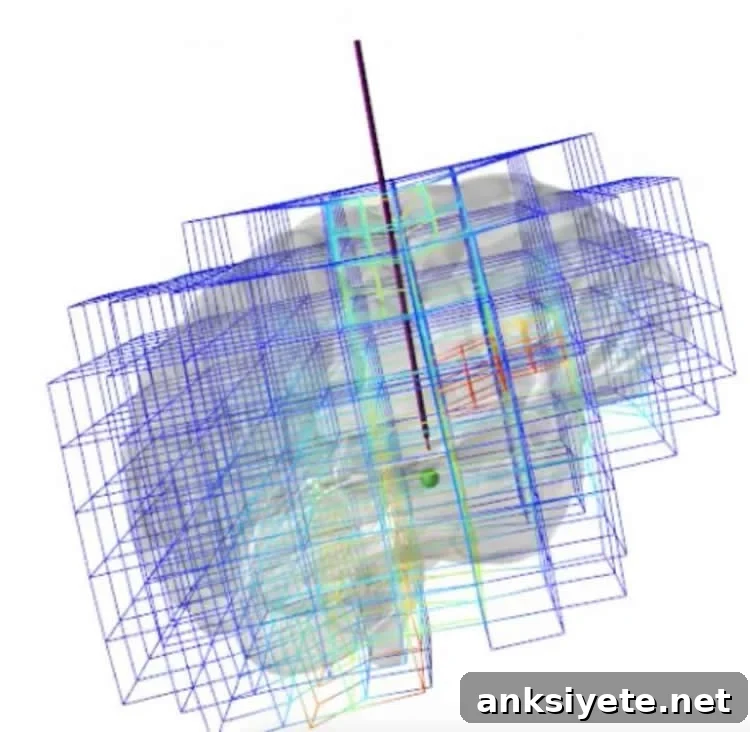
The team models the brain as a composite material composed of grey matter, white matter and interstitial fluid. Using medical imaging data, they partition the organ into many small subvolumes—conceptually similar to coloured lego blocks—each block representing one material type. The resulting colour-coded “digital lego brain” consists of thousands of interacting blocks whose combined motion and deformation are computed under surgical manipulations. Increasing the number of blocks yields higher fidelity but also increases computational cost, so selecting the appropriate resolution is a practical trade-off between accuracy and speed.
A central advance of Prof. Bordas’s method is that it provides a way to control both the simulation accuracy and the required computation time. Their approach estimates the minimum block size (mesh resolution) needed to guarantee a requested level of accuracy. For example, the method can indicate that a 1 mm block size is sufficient to keep errors within a 10% tolerance, while a 5 mm block size may be acceptable if a 20% error range is tolerable. This error-aware adaptive strategy allows users to limit calculations to the regions that demand higher precision, saving time and computing resources.
The researchers’ long-term objective is to provide a real-time solution that can run during actual operations, continuously updating the simulation from intraoperative data and guiding surgical decisions. Prof. Bordas notes that further work is needed before such a system becomes clinically available: robust methods to estimate the mechanical properties of each brain subvolume must be established, and a surgeon-friendly software platform needs to be developed and tested in practice.
Source: Thomas Klein, University of Luxembourg
Image credit: Legato Team, University of Luxembourg
Original research: “Real-time Error Control for Surgical Simulation” by Huu Phuoc Bui, Satyendra Tomar, Hadrien Courtecuisse, Stephane Cotin, and Stephane Bordas. IEEE Transactions on Biomedical Engineering. Published online May 23, 2017. DOI: 10.1109/TBME.2017.2695587
MLA: University of Luxembourg. “Modeling the Brain With ‘Lego Bricks.’” NeuroscienceNews, 15 June 2017.
APA: University of Luxembourg (2017, June 15). Modeling the Brain With ‘Lego Bricks.’ NeuroscienceNews. Retrieved June 15, 2017.
Chicago: University of Luxembourg. “Modeling the Brain With ‘Lego Bricks.’” (accessed June 15, 2017).
Abstract
Real-time Error Control for Surgical Simulation
Objective: This work introduces a real-time, a posteriori error-driven adaptive finite element framework for surgical simulation and demonstrates the method on needle insertion problems. Methods: The approach couples corotational elasticity with a frictional needle–tissue interaction model and is implemented using finite element methods. The adaptive refinement is hexahedron-based and driven by a posteriori error estimates that trigger local h-refinement to simulate soft tissue deformation efficiently.
Results: The method provides control over local and global numerical errors in mechanical fields such as displacement and stress throughout the simulation. The algorithm’s convergence is demonstrated on academic test cases, and its practical applicability is shown in a percutaneous needle insertion scenario involving a liver model. For this case, force–displacement curves from the adaptive algorithm are compared with those obtained using uniform mesh refinement, highlighting efficiency gains.
Conclusions: Error control ensures that simulation errors remain within prescribed tolerances and that local mesh refinement can accelerate computations. Significance: This work is a first step toward separating discretization error from modeling error by providing robust quantification of discretization error during real-time simulations, an important capability for surgical planning, training, and intraoperative guidance.