
Newly identified color-vision circuitry in mice offers insight into why the night sky can appear bluish in low light.
Discovery connects mouse retinal circuits to the “blue” of twilight
For more than a century biologists have puzzled over a simple but striking observation: under very dim light the sky often appears to take on a bluish cast. Researchers at Caltech report a newly discovered retinal circuit in mice that helps explain how interacting photoreceptors and retinal neurons can produce a blue shift in low light. The study, led by Markus Meister, Anne P. and Benjamin F. Biaggini Professor of Biological Sciences, appears in the print edition of Nature.
Rods, cones, and the neural pathway for vision
In mammals, light is detected by two classes of photoreceptors: rods and cones. Rods are extremely sensitive and dominate vision in dim conditions, while cones operate in brighter light and support color perception. Photoreceptors relay signals to retinal ganglion cells (RGCs), which encode visual information and transmit it to the brain via the optic nerve.
Classic descriptions teach that rods produce monochrome (black-and-white) vision at night and that color requires cones. Humans have three cone types—roughly red-, green-, and blue-sensitive—so the brain interprets color by comparing their relative activity. Mice have a simpler cone system with two types: medium-wavelength (green) cones and short-wavelength ultraviolet (UV) cones.
How mice compare colors with spatially separated cones
An unusual feature of the mouse retina is that the two cone types are distributed unevenly: UV-sensitive cones dominate the part of the retina that views the upper visual field, while green-sensitive cones dominate the part that views the lower field. That raises a question: how can a mouse detect color when a specific retinal region receives input from only one cone type and therefore cannot compare cone signals locally?
Meister’s team identified a specialized retinal ganglion cell, called the JAMB retinal ganglion cell (J-RGC), that provides a solution. J-RGCs show color-opponent responses: they increase firing to green light and decrease or stop firing to ultraviolet light. Remarkably, these green-ON responses arise even in retinal regions without local green cones, indicating that another photoreceptor contributes.
Rod–cone opponency: a key antagonistic circuit
Further experiments revealed the mechanism: rods, which are sensitive in the green portion of the spectrum, drive horizontal cells that in turn inhibit UV cones. In this circuit the rod-driven signal is antagonistic to the cone signal rather than simply blending with it. This rod–cone opponency produces a color-opponent channel—ON to green (driven by rods) and OFF to UV (driven by cones)—that remains active across a range of light intensities.
Ecological relevance: finding food and social cues
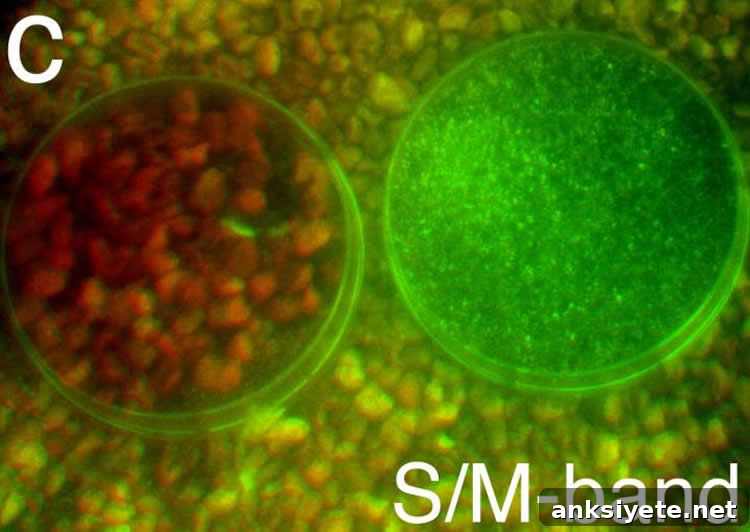
To test whether this circuit could help mice in nature, the researchers built a camera system filtered to mimic the spectral sensitivities of mouse rods and cones and photographed materials a mouse would encounter. Seeds and mouse urine stood out more clearly under the rod–cone/UV representation than they do to human color vision. The authors suggest that this spectral channel could help mice locate food and detect urine marks used in social and territorial communication.
Implications for human twilight perception
Meister and colleagues note that the same basic circuit elements—rods, horizontal cells, and multiple cone types—exist in the human retina. In humans the horizontal cell circuitry preferentially inhibits red and green cones while leaving blue cones relatively less suppressed. In very dim light, cones produce only a low-level baseline signal that is independent of stimulus photons, while rods remain active. Rod-driven inhibition of red and green cone baseline signals can make the remaining blue-cone baseline appear relatively stronger, producing a perceived blue shift across the visual field in twilight or very low light.
In other words, the perceptual “blueness” of the night sky can reflect how rod and cone signals interact through retinal circuits rather than being solely an atmospheric or artistic choice. This neural explanation aligns with longstanding observations and helps bridge human perception and retinal physiology.
The work was published under the title “A neuronal circuit for color vision based on rod–cone opponency.” Funding was provided by the National Institutes of Health and the International Human Frontier Science Program Organization. Reporting and summary by Deborah Williams-Hedges, Caltech. Image credit: M. Meister Laboratory / Caltech. Original research by Maximilian Joesch and Markus Meister, published in Nature (online April 6, 2016; print April 14, 2016).
Abstract
A neuronal circuit for colour vision based on rod–cone opponency
In bright light, cones enable colour vision by comparing signals from different cone types. In dim light, rods dominate but are thought not to support colour discrimination because they share a common visual pigment. Contrary to that expectation, this study identifies a genetically defined mouse retinal ganglion cell (J-RGC) that responds ON to green and OFF to ultraviolet light. The ON input originates in rods while the OFF input comes from cones. Both rods and cones contribute across a wide intensity range, and the rod signal antagonizes the cone signal via horizontal-cell mediated inhibition of UV cones. This ultraviolet–green channel may aid behaviours such as foraging and social communication in rodents. Equivalent circuit components exist in the human retina, and this mechanism can account for colour experiences in dim light, including the twilight blue shift. The genetically identified pathway paves the way for targeted studies of colour processing in the brain.