
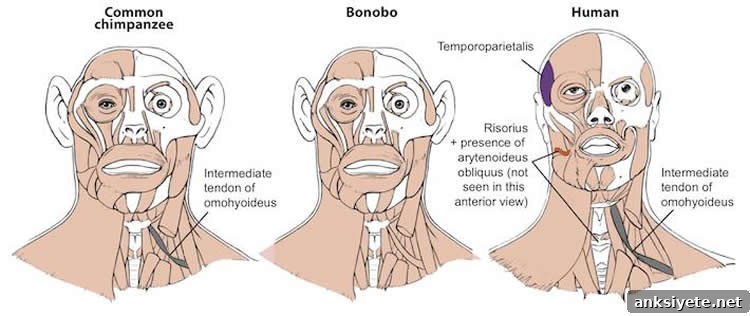
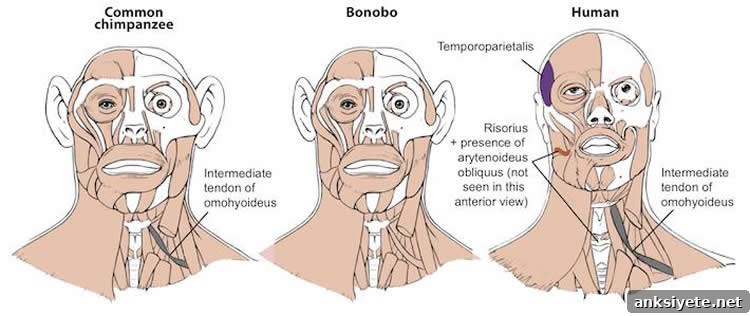
Summary: A new anatomical study indicates that bonobos may retain muscle features closer to those of the last common ancestor shared with humans than do common chimpanzees.
Source: George Washington University.
Study compares bonobo, common chimpanzee and human musculoskeletal anatomy and finds bonobos show fewer changes from the ancestral condition.
Researchers have completed the first detailed anatomical comparison of head, neck, forelimb and hindlimb muscles across humans, common chimpanzees and bonobos. The results show that, among the living great apes, bonobo muscular anatomy has changed least since the human–chimpanzee split. That relative stability suggests bonobos may be the best available living model for aspects of the last common ancestor shared by chimpanzees and humans.
Bernard Wood, professor of human origins at the GW Center for the Advanced Study of Human Paleobiology, summarized the finding: “Bonobo muscles have changed least, which means they are the closest we can get to having a ‘living’ ancestor.” This anatomical evidence builds on earlier genetic studies that hinted at a closer relationship between humans and bonobos in some respects, but this is the first study to extend that comparison to detailed musculoskeletal structures.
Current estimates place the split between the lineage leading to modern humans and the lineage leading to chimpanzees and bonobos at about eight million years ago, while the divergence between common chimpanzees and bonobos occurred later, roughly two million years ago. After that split, the two ape species evolved distinct traits despite remaining geographically near each other with the Congo River as the primary barrier. By dissecting and documenting the muscles of bonobos, researchers were able to examine how those animals function biomechanically and how their anatomy compares with both humans and common chimpanzees.
The team examined seven bonobos from the Antwerp Zoo that had died and were being preserved. Because bonobos are endangered and rarely available for comprehensive anatomical study, the opportunity to perform full dissections on multiple individuals provided valuable, otherwise unavailable data. The researchers documented more than 120 muscles in the head, neck and forelimb regions and analyzed presence/absence and structural details across the three species.
Lead author Rui Diogo, associate professor of anatomy at Howard University, emphasized the mosaic nature of the evolutionary changes: “Our study has shown that there is mosaic evolution among the three species: some anatomical features are shared by humans and bonobos, others by humans and common chimpanzees, and others by the two ape species. This mosaic pattern echoes genetic findings that each chimpanzee species shares some genetic traits with humans that are absent from the other.”
Specifically, among the head–neck and forelimb muscles examined, the chimpanzee clade overall has experienced remarkably few changes since the split from the human lineage. Where changes did occur in chimpanzees, they were minor and represented reversions to ancestral conditions. Since the common chimpanzee–bonobo split, bonobos showed no detectable changes in these muscle groups, reinforcing their value as an anatomical reference for the last common ancestor of chimpanzees, bonobos and humans. The hindlimb anatomy also showed only two presence/absence differences between common chimpanzees and bonobos.
Beyond evolutionary reconstruction, the authors note that clarifying which features are unique to humans and which are retained in our closest relatives can improve our understanding of human biology and health. Comparative anatomy informs functional hypotheses about movement, feeding, speech-related musculature and other systems that have relevance to medical and biological research.
Source: Emily Grebenstein, George Washington University
Image credit: Julia Molnar
Original research: Rui Diogo, Julia L. Molnar & Bernard Wood, “Bonobo anatomy reveals stasis and mosaicism in chimpanzee evolution, and supports bonobos as the most appropriate extant model for the common ancestor of chimpanzees and humans,” Scientific Reports. Published online April 4, 2017. doi:10.1038/s41598-017-00548-3
The study presents the first phylogenetic analysis incorporating detailed musculoskeletal data obtained from recent bonobo dissections. Among more than 120 head–neck and forelimb muscles, chimpanzees—and especially bonobos—exhibit remarkable evolutionary stasis since the human–chimpanzee split approximately eight million years ago: only four minor changes are recorded in the chimpanzee clade, all reversions to ancestral states. No changes were observed in bonobos since their divergence from common chimpanzees about two million years ago, making bonobos a more appropriate extant model for the musculoskeletal anatomy of the last common ancestor of chimpanzees, bonobos and humans. Hindlimb comparisons revealed only two muscle presence/absence differences between common chimpanzees and bonobos. The results reveal a pattern of evolutionary mosaicism between each of these species and humans and are discussed alongside available genomic evidence and hypotheses about developmental timing (heterochrony).
Feel free to share this summary and the accompanying image credit as appropriate for educational and informational purposes.