
Summary: A new study reveals the first complete neural blueprint explaining how fruit flies (Drosophila melanogaster) execute ultra-fast escape behaviors. By mining a high-resolution electron microscopy connectome of the fly’s ventral nerve cord—the insect equivalent of a spinal cord—researchers mapped all 1,314 descending neurons and identified rare axo-axonic synapses that modulate and synchronize motor commands for split-second escapes.
The team found that axo-axonic connections—specialized synapses where one axon directly contacts another axon—act as powerful, selective modulators that can amplify, suppress, or synchronize action potentials before signals reach muscles. These sparse but effective connections provide a decentralized and resilient wiring logic for rapid decision-making and motor control.
Key Facts
- Mapping the ventral nerve cord: The study analyzed all 1,314 descending neurons that carry commands from the brain to the body, identifying every axo-axonic input in the adult male Drosophila ventral nerve cord.
- Axo-axonic synapse function: Unlike typical synapses, axo-axonic contacts allow one neuron’s axon to influence another axon directly, enabling immediate modulation of outgoing motor signals.
- Exceptional selectivity: Axo-axonic connections are rare, forming in roughly 1% of all possible descending neuron pairings, yet they shape network-wide communication efficiently.
- Decentralized broker network: The motor control network lacks a concentrated “rich-club” of hub neurons; instead, control is distributed across many interconnected “broker” neurons, improving robustness and flexibility.
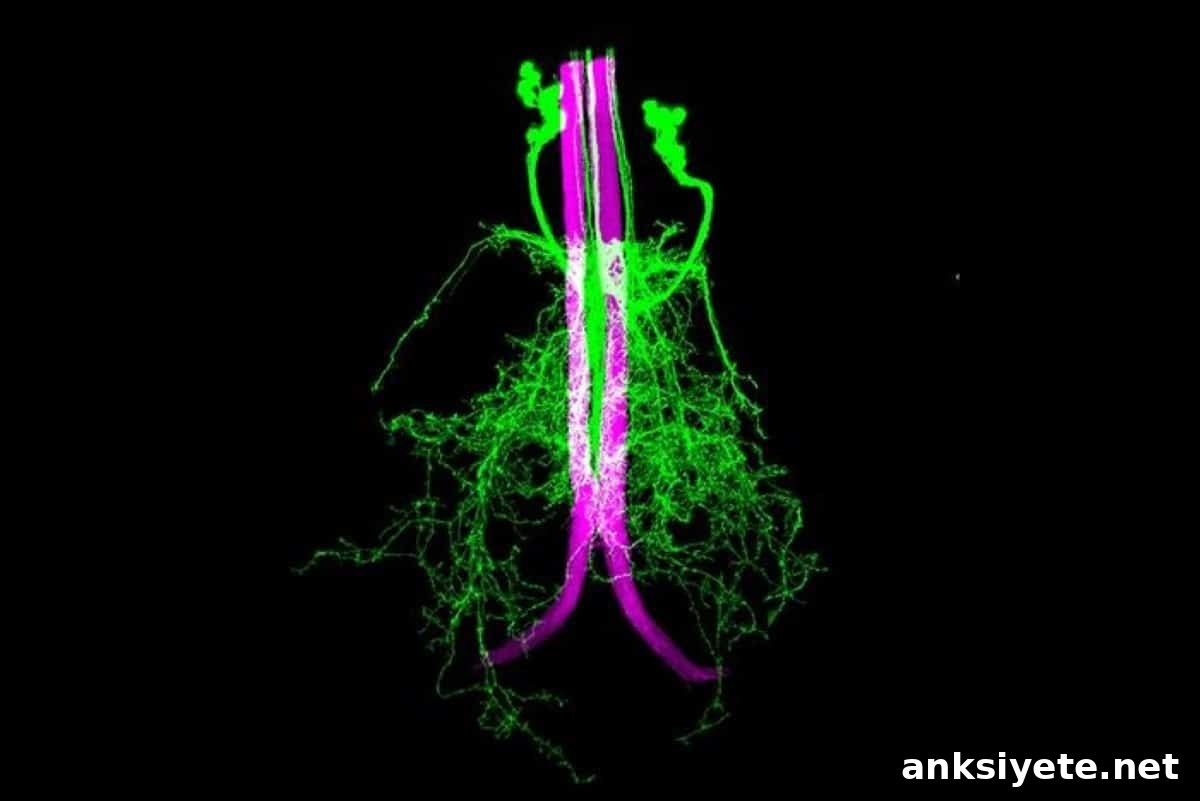
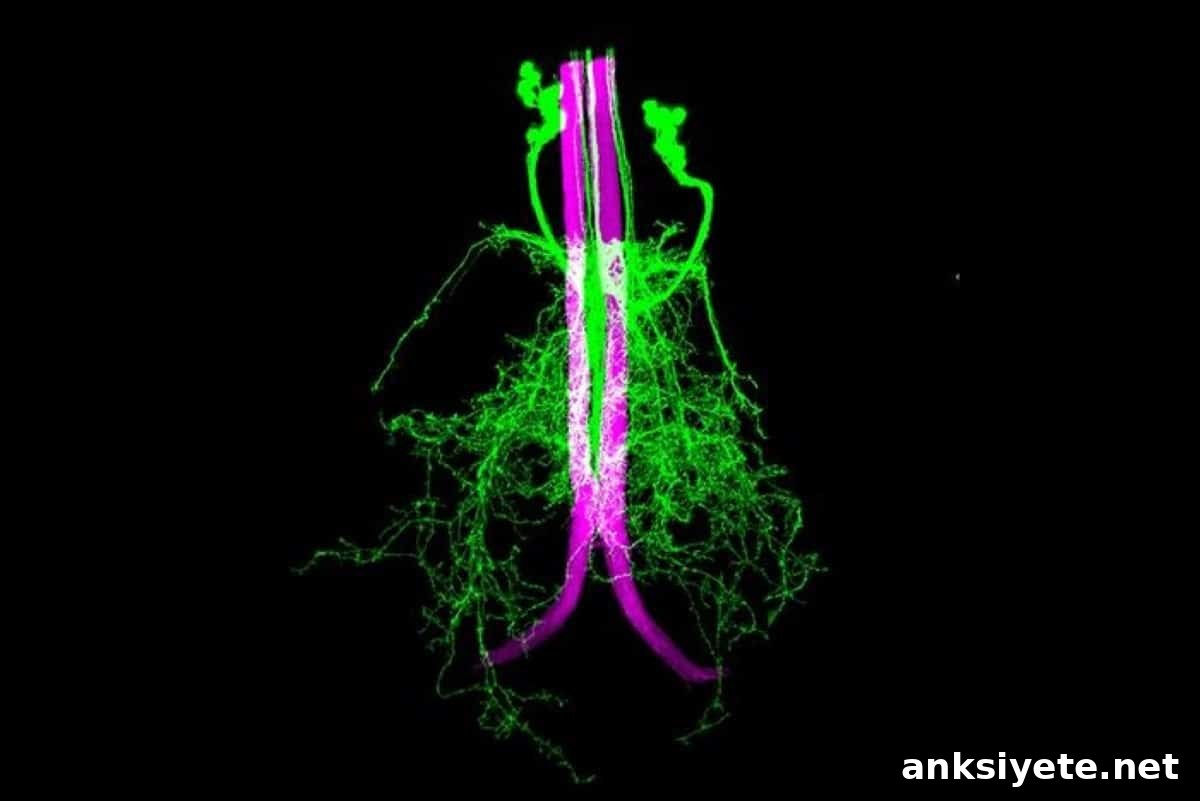
- Amplifying giant fibers: A small cohort of ascending neurons makes axo-axonic contacts onto giant fibers—major escape-command neurons—raising the excitability of those circuits and increasing the chance of a rapid escape.
Source: FAU
Have you ever wondered how a fly evades a swat so quickly? Flies rely on extremely rapid reflexes to avoid threats, but the synapse-level wiring that enables these split-second reactions has been only partially understood. This new Florida Atlantic University study provides the first comprehensive wiring diagram linking specific axo-axonic synapses to the fly’s escape behavior.
Using one of the most detailed neural maps ever assembled, the researchers examined a complete electron microscopy connectome to chart every axo-axonic input onto descending neurons. Their approach combined connectomic reconstruction with computational modeling, network analysis, immunostaining, and live optogenetic experiments to test how axo-axonic contacts influence rapid motor responses.
The analysis revealed that neurons with many partners integrate into motor circuitry without forming an interconnected cluster of dominant hubs. Instead, the network shows a distributed architecture: numerous broker neurons share control, allowing quick signal propagation across the motor system in only a few synaptic steps. This distributed design reduces vulnerability to single-point failures and supports flexible coordination between reflexive and whole-body movements.
Crucially, the team identified an octet of ascending neurons whose axo-axonic input to giant fibers predicted modulation of the escape circuit. Immunostaining confirmed these ascending neurons are cholinergic, and optogenetic activation demonstrated they increase giant fiber excitability, validating predictions derived from the connectome.
Although axo-axonic synapses are difficult to study in large mammalian brains, their presence in Drosophila and the principles uncovered here suggest a conserved strategy for fast motor control across species. These findings provide constraints for models of rapid decision-making and could inform how neuroscientists think about reflex circuits in both invertebrates and vertebrates.
“Our findings reveal a previously hidden wiring logic for how nervous systems achieve rapid and reliable motor control,” said Rodrigo Pena, Ph.D., senior author and assistant professor of biological sciences at Florida Atlantic University. The work offers a new framework to understand how sparse, targeted connections can exert outsized influence on behavior.
Key Questions Answered:
A: Flies use a specialized ultra-fast bypass in their wiring. Axo-axonic synapses let axons influence other axons directly just before motor signals reach muscles, eliminating intermediate steps and allowing signals to flood the motor system almost instantly.
A: Distributing control across many interconnected broker neurons prevents the system from failing if a single neuron is lost. This architecture increases flexibility and resilience while still enabling rapid coordination.
A: Yes. Axo-axonic connections exist in mammals but are harder to map. The efficient wiring principles observed in Drosophila may represent a conserved evolutionary strategy useful for modeling rapid human decisions and survival behaviors.
Editorial Notes:
- This article was edited by a Neuroscience News editor.
- Journal paper reviewed in full.
- Additional context added by staff.
About this neuroscience research news
Author: Gisele Galoustian
Source: FAU
Contact: Gisele Galoustian – FAU
Image: Credit to Casey Spencer, Ph.D., Florida Atlantic University
Original Research: Open access. “The Drosophila connectome reveals axo-axonic synapses on descending neurons” by César Ceballos, Juan Lopez, Ty Roachford, Daniel Sanchez, Sabrina Jara, Kelli Robbins, Casey L. Spencer, Rodney Murphey, and Rodrigo F.O. Pena. iScience. DOI: 10.1016/j.isci.2026.115624
Abstract
The Drosophila connectome reveals axo-axonic synapses on descending neurons
Axo-axonic synapses can veto, amplify, or synchronize spikes, but their circuit-scale logic has been unclear. Using the complete electron microscopy connectome of the adult male Drosophila, the authors mapped every axo-axonic input onto the 1,314 descending neurons that transmit brain commands to the ventral nerve cord. By definition, any synapse onto a descending neuron within the cord is axo-axonic, which allowed the team to chart ascending-descending and interneuron-descending relationships. High-degree neurons integrate broadly without forming a clustered rich-club of hubs. The authors identified an octet of ascending neurons whose axo-axonic input to giant fibers predicted escape-circuit modulation; immunostaining confirmed their cholinergic identity, and optogenetic activation increased giant fiber excitability, validating connectome-derived rules. This work provides a comprehensive map of axo-axonic wiring in a complete ventral nerve cord connectome and offers constraints for models of fast motor control.