
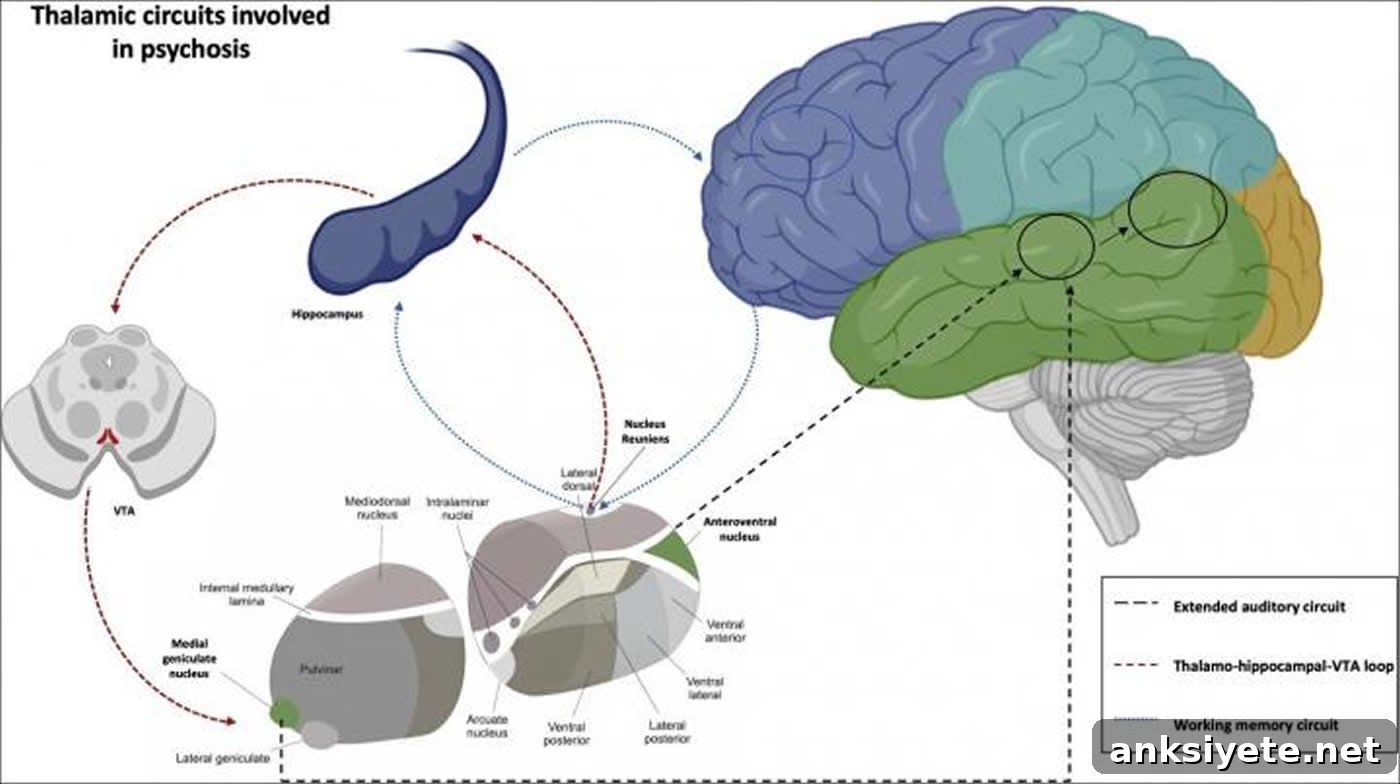
Summary: Auditory hallucinations—hearing voices or sounds without external input—may arise from altered development and increased connectivity between sensory thalamic nuclei and language-processing areas of the brain.
Source: Elsevier
Auditory hallucinations, a hallmark of psychosis and schizophrenia, occur when people perceive voices or sounds that are not present in the environment. New research suggests these experiences can result from atypical development and abnormal connectivity between sensory thalamic nuclei and cortical language regions.
The study, led by Stephan Eliez, MD, PhD, at Geneva University in Switzerland, is published in Biological Psychiatry: Cognitive Neuroscience and Neuroimaging.
“Our results demonstrate aberrant development of the thalamic nuclei involved in sensory processing and an immature pattern of thalamo-cortical connectivity with the brain’s auditory regions,” said lead author Valentina Mancini, MD.
Using magnetic resonance imaging (MRI), researchers analyzed brain structure and connectivity in 120 individuals with 22q11.2 deletion syndrome (22q11.2 DS) and 110 healthy control subjects. People with 22q11.2 DS have a substantially increased risk of developing schizophrenia and are more likely than the general population to experience sensory hallucinations. The study included serial imaging every three years for participants aged 8 to 35, with each person receiving between one and four scans, enabling the team to track developmental trajectories over time.
Prior work has implicated the thalamus—the brain’s sensory gateway—in schizophrenia and hallucinations. This study went further by examining specific thalamic subnuclei and how their volumes and connectivity to cortical regions differ in 22q11.2 DS participants both with and without auditory hallucinations (AH), compared with controls.
Although overall thalamic volume and gross developmental trends did not differ between groups, the researchers identified notable differences in particular thalamic nuclei. The medial and lateral geniculate nuclei (MGN and LGN), which relay auditory and visual information, were smaller in individuals with 22q11.2 DS. Conversely, nuclei that project to the frontal cortex—regions associated with higher cognitive functions—were enlarged in the 22q11.2 DS group. Other thalamic nuclei also showed divergent developmental patterns between groups.
When comparing 22q11.2 DS participants with and without auditory hallucinations, those reporting AH had a smaller medial geniculate nucleus and a distinct developmental trajectory characterized by a steeper volume decrease beginning in childhood.
Functional connectivity analyses revealed that participants with auditory hallucinations showed stronger connectivity between the medial geniculate nucleus and both the primary auditory cortex and language-processing regions such as Wernicke’s area. The authors propose that this hyperconnectivity could cause spontaneous activation of auditory and language areas at rest, producing the subjective experience of hearing voices.
“These findings provide a mechanistic explanation for the high frequency of hallucinatory phenomena in young people at risk for psychosis due to 22q11.2 deletion syndrome,” Dr. Mancini noted. She emphasized that studying how the thalamus and cortex interact during development may reveal intervention targets to prevent the emergence of psychotic symptoms in genetically at-risk individuals or those identified as clinically ultra-high risk.
Cameron Carter, MD, Editor of Biological Psychiatry: Cognitive Neuroscience and Neuroimaging, commented: “This study of individuals with 22q11 offers a unique window into brain developmental changes that underlie psychotic symptoms and related cognitive and developmental challenges in these young people.”
About this neuroscience research article
Source:
Elsevier
Media Contact:
Rhiannon Bugno – Elsevier
Image Credit:
Elsevier, 2020.
Original Research: Open access
“Abnormal development and dysconnectivity of distinct thalamic nuclei in patients with 22q11.2 deletion syndrome experiencing auditory hallucinations,” by Valentina Mancini, Daniela Zöller, Maude Schneider, Marie Schaer, and Stephan Eliez. Biological Psychiatry: Cognitive Neuroscience and Neuroimaging.
doi: 10.1016/j.bpsc.2020.04.015
Abstract
Abnormal development and dysconnectivity of distinct thalamic nuclei in patients with 22q11.2 deletion syndrome experiencing auditory hallucinations
Background
Previous studies in schizophrenia have identified abnormal thalamic volumes and disrupted thalamocortical connectivity. Hyperconnectivity with sensory areas has been linked to auditory hallucinations (AH). The 22q11.2 deletion syndrome is a neurogenetic condition that confers elevated risk for schizophrenia and a higher incidence of hallucinations compared with the general population.
Methods
The investigators analyzed 442 MRI scans collected from 120 individuals with 22q11.2 deletion syndrome and 110 controls at three-year intervals (age range 8–35 years). Thalamic subnuclei volumes were measured using FreeSurfer and compared across groups and between 22q11.2 DS participants with and without AH. In a subgroup of 76 22q11.2 DS participants, the study also examined functional connectivity between thalamic nuclei implicated in AH and cortical regions.
Results
Compared with controls, 22q11.2 DS participants had reduced volumes in nuclei involved in sensory processing and increased volumes in nuclei linked with cognitive functions. Those with AH had a smaller medial geniculate nucleus and showed a steeper developmental volume decline beginning in childhood versus those without AH. Aberrant development was also observed in nuclei that connect prefrontal cortex and hippocampus (anteroventral and medioventral reuniens nuclei). Functional data showed hyperconnectivity between the medial geniculate and anteroventral nuclei with the auditory cortex and Wernicke’s area.
Conclusions
Increased connectivity between specific thalamic nuclei and temporal language regions may reflect immature thalamocortical development and contribute to auditory hallucinations. Overall, the findings point to disrupted thalamic maturation and atypical connectivity with auditory and language areas as mechanisms linked to AH in 22q11.2 deletion syndrome.