
Innovative technique restores some hand and arm function for people with cervical spinal cord injuries
A pioneering nerve-transfer surgical technique at Washington University School of Medicine in St. Louis has restored partial hand and arm movement to patients left immobilized by neck-level spinal cord injuries, according to a new clinical report. By rerouting healthy peripheral nerves above the site of injury to replace damaged connections, surgeons create a new path for the brain to communicate with paralyzed muscles, enabling patients to regain practical, independence-supporting abilities such as feeding themselves, writing and performing basic personal-care tasks.
In the study, surgeons performed nerve-transfer procedures on nine patients with cervical spinal cord injuries that caused quadriplegia. Every participant reported measurable improvement in hand and arm function after surgery and subsequent rehabilitation.
The research appears in the October issue of Plastic and Reconstructive Surgery, the journal of the American Society of Plastic Surgeons, and summarizes preliminary outcomes of nerve-transfer operations tailored for people with injuries at the lower cervical levels (typically C6–C7).
“Although the physical gains from nerve-transfer surgery can be incremental, the psychological and practical impact is huge,” said lead author Ida K. Fox, MD, assistant professor of plastic and reconstructive surgery. “One patient, who could not move his fingers before surgery, told me he was able to pick a noodle off his chest — a small act that meant a great deal because he could do it without assistance.”
The spinal cord contains soft nerve bundles that serve as the body’s primary communication highway between the brain and muscles. When the injury occurs in the cervical region of the neck, voluntary control of the upper extremities can be severely impaired. More than half of the approximately 250,000 people in the United States living with spinal cord injuries have damage that involves the neck, and restoring even limited function can substantially improve quality of life.
One of the most distressing consequences of spinal cord injury is loss of autonomous bladder and bowel control. “Patients often cannot sense or control the need to urinate or have a bowel movement because the brain cannot communicate with the lower-body nerves,” Fox said. They frequently rely on caregivers for catheterization or bowel care. After nerve-transfer surgery, however, one patient regained the ability to catheterize himself independently after more than a decade, restoring privacy and dignity.
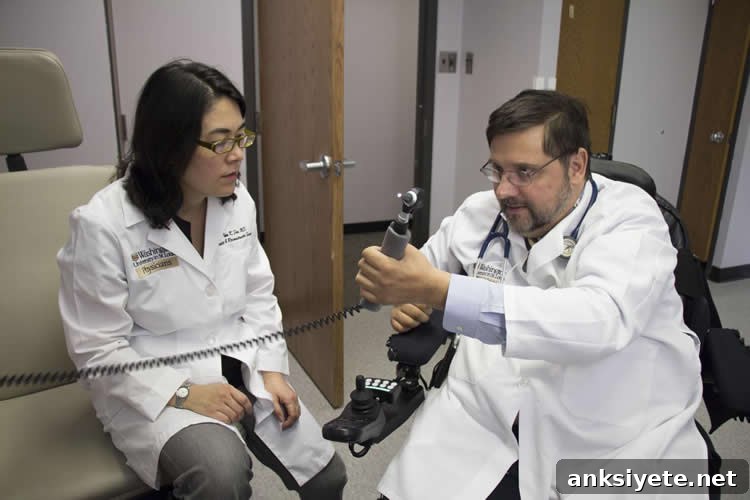
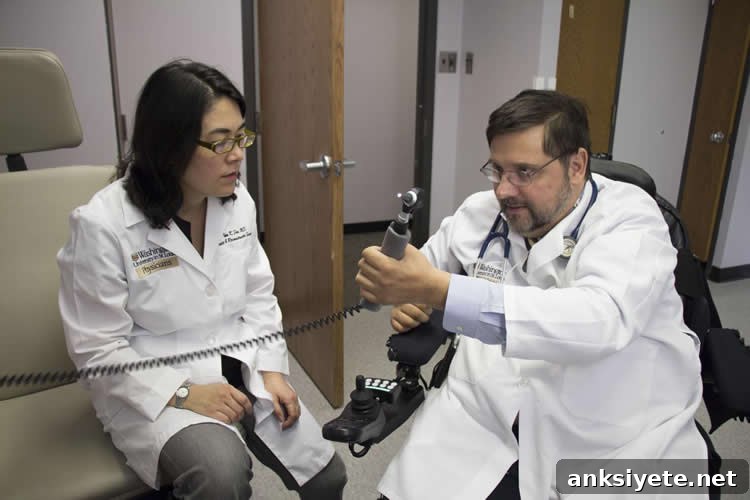
Michael D. Bavlsik, MD, a St. Louis primary care physician and father of eight who became a quadriplegic after a 2012 vehicle accident, is among the patients who benefited. The surgery improved triceps function and grip strength, allowing him to feed himself with a fork, write with a pen, examine patients with an otoscope during office visits and drive his children to activities while using a motorized wheelchair. “Nerve-transfer surgery has been very successful in helping me,” Bavlsik said. “I am extremely grateful for this surgery.”
Washington University surgeons pioneered the modern nerve-transfer technique roughly 25 years ago. Developed by Susan E. Mackinnon, MD, director of the Division of Plastic and Reconstructive Surgery and the Center for Nerve Injury and Paralysis, the approach was first used to restore movement after peripheral nerve injuries to hands and feet. In the past five years the same principles have been adapted to help patients with cervical spinal cord injuries regain limited but functional upper-extremity control.
The procedure is typically performed by connecting working donor nerves located above the spinal cord lesion — often in the shoulder or upper arm — to recipient nerves that control paralyzed muscles in the forearm and hand. Because the surgery bypasses the injured segment of spinal cord, it is generally suitable for people whose injuries spare some nerve function above the level of paralysis, most commonly those with C6 or C7 injuries. It is less effective for injuries that occur higher in the cervical spine (C1–C5), where all arm function is lost.
Operations usually take about four hours, can be performed months or even years after the initial injury, and most patients are discharged the day after surgery. After the nerve coaptation, patients embark on an intensive rehabilitation program to retrain the brain to interpret and use the new nerve signals; meaningful functional improvement typically develops over 6 to 18 months.
In one representative case, surgeons transferred tissue from a patient’s upper arm to reinnervate a nerve controlling pinch strength. After recovery, the patient regained the ability to flex his thumb and index finger, enabling him to feed himself and hold a water bottle — actions that improved nutrition, reduced the risk of urinary tract infections and bolstered overall health.
“Our innovations in addressing spinal cord injury grew out of a quarter century of clinical experience with nerve transfers,” Mackinnon said. “The surgery can be technically straightforward, but selecting the right patients and planning the correct nerve combinations requires careful judgment. We encourage people with cervical spinal cord injuries to consider this approach when appropriate, because it can provide meaningful functional gains when few options exist.”
Funding: This study was funded by the Craig H. Neilsen Foundation.
Source: Diane Duke Williams, Washington University School of Medicine. Image credit: E. Holland Durando.
Abstract
Nerve Transfers to Restore Upper Extremity Function in Cervical Spinal Cord Injury: Update and Preliminary Outcomes
Background: Cervical spinal cord injury often causes severe loss of voluntary upper-extremity function. Interest in nerve transfers to reestablish volitional control has increased as a promising reconstructive option for these complex patients.
Methods: The authors reviewed existing literature and analyzed a case series comprising 13 nerve-transfer operations in nine patients with cervical spinal cord injury, highlighting representative cases to explore outcomes and critical decision points.
Results: Expendable donor nerves innervated above the level of injury (for example, branches to teres minor, deltoid, supinator and brachialis) were redirected to restore functions such as elbow extension, wrist extension and hand movements (including reinnervation of posterior or anterior interosseous nerve targets). At a mean follow-up of 12 months, patients showed functional gains on manual muscle testing and in self-reported outcomes, reflecting meaningful improvements in daily activities despite relatively modest increases in isolated muscle strength.
Conclusions: Nerve transfers offer a reproducible surgical strategy to reestablish volitional control of the upper extremity after cervical spinal cord injury. Early results support clinically relevant improvements in patient function. Further study is needed to define optimal timing, combinations of nerve transfers, integration with tendon transfers or functional electrical stimulation, and standardized outcome measures to determine the procedure’s role in comprehensive rehabilitation strategies.