
Summary: MIT researchers have created an inexpensive disposable “smart” diaper that combines conventional diaper materials with passive RFID technology to detect wetness and notify caregivers when a change is needed.
Source: MIT
Overview: Some infants cry immediately when their diaper becomes wet, while others remain comfortable despite prolonged dampness. Extended exposure to moisture increases the risk of painful rashes and infections, creating discomfort for both infants and caregivers. To address this problem, researchers at MIT have designed a low-cost smart diaper that senses moisture and wirelessly alerts a nearby reader, which can forward a notification to a caregiver’s smartphone or computer.
The sensor integrates a passive radio frequency identification (RFID) tag with the super absorbent polymer (SAP) layer already found in most disposable diapers. When the hydrogel-based SAP soaks up liquid, it swells and becomes weakly conductive. That change in material property is sufficient to activate the RFID tag: the tag harvests energy from an RFID reader’s radio waves, the wet SAP modifies the antenna behavior, and the tag then transmits a signal indicating wetness. The design achieves communication to a reader at distances up to around one meter.
Researchers report this is the first demonstration of using hydrogel as an antenna element for RFID-based moisture sensing in diapers. The team estimates the sensor can be manufactured for under two cents per unit, offering an affordable, disposable alternative to current smart-diaper prototypes that rely on reusable, battery-powered devices and often cost tens of dollars.
Beyond routine diaper changes, smart diapers could support clinical care by recording patterns that reveal health issues such as constipation, incontinence, or urinary tract infections. The technology could be especially helpful in neonatal units, busy nurseries, and long-term care settings where staff must monitor multiple patients.
Pankhuri Sen, a research assistant in MIT’s AutoID Laboratory, notes that the same approach could be applied to adult incontinence products. “Diapers are used not just for babies but also for elderly and bedridden patients,” she says. “A disposable sensor that notifies caregivers when a change is needed could reduce discomfort and improve hygiene in multi-bed facilities.”
Sai Nithin R. Kantareddy, a graduate student in MIT’s Department of Mechanical Engineering, adds, “Prompt changes can prevent rashes and reduce the risk of infections such as urinary tract infections in both infant and geriatric populations.”
The work was carried out by members of MIT’s AutoID Laboratory, including Sen, Kantareddy, Rahul Bhattacharyya, and Sanjay Sarma, in collaboration with Joshua Siegel at Michigan State University. The results are published in IEEE Sensors. Sanjay Sarma is MIT’s vice president for open learning and the Fred Fort Flowers and Daniel Fort Flowers Professor of Mechanical Engineering.
Sticker sense
Most conventional disposable diapers include a simple wetness indicator strip printed on the exterior that changes color when exposed to moisture. Those indicators require visual inspection and often mean removing clothing to confirm whether the diaper is wet. Emerging commercial smart-diaper concepts tend to use wireless or Bluetooth modules that clip onto the diaper’s exterior; these devices require batteries and are typically reusable, which means they must be removed, cleaned, and reattached between uses. Such reusable sensors can cost more than $40.
In contrast, passive RFID tags are extremely low-cost and can be produced as printable sticker-like tags on rolls, similar to barcode labels. MIT’s AutoID Laboratory has a long history of RFID innovation aimed at connecting physical objects to digital networks. A standard passive RFID tag consists of an antenna for backscattering radio waves and a small chip that encodes the tag’s identity. The tag draws power from the reader’s radio emission, briefly activates, and modulates the returned signal to convey information. By designing RFID tags that change their radio response when exposed to moisture, the team turned a simple tag into a disposable wetness sensor.
Tag, you’re it
The MIT design places the sensor in the diaper’s bottom layer. The tag resembles a bow tie: an RFID chip sits at the narrow center while two triangular SAP regions form the flanking antenna elements. Dry SAP is an electrical insulator, but once it absorbs liquid it becomes weakly conductive. That conductivity interacts with radio-frequency fields, inducing a small current sufficient to power the RFID chip and allow the tag to backscatter a signal to the reader indicating wetness.
To extend the read range, the researchers added a small amount of copper to the sensor design, improving conductivity so the tag can communicate with an RFID reader at distances exceeding one meter under test conditions. In laboratory trials, tags were embedded within newborn-sized diapers fitted on life-sized baby dolls that were filled with saltwater to mimic the conductive properties of human bodily fluids. The wet diaper sensor reliably activated and transmitted to the reader up to approximately one meter away in various orientations.
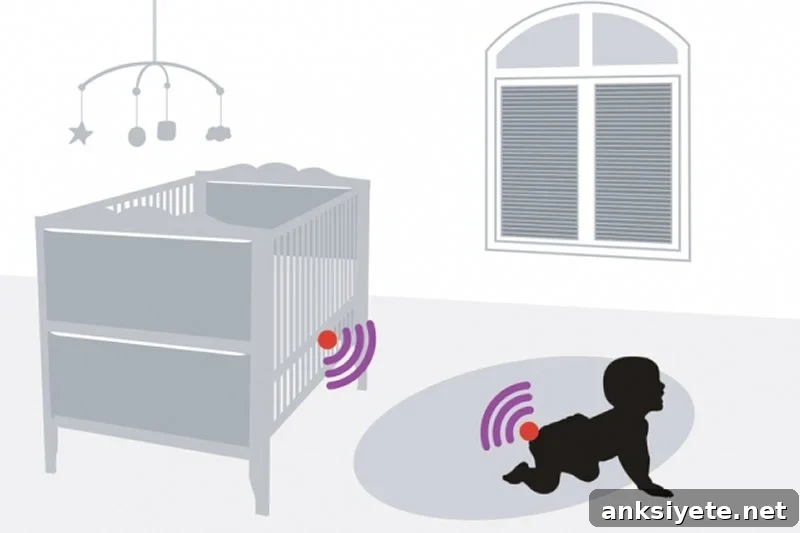
Sen suggests practical deployments could include an RFID reader in a baby’s room that forwards wetness alerts to caregivers’ phones or computers. For adults or elderly patients, compact readers might be mounted on assistive devices such as wheelchairs or canes to detect tagged diapers and notify caregivers discreetly.
Funding: This research received partial support from Softys through the MIT Industry Liaison Program.
Source:
MIT
Media Contacts:
Jennifer Chu – MIT
Image Source:
Image credited to MIT News.
Original Research: Closed access
“Low-Cost Diaper Wetness Detection Using Hydrogel-Based RFID Tags.” Pankhuri Sen; Sai Nithin R. Kantareddy; Rahul Bhattacharyya; Sanjay Emani Sarma; Joshua E. Siegel. IEEE Sensors. DOI: 10.1109/JSEN.2019.2954746.
Abstract (summary): Disposable diapers with built-in, low-cost moisture sensors offer opportunities for improved self-care and clinical monitoring across populations that include infants, the elderly, and bedridden patients. Event-based alerts can support incontinence management, reduce rashes and infections, and minimize embarrassment while enabling data collection to optimize change intervals and reduce waste. This work realizes a novel disposable moisture sensor that leverages the water-absorbing polymer gel common to diapers, demonstrating a functional UHF RFID moisture monitor based on hydrogel sensing. A hybrid sensor design using metal and hydrogel is proposed and optimized for diaper geometry, achieving a read range near one meter, a small bend radius, orientation insensitivity relative to the reader, and lower cost compared with metallic-antenna sensors. The article discusses integration with manufacturing processes and explores potential future applications enabled by hydrogel-based sensing.