
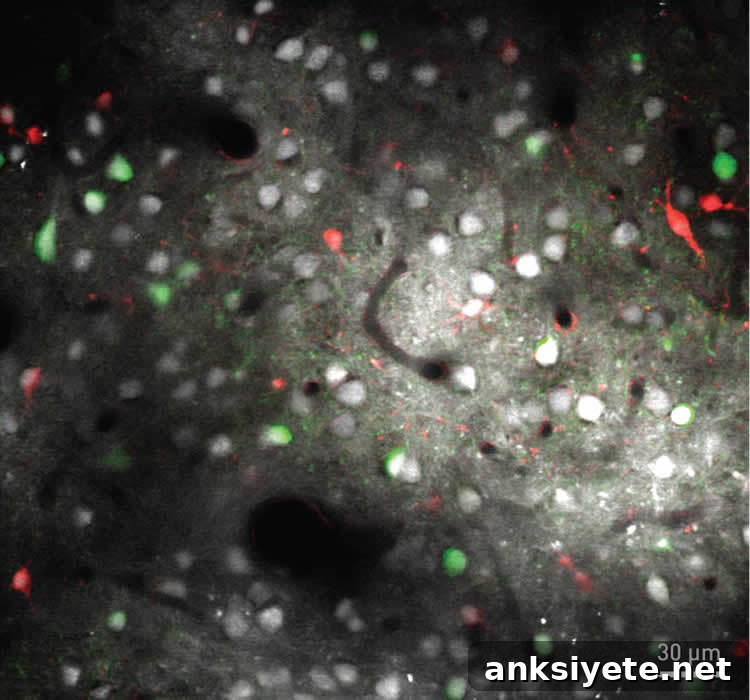
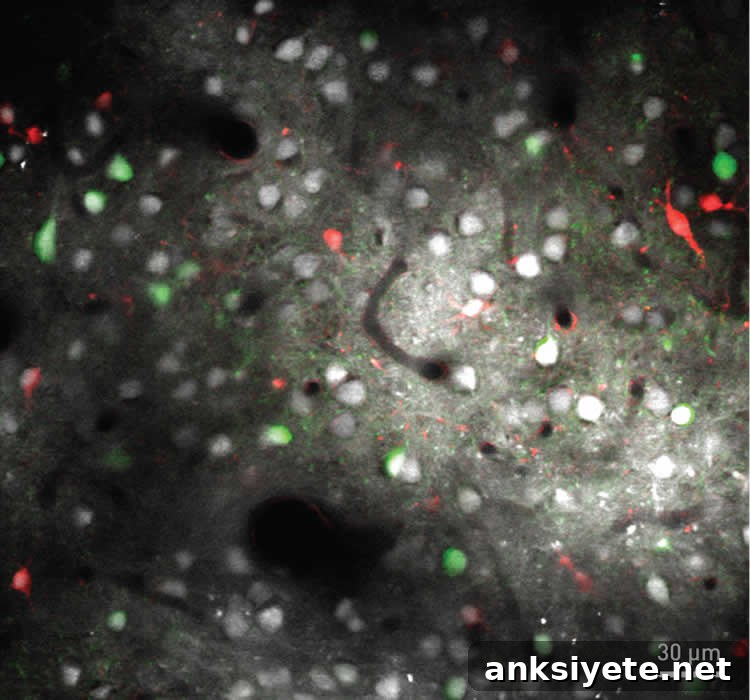
Two distinct neuronal populations in the visual cortex alter their firing patterns in response to visual input when rodents awaken from anesthesia.
The way neurons respond to sensory input depends strongly on brain state. Responses differ when an animal is asleep, drowsy, alert, paying attention, or ignoring a stimulus. Although the cellular and circuit properties of the visual cortex are well characterized, the mechanisms that shift cortical activity between drowsy and fully awake states are not fully understood. Researchers led by Tadaharu Tsumoto at the RIKEN Brain Science Institute investigated how neuronal activity in the visual cortex changes as rodents transition from anesthesia to wakefulness.
The team recorded neural activity in the visual cortex of rats using two-photon functional calcium imaging, a technique that visualizes changes in intracellular calcium as a proxy for neuronal firing. By using animals in which inhibitory neurons were labeled with a green fluorescent protein, they were able to distinguish inhibitory from excitatory cells and monitor the responses of these two populations separately. The experiment measured responses to a visual stimulus—an image moving across a screen—while the animals were under anesthesia and then again after they were allowed to wake.
The investigators found clear, state-dependent differences in how inhibitory and excitatory neurons responded to the moving visual stimulus. In the awake state, inhibitory neurons showed stronger and more reliable responses compared with their behavior under anesthesia. Excitatory neurons also changed their temporal dynamics: in awake animals, their responses decayed more rapidly after stimulus presentation, indicating that excitatory activity was more tightly time-locked to the visual input than during anesthesia.
Functionally, these shifts make visual responses more precise and dependable when an animal is awake. Faster-decaying excitatory responses sharpen the temporal link between stimulus and firing, while enhanced and dependable inhibition can improve contrast and timing in cortical processing. As Tsumoto notes, heightened sensitivity and resolution for moving visual stimuli upon waking could have clear survival advantages—allowing animals to more accurately judge the speed and direction of approaching threats when roused from a drowsy state.
The researchers went on to identify a key modulatory source for these state-dependent changes: the basal forebrain. This brain region contains cholinergic neurons that are known to influence cortical activity and behavioral state. By stimulating the basal forebrain in anesthetized animals, the team was able to induce the awake-like firing patterns in visual cortical neurons, demonstrating that cholinergic activation of inhibitory circuits in the cortex can reproduce key features of the awake response. These results highlight the basal forebrain’s role in switching cortical processing modes and in shaping the balance between excitation and inhibition according to wakefulness.
These findings have several important implications. They clarify how neuromodulatory systems adjust sensory coding across behavioral states and provide direct evidence that cholinergic inputs can rapidly reorganize cortical responses. The work also cautions that recordings obtained under anesthesia may not fully reflect the dynamics present during wakefulness, a consideration relevant for interpreting many physiological studies. Understanding the circuit mechanisms that underlie these state-dependent changes can help guide more accurate models of sensory processing and may inform future studies of attention, arousal, and disorders in which neuromodulatory systems are disrupted.
Contact: Tadaharu Tsumoto – RIKEN Research
Source: RIKEN Research press release
Image Source: Image credited to R. Kimura M et al., adapted from the RIKEN Research press release
Original Research: Abstract for “Curtailing effect of awakening on visual responses of cortical neurons by cholinergic activation of inhibitory circuits” by Rui Kimura, Mir-Shahram Safari, Javad Mirnajafi-Zadeh, Rie Kimura, Teppei Ebina, Yuchio Yanagawa, Kazuhiro Sohya, and Tadaharu Tsumoto in Journal of Neuroscience. Published online July 24, 2014. doi:10.1523/JNEUROSCI.0863-14.2014