
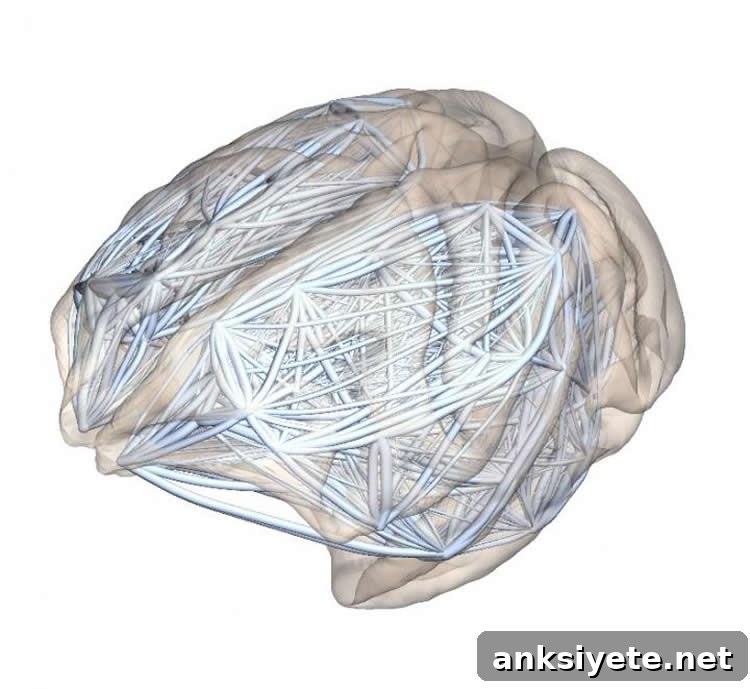
Summary: Weaker long-distance connections in the mammalian cortex may help explain why larger brains show greater vulnerability to certain mental illnesses.
Source: PLOS
Understanding cortical networks across mammals — a common organizational principle may explain why larger brains are more susceptible to some mental disorders
The cerebral cortex in humans and other mammals supports sensory perception, motor control and higher cognitive functions. Revealing how cortical neurons and areas are wired together provides essential insight into the computations the brain performs and how those circuits can fail. A study published July 21 in the open-access journal PLOS Biology reports evidence that a single spatial rule governs cortical connectivity across very different mammalian brains, while also identifying a key difference: species with larger cortices have proportionally fewer and much weaker long-range connections. This pattern may contribute to the increased susceptibility of large-brained animals, including humans, to disconnection-related disorders such as Alzheimer disease and schizophrenia.
Previous work by Zoltán Toroczkai, Mária Ercsey-Ravasz, Henry Kennedy and colleagues combined anatomical tracer experiments in macaques with network-theory analysis and identified a quantitative relationship between connection strength and distance called the exponential distance rule (EDR). The EDR captures a simple yet powerful principle: the strength or number of connections between two cortical locations declines exponentially with the physical distance separating them. In practical terms, this means there are many more short-range axons than long-range axons, and nearby cortical areas are, on average, more densely connected to each other than distant areas.
In the new study, the authors extend this comparative approach by analyzing detailed tract-tracing data from both macaque and mouse cortices. These datasets measure the directed, weighted connections between identified cortical areas and provide a basis for rigorous cross-species comparison. Despite large differences in overall brain size and some differences in local organization, the analysis shows that the basic statistical features of cortical networks in both species conform to the EDR and to constraints imposed by cortical geometry. In other words, the same spatial embedding principle appears to shape cortical wiring in both rodents and primates.
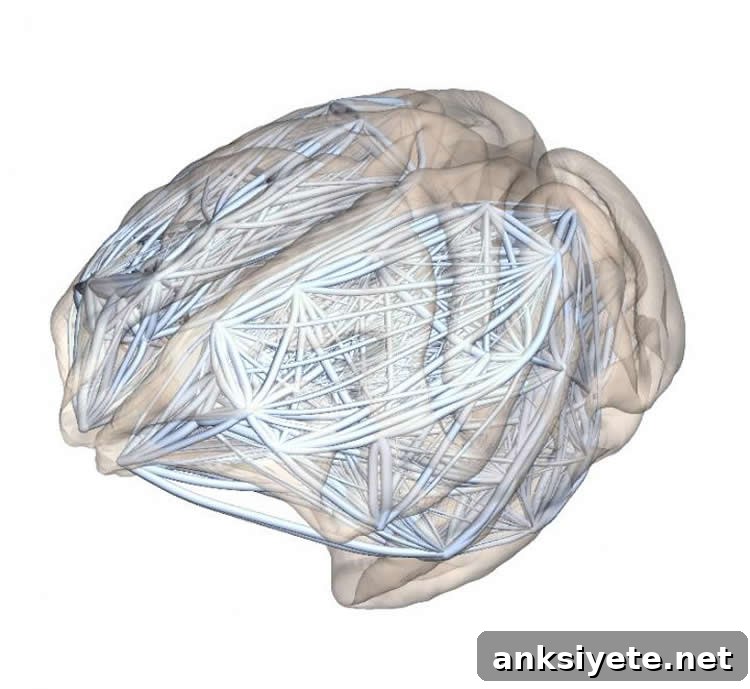
Although the EDR holds across species, the researchers found an important quantitative difference: macaques have a substantially smaller fraction of long-distance connections and those long-range connections are correspondingly much weaker than those observed in the mouse. The authors provide mathematical arguments indicating that the EDR and spatial embedding together offer a universal, evolutionarily preserved design principle that balances wiring cost and communication efficiency as brains grow and scale.
These scaling properties lead to a striking implication for very large cortices such as the human brain. If the EDR applies to humans in the same way it does to macaques and mice, then long-range cortico-cortical connections in humans would be expected to be relatively light-weight compared with short-range wiring. That relative weakness of distant links could make communication between far-apart cortical regions more fragile, increasing vulnerability to disorders that involve widespread network disconnection. The authors suggest this mechanism may help explain why diseases characterized by disrupted long-range connectivity, including Alzheimer disease and schizophrenia, are more prominent in species with larger cortices.
The study also examined tracer data restricted to gray-matter connections within primary visual cortex in macaque, mouse and mouse lemur. Those high-resolution local datasets show that the EDR holds at sub-millimeter to millimeter scales as well, supporting the idea that the exponential decrease in connection strength with distance is a general property of cortical wiring across spatial scales and possibly across the mammalian class.
Funding: Authors received support from multiple national and international programs and research grants including programs of the Université de Lyon, Marie Curie and European Union Horizon 2020, National Institutes of Health grants, U.S. Department of Defense agencies, and national research agencies in France and Romania. The funders declared no role in study design, data collection and analysis, decision to publish, or manuscript preparation.
Competing interests: The authors declared no competing interests.
Source: Henry Kennedy — PLOS
Image credit: Szabolcs Horvát
Original research: Horvát S., Gămănuț R., Ercsey-Ravasz M., Magrou L., Gămănuț B., Van Essen D. C., Burkhalter A., Knoblauch K., Toroczkai Z., Kennedy H. (2016). Spatial Embedding and Wiring Cost Constrain the Functional Layout of the Cortical Network of Rodents and Primates. PLOS Biology. doi:10.1371/journal.pbio.1002512
Abstract
Spatial Embedding and Wiring Cost Constrain the Functional Layout of the Cortical Network of Rodents and Primates
Mammals exhibit a large range of brain sizes reflecting evolutionary adaptation. Comparing inter-areal cortical networks across species of different sizes reveals both conserved organizational principles and species-specific differences. Using tract-tracing data from macaque and mouse, the authors identify a general organizational rule — the exponential distance rule (EDR) — coupled with cortical geometry that allows network comparisons within a common framework. Network invariants appear in motif profiles and connection-similarity measures, yet the data also show notable differences: larger-brained primates have a smaller fraction of long-distance connections and those connections are much weaker than in rodents. This observation supports the prediction that in much-expanded cortices, such as the human cortex, long-range connections could be especially weak, a pattern that may predispose large-brained species to disconnection syndromes such as Alzheimer disease and schizophrenia. High-resolution tracer data from primary visual cortex in multiple species indicate that the EDR also holds at local scales, suggesting the rule may operate broadly across spatial scales and mammalian taxa.