Summary:
Researchers at University College London have developed a new physiological model that explains why modern wide-gamut displays can produce striking color mismatches between viewers. Published in Optics Express, the study shows that ultra-narrowband display primaries interact with individual variations in retinal cone sensitivity and age-related changes in the eye’s lens. By replacing century-old calibration standards with computational models of human vision, the work points toward displays that appear consistent across a broad range of observers.
Key Facts:
- The narrowband gamut paradox: Modern displays—OLED TVs, laser cinema projectors, and many smartphones—use very narrow spectral primaries to expand color gamuts and increase saturation. Those sharp spectral peaks amplify perceptual differences between individual observers compared with older broadband displays.
- Outdated calibration standards: Industry colorimeters and photometers still rely on standard observer functions developed nearly a century ago (e.g., CIE 1931). Those curves smooth over real physiological variability, so two displays that are instrumentally “matched” can nevertheless look different to real viewers.
- Biological sensitivity profiles: The model shows that the spectral width and peak of the blue primary drive age-related mismatches because of lens yellowing, while the red and green primaries determine mismatches among people with common variations in L- and M-cone opsins (for example, deuteranomaly).
Source: Optica
Over the last decade, display makers and digital cinema engineers have pushed for wider color gamuts, richer saturations, and higher dynamic range. To reach these goals they shifted from broad-spectrum phosphors to highly precise narrowband emitters like quantum dots and lasers. That engineering progress expanded the color space, but it also introduced a new problem: colors that instruments report as matching can look noticeably different to different people or on adjacent screens.
For example, a colorist working on a mastering monitor may see a sky as a subtle teal while a viewer on a calibrated high-end home TV perceives it as an over-saturated cyan. To understand these discrepancies, vision scientists at UCL’s Institute of Ophthalmology developed a computational model that simulates how diverse human eyes perceive commercially available displays.
“Content creators want their work to look consistent across devices, but differences in human color vision and legacy calibration methods make that difficult,” said lead author Andy Rider, Ph.D., from the UCL Institute of Ophthalmology. “Our model accounts for individual variability in color vision and can guide how to adjust a display’s primaries so images appear correct to as many viewers as possible.”
Bridging engineering calibration and retinal biology
A central issue is that color-measuring instruments translate physical light measurements into color coordinates using standard observer curves that represent an average retina. Those curves do not capture the full range of biological differences found in real populations. To address this, the UCL team built a physiological simulation that includes key sources of variation:
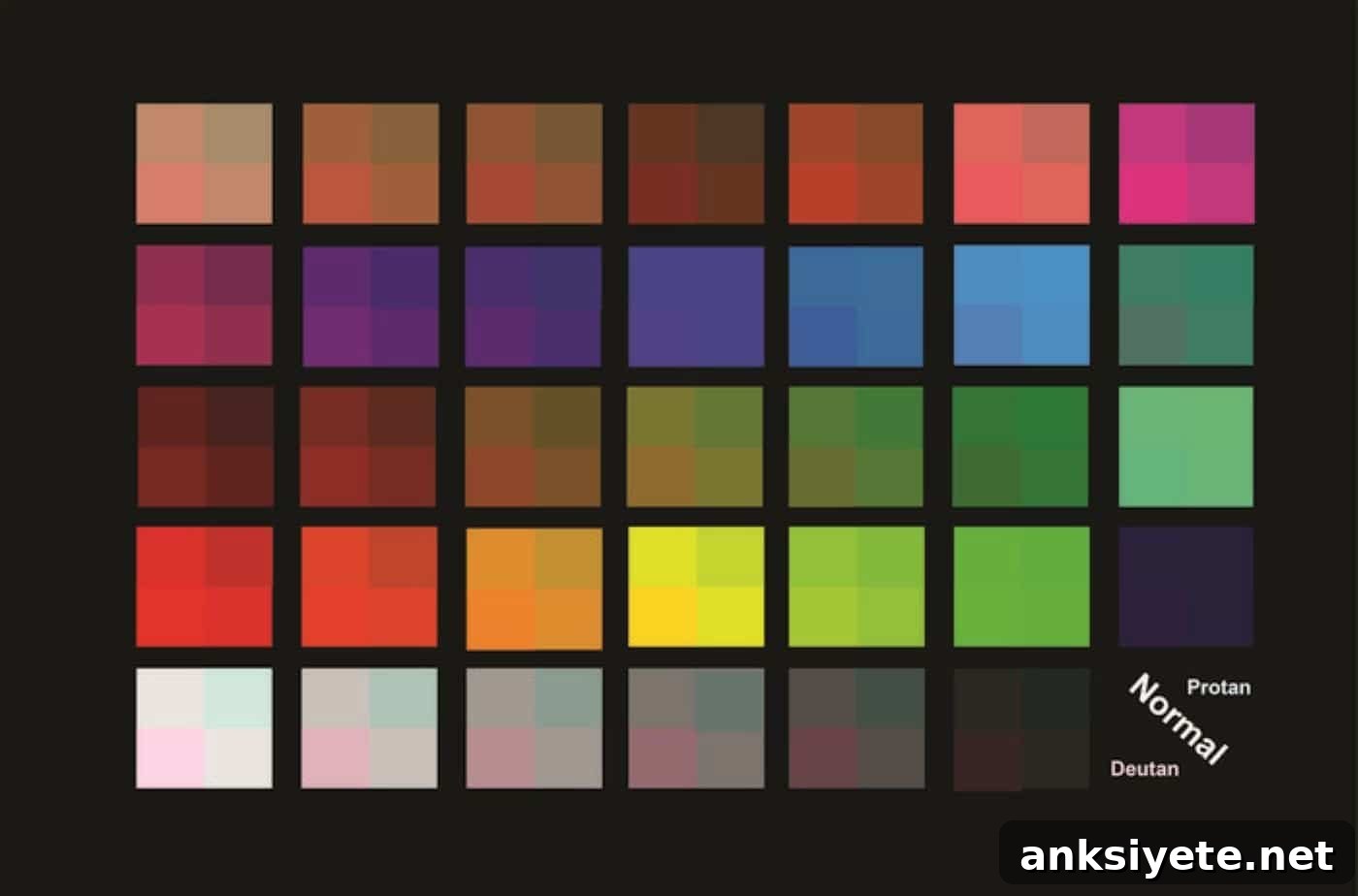
- Photoreceptor opsin tuning: The model represents shifts in the spectral sensitivities of the long- (L), medium- (M), and short-wavelength (S) cone photoreceptors, including common anomalous trichromacy such as deuteranomaly, which affects roughly 1 in 20 biological males.
- Ocular lens density and aging: The eye’s crystalline lens gradually yellows and becomes denser with age, filtering out more short-wavelength light and altering how blue-rich primaries are perceived by older observers.
The team ran simulations across 16 real-world display architectures, including consumer OLED and LED televisions, production-grade mastering monitors, and theatrical cinema projectors. Results show that some narrowband display technologies create substantial perceptual divergence between observer groups, while others remain relatively stable.
The anatomy of a spectral mismatch
The model isolates how particular primary channels interact with human visual anatomy:
- Blue primaries and aging eyes: Differences in the blue primary’s spectrum produce the largest perceptual gaps between younger and older viewers because the aged lens absorbs more short-wavelength light.
- Red and green primaries and retinal genotypes: The spectral peaks and bandwidths of red and green primaries largely determine whether images will appear shifted to observers who have subtle genetic shifts in M- and L-cone photopigments.
Although the study focuses on displays, the same modeling approach can be applied to other lighting and color challenges—such as differences between LED and incandescent lighting or situations where dyes and pigments change object reflectance.
Designing the next generation of screens
The physiological model offers both diagnostic insight and practical guidance for display design. The researchers emphasize that psychophysical testing with human observers will follow to validate the model’s predictions against subjective experience. In the meantime, hardware engineers can use the algorithm to select peak wavelengths and spectral widths for primaries that minimize perceptual mismatch across diverse viewers.
The research also supports multi-primary displays—screens that use four, five, or more primaries instead of the conventional three (RGB)—allowing dynamic spectral tuning to preserve color fidelity for the widest possible range of human observers.
Editorial Notes:
- This article was edited by a Neuroscience News editor.
- Journal paper reviewed in full.
- Additional context added by our staff.
About this visual neuroscience research:
- Media Contact: Kayla Hunt
- Source: Optica
- Image Credit: Image credited to Andy Rider and Andrew Stockman, Institute of Ophthalmology at University College London
- Original Research is Open Access: Optics Express (Sept 22, 2026). Title: “Why the colours of modern displays can look so different to different observers.” Authors: Andrew T. Rider, John A. Frith, and Andrew Stockman.
- DOI: 10.1364/OE.613255
Abstract
Why the colours of modern displays can look so different to different observers
Human color vision relies on photon absorption by three types of cone photoreceptors with different spectral sensitivities, making vision effectively trichromatic. A set of three primary lights can mix to reproduce colors that lie within the gamut defined by those primaries. Older displays with broadband primaries yield smaller gamuts and a narrower range of colors that typically appear similar across observers. Modern displays using narrowband primaries expand the gamut but can produce colors that different viewers perceive differently. These observer metamerism failures arise from physiological and genetic variability across the population.
Using a model of those biological differences, the authors simulated how colors from many display types are perceived across varied observers. Their simulations predict substantial color differences for narrowband displays, particularly for people with red–green color vision deficiencies and for older observers with yellowed lenses. Noticeable differences are also predicted for some viewers whose color vision deviates from the population mean yet would otherwise be classified as normal—an important consideration for color-critical industries such as film grading and product design.