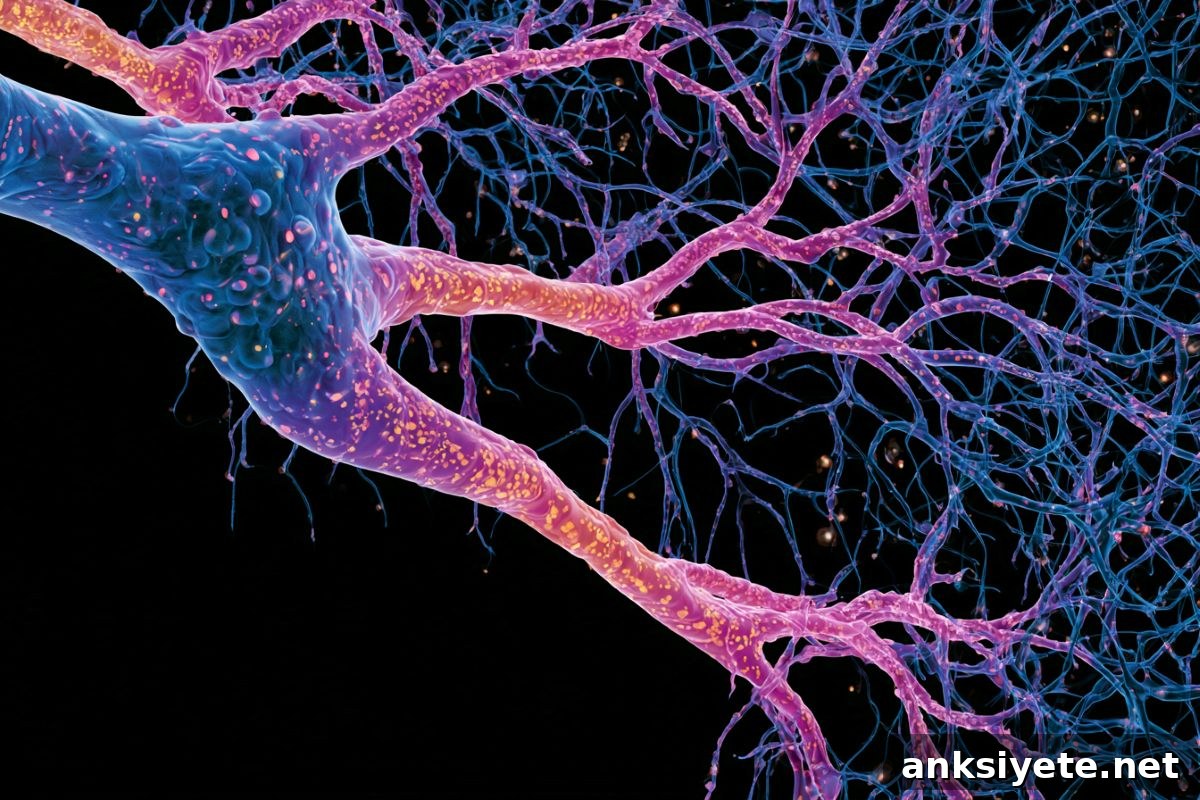
Summary: Researchers have shown that axon formation is an autonomous, internally driven process. Young neurons use an internal protein complex to systematically loosen their own cytoskeletal scaffold from the inside out, establishing the early wiring of the nervous system through an intrinsic genetic program.
Key Facts
- The Intrinsic Control Shift: Instead of relying primarily on external chemical cues, embryonic neurons actively remodel their own cytoskeleton—the cell’s internal structural scaffold—to initiate axon outgrowth, with the process beginning in the cell body (soma).
- The Dance of the Neurites: Early, symmetric neurons extend multiple small projections called neurites. These protrusions show a rhythmic “two steps forward, one step back” behavior, repeatedly extending and retracting on a minute-by-minute timescale.
- The Arp2/3 Molecular Zipper: A protein complex known as Arp2/3 functions like a microscopic zipper. It locally loosens the cell’s tension-bearing structural network, enabling an individual neurite to bulge outward.
- Wave-Like Propagation: This internal unzipping propagates along a single neurite at a time in a wave-like manner. The wave proceeds until the remaining cytoskeletal tension arrests it, at which point the neurite briefly retracts and the cycle repeats.
- Microtubule Lock-In: While Arp2/3-driven expansions alternate among neurites, rigid structural proteins called microtubules steadily extend from the soma into the branches. Eventually, one neurite accumulates enough microtubule support to resist retraction.
- Symmetry Shattered: Within roughly 48 hours, the stabilized neurite continues to grow rapidly on its own and becomes the neuron’s single axon. The other neurites stop participating in the wave-driven growth and are committed to become input-receiving dendrites.
Source: DZNE
Neurons in the brain and spinal cord form vast networks in which each cell receives many inputs but sends output through only one long projection: the axon.
“If a neuron had multiple axons, it would disrupt the brain’s circuits,” says Professor Frank Bradke, neurobiologist and research group leader at DZNE.
“Nature has therefore evolved a robust strategy to ensure that each neuron generates only a single axon. This mechanism is conserved across animals, so it represents a fundamental principle of nervous system wiring.”
Breaking symmetry
During early development, neurons are largely symmetric and bear several short protrusions called neurites. Eventually one neurite becomes the axon, breaking that initial symmetry. Until now, many researchers assumed external growth factors and guidance cues primarily determine which neurite becomes the axon. The team led by Frank Bradke describes a different picture.
“Our observations indicate that axon formation arises from a cytoskeletal remodeling program initiated inside the neuron. The process begins in the soma—the cell’s central hub,” explains Dr. Tien-chen Lin, first author of the study and scientist at DZNE.
Young neurons display a rhythmic pattern: their neurites extend slightly, then contract. “This repeating cycle—two steps forward, one step back—happens on a minute-by-minute basis,” Lin says.
Within roughly 48 hours, one neurite typically grows into an axon while the other neurites later differentiate into dendrites. “Although this rhythmic behavior was previously noted, the underlying mechanism was unclear. Our work illuminates the cellular machinery that drives it,” Lin adds.
The central element is the neuron’s cytoskeleton: a tension-bearing molecular network that acts like a corset around the cell.
“Here the Arp2/3 protein complex plays a key role,” Lin says. “Arp2/3 operates like a zipper, locally opening the cell’s corset and enabling the rhythmic shape changes that briefly loosen a network that would otherwise remain constricted.”
Wave-like propagation
The researchers found that Arp2/3 activity targets only one neurite at a time, temporarily permitting its extension.
“This action involves a localized cytoskeletal reconfiguration that moves like a wave,” Lin explains. “These waves continue until the loosened corset still exerts enough resistance to stop further progress. Then the cycle begins anew—sometimes repeating in the same neurite, sometimes in a different one, apparently by chance.”
At the same time, rigid microtubules grow outward from the soma into the neurites.
“Eventually one neurite remains extended long enough for microtubules to accumulate and stabilize its structure. At that point it can continue growing independently of Arp2/3 and becomes the axon, while the wave-driven outgrowth halts for the whole cell,” Lin notes.
Open questions
“We cannot rule out some contribution from external factors, but our data indicate that the core mechanism driving axon selection is intrinsic to the neuron,” says Frank Bradke.
Important questions remain: what triggers the initial remodeling? What enforces the rhythmic, one-neurite-at-a-time progression? And why does remodeling stop once one neurite stabilizes?
“A genetic program encoded in the cell likely directs this behavior, but the specific genes and regulatory pathways remain to be identified. There is much still to learn, and these open questions will guide our future work,” Bradke adds.
Key Questions Answered:
A: A neuron functions like a dedicated output channel: it collects many inputs through dendrites but must send its processed signal along one precise output, the axon. If a neuron produced multiple axons, it could broadcast the same signal into several circuits simultaneously, creating cross-talk, disrupting signal routing, and undermining the brain’s orderly information flow.
A: Young neurons are enclosed by a tense, interlinked network of actin and myosin that constrains their shape. Arp2/3 locally promotes actin branching at the soma, temporarily releasing that tension in a confined region. This local relaxation allows the cell’s interior to push outward in a wave, producing transient protrusion of a neurite.
A: The initial selection is largely stochastic: Arp2/3 activity shifts between neurites, causing them to extend and retract rhythmically. Meanwhile microtubules grow into the protrusions. By chance, one neurite will remain extended long enough to accumulate sufficient microtubule support to stabilize its structure permanently, after which it proceeds to form the axon.
Editorial Notes:
- This article was edited by a Neuroscience News editor.
- The full journal paper was reviewed for this summary.
- Additional contextual information was provided by editorial staff.
About this neuroscience research news
Author: Marcus Neitzert
Source: DZNE
Contact: Marcus Neitzert – DZNE
Image: The image is credited to Neuroscience News
Original Research: Open access. “An intrinsic cytoskeletal oscillator establishes neuronal polarity” by Tien-chen Lin (林天正), Charlotte H. Coles, Eissa Alfadil, Florian Fäßler, Andreas Husch, Sebastian Dupraz, Thorben Pietralla, Akihiro Narita, Max Schelski, Kevin C. Flynn, Sina Stern, Christoph Möhl, Brett J. Hilton, Franz Vauti, Hans-Henning Arnold, Florian K. M. Schur & Frank Bradke. Published in Nature. DOI: 10.1038/s41586-026-10755-6
Abstract
An intrinsic cytoskeletal oscillator establishes neuronal polarity
Neurons become polarized when one neurite is specified as the axon while the others form dendrites. How this fundamental asymmetry arises has been unclear. Traditionally, neuronal polarization was thought to depend mainly on growth cones sensing external cues.
This study shows that growth cones are not solely responsible and that the soma functions as a central organizer of neuronal polarity. Using live imaging and genetic loss-of-function experiments in vivo, together with optogenetic control and local cytoskeletal perturbations in cultured neurons, the authors identify a soma-initiated oscillatory program that primes axon selection.
Periodic actin branching driven by the Arp2/3 complex at the soma remodels a global actomyosin network, producing an actin wave that transiently retracts neurites before propagating into a single neurite tip. Exposure to this wave relaxes local actomyosin contractility, enabling a temporary microtubule-based protrusion that biases that neurite toward axon fate.
When the cell exits this oscillatory phase, the chosen neurite can overcome global inhibition and extend independently of Arp2/3, while actomyosin activity suppresses axon formation in the remaining neurites so they develop as dendrites. This soma-driven mechanism ensures the emergence of a single axon independent of environmental cues and underlies unidirectional information flow in neuronal circuits.