
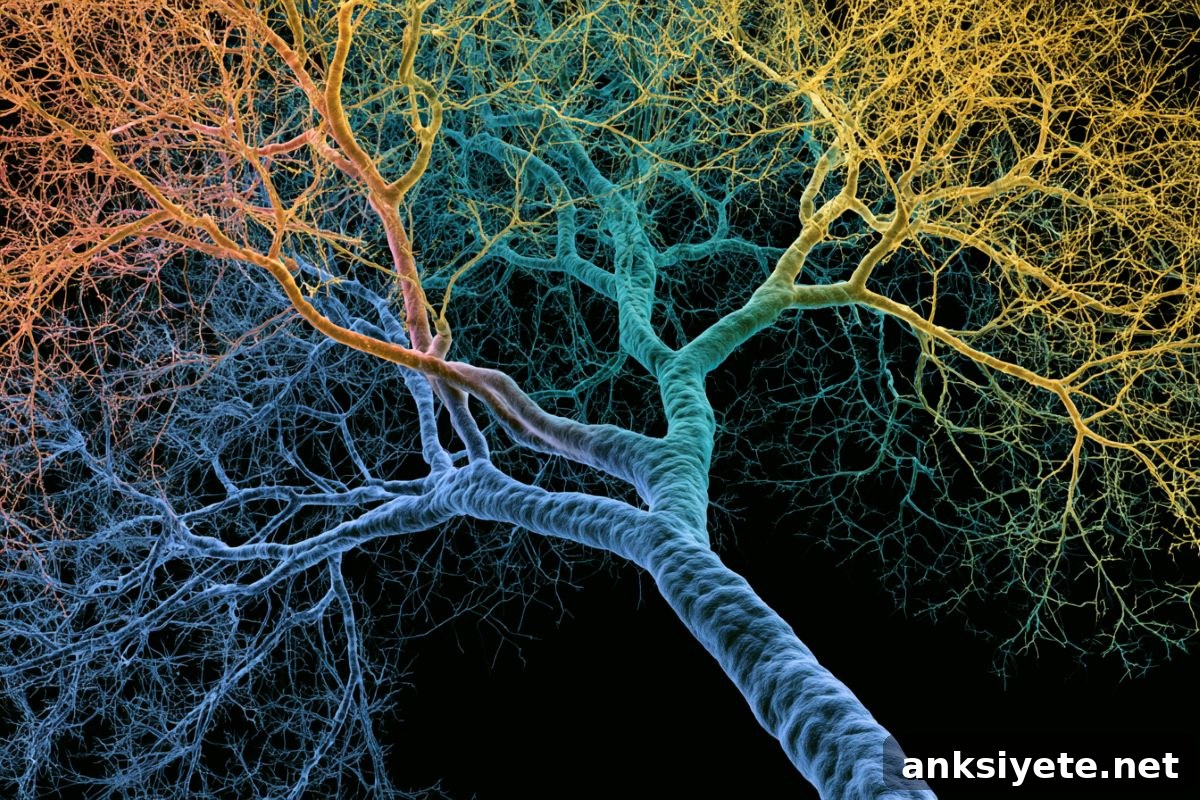
Summary: Researchers have shown that individual human cortical neurons act like powerful, compact microchips. Using artificial intelligence to quantify the computational complexity of single cells, the team demonstrated that a single human cortical neuron is far more than a simple switch: it performs computations comparable in depth and sophistication to a multi-layered deep artificial neural network (ANN).
Key Facts
- The “Twin” Imitation Metric: The researchers created a new, rigorous framework to measure a neuron’s processing depth. They task a modern artificial neural network with learning and reproducing the input/output behavior of a single human cortical cell. The greater the number of computational layers the artificial “twin” requires to match the biological cell, the higher the measured complexity of that neuron.
- The Dendritic Tree Advantage: Human cortical neurons display a substantial computational edge over those of other mammals. This advantage is driven by their expansive, highly branched dendritic trees and by distinctive electrical membrane properties that enable more sophisticated local computations.
- Single-Cell Pattern Recognition: Thanks to their elaborate branching and biophysical specializations, an individual human cortical neuron can perform advanced discriminations on incoming signals. In simulations, a single neuron can carry out tasks analogous to distinguishing complex visual patterns—functions once thought to require large populations of cells.
- Challenging the Scale Theory: These results question the long-standing idea that human cognition depends mainly on brain size and total neuron count. Instead, evolution appears to have increased the intrinsic computational depth of single neurons, making each cell a richer processing unit.
- A New Template for Neuromorphic AI: Contemporary machine learning relies on vast arrays of simplified, uniform processing units. This study links cell geometry and biophysics to computational capability, offering a blueprint for neuromorphic systems built from artificial units that mimic the deep, multi-layered computation seen in biological human neurons.
Source: Hebrew University of Jerusalem
What makes the human brain capable of language, imagination, mathematics, and invention?
For decades, many scientists have attributed human intelligence primarily to scale—the large number of neurons in the human brain and the enormous web of connections among them. This new study suggests an important complementary factor: the exceptional computational power contained within single cortical neurons. Rather than being passive switches, individual human neurons appear to be complex processing units that contribute substantially to cognitive capacity.
The research team, led by Professors Idan Segev and Mickey London at the Edmond and Lily Safra Center for Brain Sciences (ELSC) at the Hebrew University, together with PhD students Ido Aizenbud and Daniela Yoeli and in collaboration with Prof. Chris de Kock of the Free University, Amsterdam, developed a quantitative method to compare neuronal complexity across species.
“People often imagine a neuron as a simple on/off element,” said Professor Segev. “Our findings indicate that a single human cortical neuron is itself a remarkably sophisticated computing device.”
To test this idea the team introduced the Functional Complexity Index (FCI), a deep-learning-based metric that measures how difficult it is for a state-of-the-art artificial neural network to learn and reproduce a biological neuron’s input/output mapping. If an ANN needs many layers to imitate a neuron’s behavior, that neuron is judged to possess high computational depth.
Using detailed neuronal morphologies and biophysical models, the investigators compared human and rat cortical pyramidal neurons. They found that human neurons are substantially more functionally complex, primarily due to larger dendritic membrane area, richer branching patterns, and stronger, more nonlinear NMDA-mediated synaptic responses.
Those structural and biophysical features allow single human neurons to perform non-linear operations on multiple streams of input before producing an output spike. In practical terms, a single human cortical cell can implement computations analogous to multi-layer processing in artificial networks, supporting tasks such as complex pattern discrimination.
The implications are twofold. Biologically, the study suggests that human cognitive evolution involved enriching the computational repertoire of individual neurons, not only increasing neuron count. Technologically, the findings point to new avenues for neuromorphic AI: replacing simple, flat processing nodes with artificial units that emulate the depth, parallelism, and nonlinearity of human neurons could yield far more compact and efficient models.
Key Questions Answered:
A: It suggests that traditional estimates of the brain’s computational power have been too conservative. Treating each neuron as a single simple switch understates the depth of processing embodied in cortical cells. If individual neurons operate like multi-layer networks, the brain becomes a hierarchical assembly of highly capable units, greatly increasing its overall computational potential.
A: The principal factors are dendritic morphology and membrane properties. Human cortical pyramidal neurons have extensive, highly branched dendritic trees that act as local processing compartments. Coupled with nonlinear synaptic mechanisms—especially NMDA receptor dynamics—these features enable individual neurons to combine and transform multiple input streams before producing an output.
A: Current AI relies on large numbers of very simple units, which drives inefficiency and high energy costs. By adopting designs that mirror the layered, compartmentalized computation of biological neurons—artificial nodes with internal depth and nonlinear integration—engineers could create neuromorphic networks that are both more powerful per unit and far more energy-efficient.
Editorial Notes:
- This article was edited by a Neuroscience News editor.
- The underlying journal paper was reviewed in full.
- Additional context was added by editorial staff.
About this neuroscience and cognition research news
Author: Danae Marx
Source: Hebrew University of Jerusalem
Contact: Danae Marx – Hebrew University of Jerusalem
Image: The image is credited to Neuroscience News
Original Research: Open access.
Title: Dendritic morphology and synaptic nonlinearities enhance functional complexity in human cortical neurons — Daniela Yoeli, David Beniaguev, Idan Segev, Ido Aizenbud. PNAS
DOI: 10.1073/pnas.2533168123
Abstract
Dendritic morphology and synaptic nonlinearities enhance functional complexity in human cortical neurons
Humans display exceptional cognitive abilities compared with other animals, yet the neural mechanisms that support these capacities remain incompletely understood.
Human cortical neurons differ from those of smaller mammals in both structure and physiology. This raises the question: do these distinct cellular properties contribute to the superior information-processing abilities seen in humans?
To address this, the authors introduce the Functional Complexity Index (FCI), a general metric based on deep learning that quantifies how complex a neuron’s input–output transformation is. By computing the FCI for cortical pyramidal neurons across layers in rats and humans, the study isolates morpho-electrical features that drive single-neuron functional complexity.
The analysis shows that human cortical pyramidal neurons are substantially more functionally complex than their rat counterparts. Key contributors include increased dendritic membrane area, more elaborate branching, and higher density and nonlinearity of NMDA-mediated synaptic responses.
These results clarify how structural and biophysical specializations enhance single-neuron computation and represent an important step toward understanding the cellular bases of human cognition.