
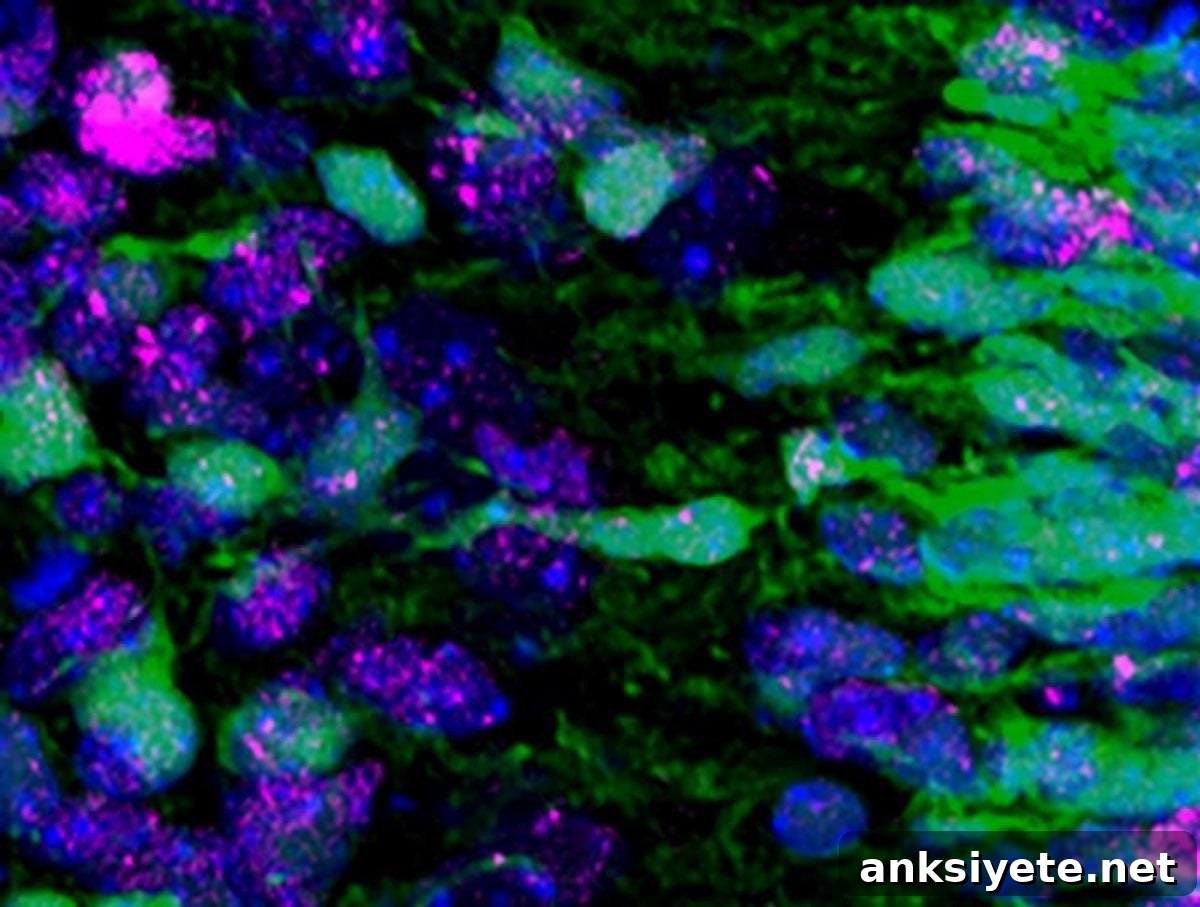
Summary: As newborn neurons migrate through the crowded, narrow spaces of the developing brain, the physical stress of that journey creates widespread, yet non-lethal, DNA double-strand breaks (DSBs). Researchers report that migrating neurons endure these severe breaks when both strands of the DNA helix are cut, but a normal, healthy brain repairs them rapidly. Rather than representing a pathological error, this form of DNA damage appears to be a routine aspect of cortical and cerebellar development that is resolved through efficient repair mechanisms before lasting harm occurs.
In controlled experiments that guided neurons through engineered microchannels mimicking tight interstitial spaces, fluorescent markers revealed bursts of DSBs forming as cells squeezed through constrictions and then disappearing within about 24 hours. The breaks are traced to the enzyme Topoisomerase IIβ: under torsional strain created by deformation, the enzyme makes a controlled cut to relieve DNA supercoiling but can become mechanically trapped mid-process, leaving broken DNA ends. Healthy developing neurons repair these lesions using the non-homologous end joining (NHEJ) pathway, repairing damage predominantly in inactive, non-critical regions of the genome so essential genes remain protected.
When the researchers disrupted repair by removing the key ligation enzyme Ligase 4 in mice, cerebellar neurons accumulated persistent DSBs. Those mutant animals developed progressive balance and coordination deficits in adulthood, indicating that unrepaired damage from developmental migration can have long-term functional consequences. The work suggests that the physical stresses of brain formation can leave subtle, permanent genetic marks on individual neurons and may inform new perspectives on neurodevelopmental and neurodegenerative disorders.
Key Facts
- Widespread double-strand breaks: Neuronal migration through dense tissue causes frequent DSBs as cells deform to traverse narrow spaces.
- Topoisomerase IIβ involvement: DSBs arise when Topoisomerase IIβ, which normally cuts and rejoins DNA to relieve torsional strain, becomes stalled by mechanical stress and leaves DNA ends severed.
- Rapid, routine repair: In healthy developing brains, neurons repair these DSBs with the non-homologous end joining pathway, typically restoring genomic integrity within 24 hours.
- Protection of active genes: Damage concentrates in transcriptionally inactive regions rather than in essential, active genes, preserving cellular function during development.
- Consequences of repair failure: Loss of Ligase 4 in migrating neurons leads to persistent DSBs and mild, progressive motor deficits later in life, linking developmental repair failure to disease risk.
Source: Kyoto University
Newborn neurons must squeeze through dense tissue, past other cells and fibers, to reach their final positions in the cerebral and cerebellar cortices.
Published in Nature, this study from Kyoto University’s Institute for Integrated Cell-Material Sciences (WPI-iCeMS) and collaborators demonstrates that confined migration during normal brain development produces extensive, but non-lethal, DNA double-strand breaks. The team shows these lesions form without detectable nuclear envelope rupture—distinct from many cancer models—and are repaired efficiently during development.
Professor Mineko Kengaku, who led the study, emphasizes that the developing brain appears adapted to tolerate and repair this form of mechanical damage. The finding reframes how scientists view the neuronal genome: while all neurons begin with the same DNA sequence, the mechanical history of each cell’s migration can introduce small, possibly permanent genomic changes through cycles of breakage and repair.
Using microchannels that mimic physiological confinement, the researchers recorded DSB formation precisely when neurons compressed to pass through narrow gaps. Fluorescent labeling showed the breaks increase during migration and decline after completion, consistent with a repair process that restores integrity within a day. Genome sequencing of affected cells indicated that DSBs are enriched in transcriptionally inactive regions, suggesting a protective bias away from genes critical to cell function.
Mechanistically, confined migration raises torsional strain on the genome. Topoisomerase IIβ normally resolves such strain by transiently cutting and religating DNA strands. Under mechanical pressure, the enzyme can become trapped during the cleavage step, generating covalently bound DSB intermediates. Cells resolve these intermediates by non-homologous end joining, a fast repair route suited to post-mitotic neurons.
To assess long-term impact, scientists engineered mice lacking Ligase 4 specifically in newly migrating cerebellar neurons. These mice developed normally at first but gradually manifested balance and coordination problems in adulthood. Molecular analyses revealed persistent DSB accumulation and moderate transcriptional shifts in genes linked to synaptic function, neuronal development and stress responses, suggesting incomplete repair can alter neuronal physiology and elevate disease risk.
Key Questions Answered:
A: Neurons have a targeted tolerance and repair strategy. While migrating cancer cells often suffer random DSBs that hit active, essential genes and impair survival, neuronal DSBs occur mainly in inactive, non-coding regions. Combined with rapid repair via non-homologous end joining, this selective pattern prevents widespread loss of function and cell death during normal development.
A: Physical deformation increases torsional strain on the DNA helix. Topoisomerase IIβ normally cuts and rejoins DNA to relieve that strain. Under mechanical compression, the enzyme can stall mid-cut, leaving double-stranded DNA ends that require repair.
A: The study suggests that neuronal genomes are not static copies of a single blueprint. Instead, migration-induced damage and repair can introduce small, lasting differences between individual neurons. These differences may contribute to neuronal individuality and could influence susceptibility to neurodevelopmental or neurodegenerative conditions if repair mechanisms fail.
Editorial Notes:
- This article was edited by a Neuroscience News editor.
- The full journal paper was reviewed for accuracy.
- Additional explanatory context was added by editorial staff.
About this neuroscience and genetics research news
Author: Nashaat Ghanem
Source: Kyoto University
Contact: Siyun Qin – Nashaat Ghanem
Image: The image is credited to Kyoto University iCeMS
Original Research (open access): Confined migration induces non-lethal DNA damage in developing neurons. Authors include Zhejing Zhang, Andres Canela, Junko Kurisu, Peilin Zou, Takumi Kawaue, Naotaka Nakazawa, Noriko Takeda, Mai Saeki, Masaki Utsunomiya, Merve Bilgic, Fumiyoshi Ishidate, Gianluca Grenci, Takahiro Furuta, Yusuke Kishi, Hiroyuki Sasanuma & Mineko Kengaku. Published in Nature. DOI: 10.1038/s41586-026-10648-8
Abstract
Confined migration induces non-lethal DNA damage in developing neurons
Migratory cells often have deformable nuclei that must squeeze through tight spaces. In cancer models, extensive nuclear deformation can cause nuclear envelope rupture and DNA damage, contributing to malignant progression. The role of DNA damage during normal, physiological migration is less understood. This study demonstrates that neuronal migration in developing cerebral and cerebellar cortices is accompanied by extensive DNA double-strand breaks caused by mechanostress during passage through narrow interstitial spaces, and notably these DSBs occur without obvious nuclear envelope rupture.
Confined migration increases Topoisomerase IIβ-linked DSBs, which are repaired through non-homologous end joining during brain development without provoking cell death. Genome sequencing shows DSBs are enriched in transcriptionally inactive regions. Deleting Ligase 4 at the onset of neuronal migration results in persistent DSB accumulation in cerebellar neurons and moderate transcriptional changes in genes associated with synaptic function, neuronal development and stress and immune responses. Mutant mice develop mild motor deficits later in life, suggesting that DNA damage generated during normal brain development poses a potential disease risk if left unrepaired.