
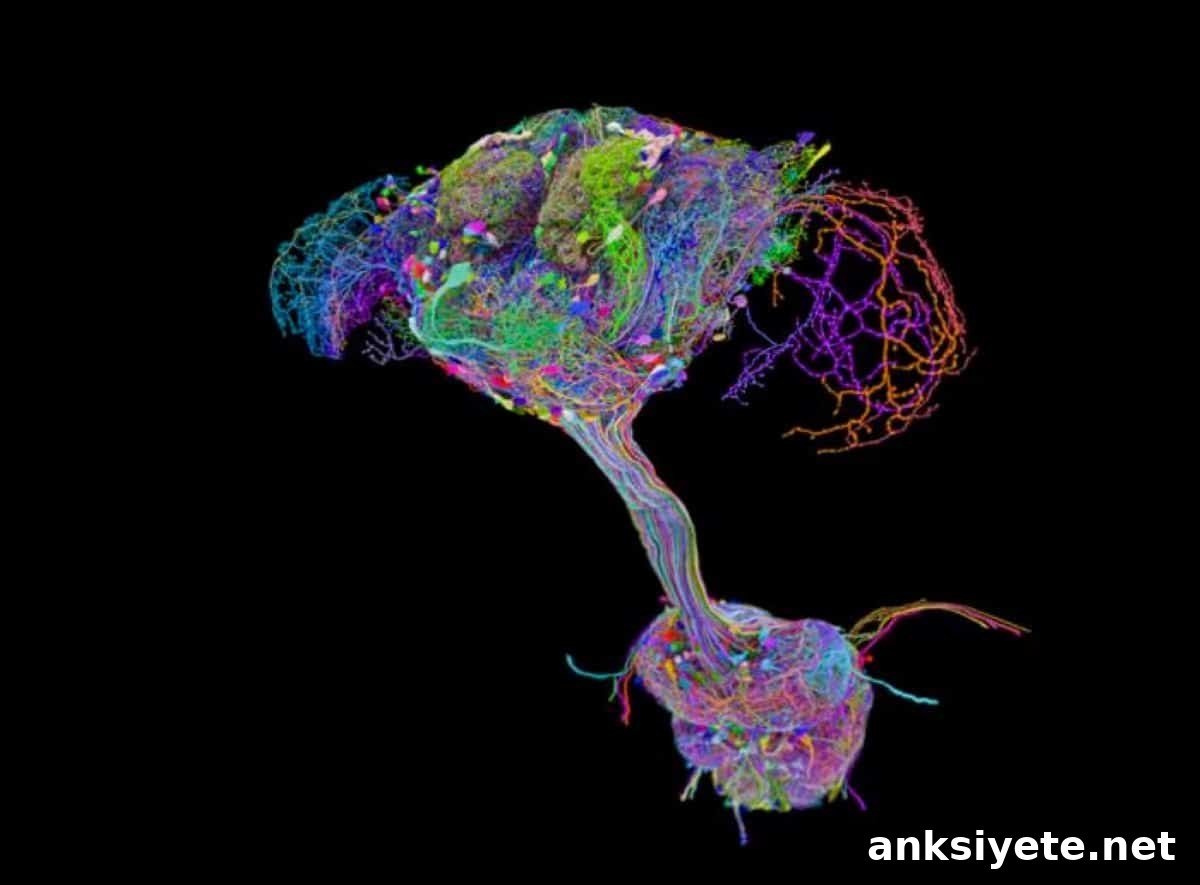
Summary: Researchers have published the first complete synapse-level wiring diagram — a full connectome — of the entire central nervous system of an adult fruit fly (Drosophila melanogaster). This work integrates a newly mapped nerve cord (the fly equivalent of a spinal cord) with the earlier brain connectome to present a unified, whole-animal view of neural circuitry.
Analysis of this comprehensive dataset challenges traditional ideas about centralized neural command. Instead, it reveals that control of complex actions such as walking and flying is largely distributed: localized neural modules embedded in limbs and other body parts perform much of the motor control and coordinate with neighboring modules to produce coherent behavior.
Key Facts
- The Complete Central Nervous System Connectome: For the first time, scientists can trace information flow from sensory input to motor output across a single intact adult invertebrate nervous system at synaptic resolution.
- The Brain and Nerve Cord (BANC) Dataset: High-resolution electron microscopy images from the Lee Lab were stitched together using custom AI alignment and reconstruction tools to produce a continuous 3D map from brain to nerve cord.
- The Distributed Control Paradigm: Structural analysis shows that many motor behaviors are executed by local circuits situated within the relevant appendages. These local units coordinate with one another, rather than relying entirely on a single central controller in the brain.
- Building on FlyWire: The project extends the 2024 FlyWire Consortium brain connectome by linking cerebral networks to the nerve-cord circuits that control legs, wings, and other appendages.
- Embodied Connectome: Although electron microscopy captured the central nervous system, identifiable neurons and existing literature enabled the team to trace synaptic connections to many sensory organs and appendages, producing an “embodied” connectome.
- Open-Source Resource: Supported in part by the U.S. BRAIN Initiative, NIH, and NSF, the full interactive dataset is available free to the scientific community as a baseline resource—analogous to the Human Genome Project—for computational neuroscience and comparative studies.
- Impact on AI and Robotics: The connectome’s decentralized wiring offers biological design principles that can help develop more efficient AI agents and robots for navigating complex virtual and physical environments.
Source: Harvard
In a major milestone, a large international team led by labs at Harvard Medical School and Princeton University has released a complete wiring diagram of all neuronal connections in the central nervous system of an adult fruit fly.
This map enables scientists to study how the brain and body interact to produce behaviors such as walking and flying, and it provides a foundation for discovering core principles of nervous-system organization and function.
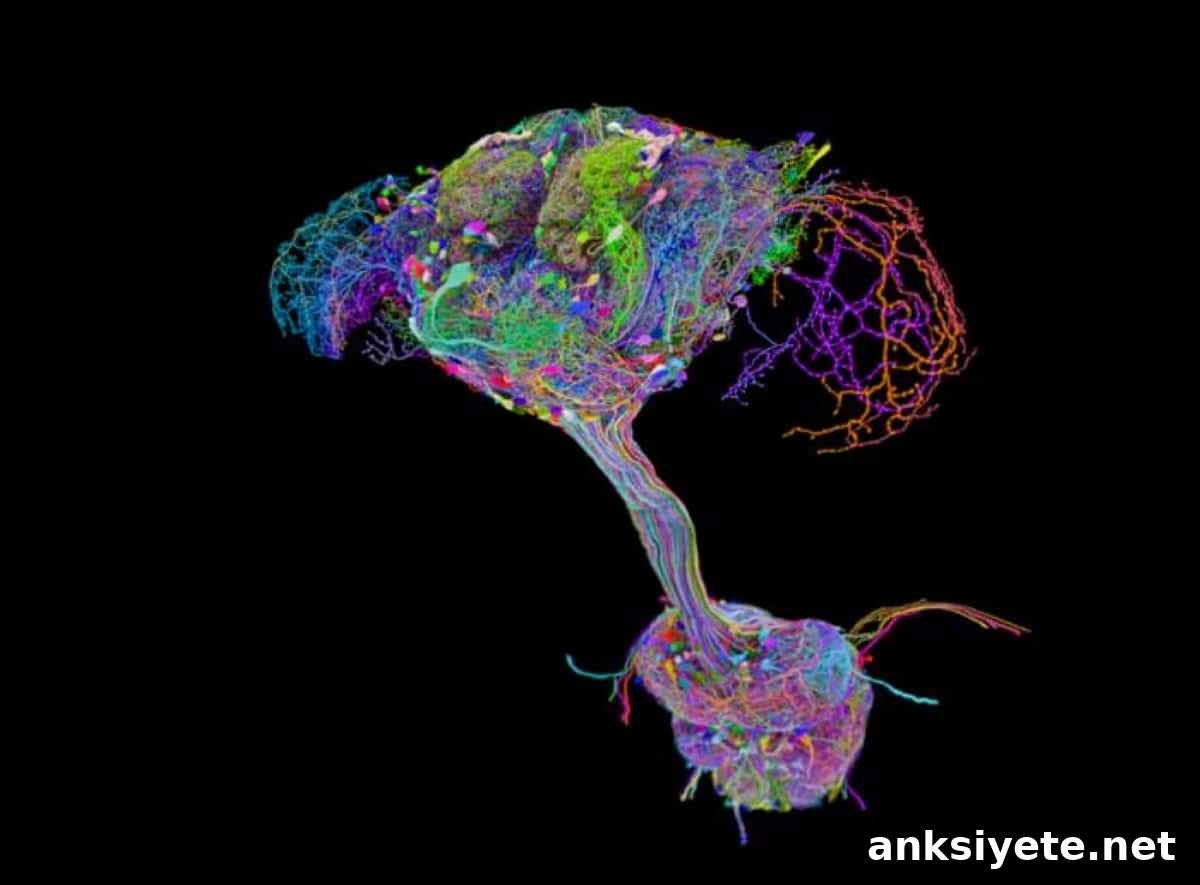
“We can see every neuron and every connection as a single integrated system for the first time,” said co-senior author Rachel Wilson, Joseph B. Martin Professor of Basic Research in Neurobiology at HMS. “That perspective lets us ask new questions about how the whole system produces behavior.”
The new connectome builds on an earlier dense reconstruction of the fruit fly brain by adding the ventral nerve cord, the structure that controls legs, wings, and other appendages and processes peripheral sensory information.
“A connectome that links brain and body is crucial for studying behavior holistically,” said co-senior author Wei-Chung Allen Lee, associate professor of neurobiology at HMS and professor of neurology at Boston Children’s Hospital.
In examining the connectome, the team observed that many behaviors are governed primarily by local circuits within the body parts responsible for those actions, not by a single central hub in the brain. The dataset is available online to accelerate discovery across the field.
The study was published June 8 in Nature and received support from U.S. federal programs including the BRAIN Initiative, the National Institutes of Health, and the National Science Foundation.
Creating a complex connectome
Understanding how brain and body circuits connect to produce behavior is a central problem in neuroscience. The fruit fly (Drosophila melanogaster) is a powerful model: its nervous system contains roughly 160,000 neurons yet supports navigation, learning, social behaviors, and rapid motor responses. Flies are genetically tractable, enabling precise experiments that link structure to function.
After the FlyWire Consortium released a full brain connectome in 2024, the Lee Lab focused on reconstructing a dense map of the ventral nerve cord. Combining those resources into a unified brain-and-cord dataset (BANC) gives researchers the ability to follow information from sensation to action across the entire central nervous system of a single adult fly.
To produce the connectome, the team sectioned a single fly into thousands of ultra-thin slices, imaged them with electron microscopy, and used AI methods to align and assemble millions of images into a continuous three-dimensional reconstruction at synaptic resolution.
Although the imaging targeted the central nervous system, identifiable neurons and prior literature allowed the researchers to trace many synaptic relationships to peripheral sensory organs and muscles, effectively embodying the connectome in the context of the animal’s body.
Distributed motor control revealed
A long-held view in neuroscience posits that a centralized controller in the brain issues commands that drive movement. The connectome reveals a different architecture in the fly: motor control is organized into many local feedback loops—motor neurons, endocrine cells, and other effectors are mainly influenced by sensory inputs from the same body part.
These local modules communicate with each other through ascending and descending neurons that form long-range pathways organized into behavior-focused circuits. Single ascending or descending neurons often influence voluntary movements across multiple body parts as well as the supporting visceral or endocrine systems that enable those movements.
“Control is distributed among local modules that link up in flexible ways,” said co-first author Alexander Bates. Local leg circuits, for example, manage individual leg mechanics and coordinate with neighboring legs to produce walking gaits; similar modular control applies to wings, mouthparts, and other effectors.
Brain regions that handle learning and navigation sit above these modules and supervise or modulate their activity, integrating higher-order information with the embodied motor circuits.
Future directions
The authors compare this open connectome resource to the Human Genome Project: a foundational dataset that many labs can use to generate and test hypotheses. Near-term plans include enriching the map with molecular details such as neuropeptide signaling and expanding comparative studies to other species.
Researchers are already using the connectome to guide experiments on motor control and to explore whether similar distributed architectures exist in mammals. Early indications suggest many animals may rely on local neural modules, and the team is investigating this question experimentally in mice.
Beyond biology, the connectome provides a concrete blueprint for designing decentralized control systems in AI and robotics, offering potential gains in efficiency and robustness for agents operating in complex environments.
Authorship, funding, disclosures
Co-first authors include Jasper S. Phelps and Minsu Kim; Jan Drugowitsch is a co-senior author. The full author list and funding acknowledgements are extensive and are included in the published paper. Funding came from a range of sources, including multiple NIH grants, the National Science Foundation, the BRAIN Initiative, international agencies, private foundations, and institutional support. The work also benefited from high-performance computing resources at HMS. Some authors and institutions declare financial interests and patent filings as disclosed in the original publication.
Key Questions Answered:
A: A brain map alone cannot show how sensory signals are transformed into coordinated physical movements. The nerve cord acts like a spinal cord, processing sensations and controlling limbs. Linking brain and cord lets scientists trace the full path from perception to action.
A: The study shows a decentralized organization: independent, local neural modules in appendages control most movements. Those modules exchange information with adjacent modules so the animal can perform coordinated behaviors with minimal centralized oversight.
A: The connectome demonstrates how thousands of relatively simple neurons form efficient, distributed networks to produce sophisticated behaviors. These biological principles can inspire AI architectures that are more scalable, robust, and computationally efficient for embodied agents.
Editorial Notes:
- This article was edited by a Neuroscience News editor.
- The original journal paper was reviewed in full for accuracy.
- Additional context was added by editorial staff to clarify technical points.
About this neuroscience research news
Author: Katie Brace
Source: Harvard
Contact: Katie Brace – Harvard
Image credit: Tyler Sloan
Original Research: “Distributed control circuits across a brain-and-cord connectome,” published in Nature. DOI: 10.1038/s41586-026-10735-w.
Abstract
Distributed control circuits across a brain-and-cord connectome
Connectomes—complete maps of neurons and synapses—are reshaping neuroscience much like genomes transformed molecular biology. Previously, only a few simple animals had full connectomes. The fruit fly presents a much richer system: a brain capable of learning and memory coupled to a ventral nerve cord analogous to a vertebrate spinal cord. Here we present the first densely reconstructed adult fly connectome that unites brain and nerve cord, and we use it to examine principles of neural control. Effector neurons (motor neurons, endocrine cells, and visceral efferents) are chiefly influenced by sensory inputs from the same body part, forming local feedback loops. These local loops are connected by ascending and descending pathways organized into modules aligned with behavior. Brain regions for learning and navigation modulate these modules, producing an architecture that is distributed, parallelized, and embodied—reminiscent of engineered distributed control systems.