
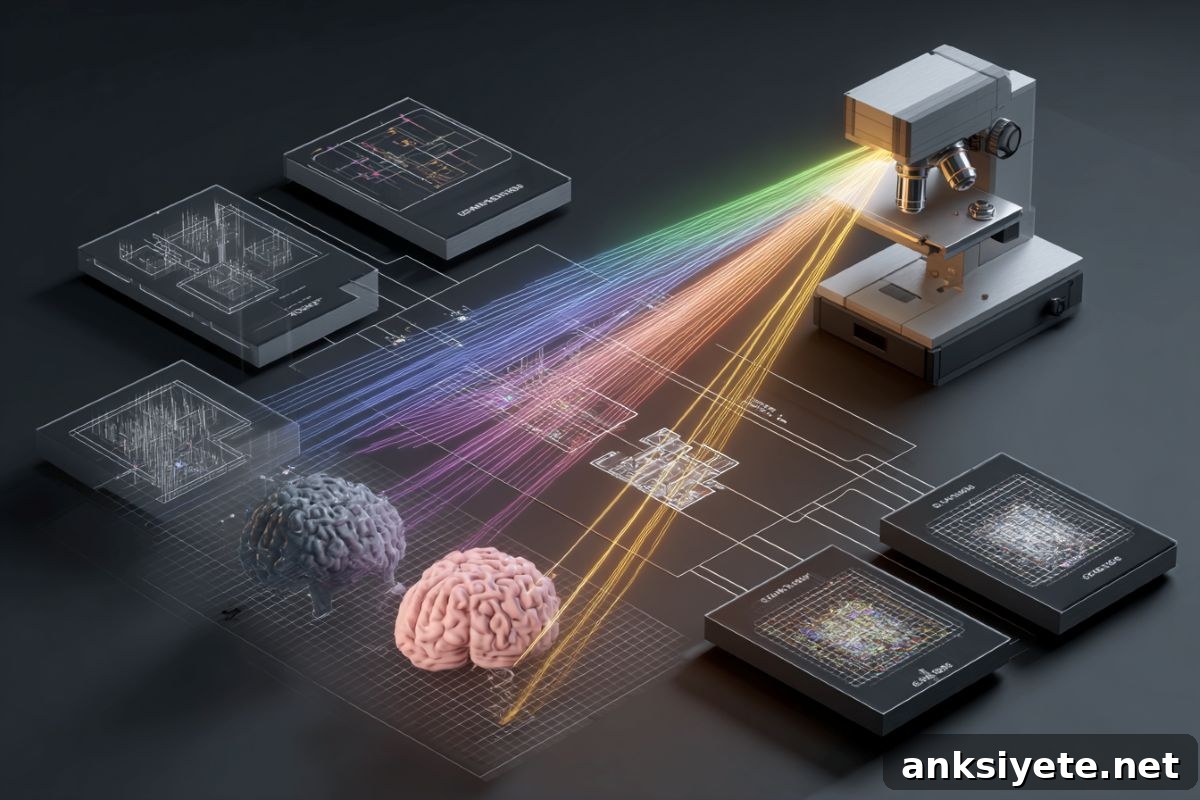
Summary: A major technological advance removes a long-standing barrier in behavioral neuroimaging. Researchers introduced Neuroplex, an imaging pipeline that can simultaneously identify and track the real-time functional activity of up to nine distinct neuronal populations in freely moving mice.
Neuroplex combines lightweight, head-mounted miniscopes with high-performance spectral confocal microscopy and a custom Python alignment tool to map genetic and circuit identities directly onto functional recordings. This open-source workflow offers a practical, non-destructive approach for longitudinal studies of learning, aging, and neurodegenerative disease progression, greatly expanding the scale and resolution of circuit-level analysis.
Key Facts
- Overcoming the two-color limit: Traditional head-mounted miniscopes reliably record neural activity in behaving animals but are limited to distinguishing at most two color-coded cell types, forcing slow, animal-by-animal experiments.
- Neuroplex in vivo: The pipeline preserves intact brain tissue. Researchers record broad neural activity with a head-mounted miniscope during behavior, remove the miniscope, and immediately image through the same implanted lens using a spectral confocal microscope to decode up to nine fluorescent tags.
- Automated spatial co-registration: Developed with MetaCell data scientists, Neuroplex uses anatomical landmarks and a custom Python alignment script to precisely overlay functional miniscope footage with the multicolor confocal identity map.
- High-throughput validation: As proof of principle, the team labeled nine projection-defined circuits from the medial prefrontal cortex and recorded their activity during social interactions. The automated workflow assigned roughly 75% of active neurons to a specific circuit identity with about 90% accuracy.
- Longitudinal tracking: Because the entire alignment is performed nondestructively in the living animal through the same implanted lens, the method enables repeated identification and monitoring of the same neurons across weeks or months.
Source: MPI Florida
Researchers at the Max Planck Florida Institute for Neuroscience (MPFI), collaborating with ZEISS and MetaCell, developed Neuroplex.
Published in eLife, the technique allows simultaneous monitoring of up to nine distinct neuronal populations in freely moving mice, accelerating the study of how neural circuits control behavior.
The Challenge
For years, researchers attempting to link brain activity to behavior faced a persistent limitation: head-mounted miniscopes are excellent at recording fluorescence signals in freely moving animals but cannot reliably distinguish more than two spectrally distinct labels at once. That limitation forced scientists to test one cell type per animal or to rely on destructive post-mortem tissue processing to identify cell types, which prevented direct within-animal comparisons and longitudinal tracking.
“To understand the brain, we need to link patterns of activity in specific neurons to behavior,” said lead author Dr. Mary Phillips. “Although multiple labels can be applied to distinguish cell populations, conventional miniscopes produce monochrome activity videos that mask which cell belongs to which circuit.”
Workarounds—repeating behavioral tests with different labels in separate animals or matching miniscope recordings to post-mortem, sliced tissue—were slow, costly, and prone to data loss. Post-hoc matching was technically challenging and prevented monitoring the same identified neurons over time, limiting studies of learning, development, aging, and disease progression.
The Solution: Neuroplex
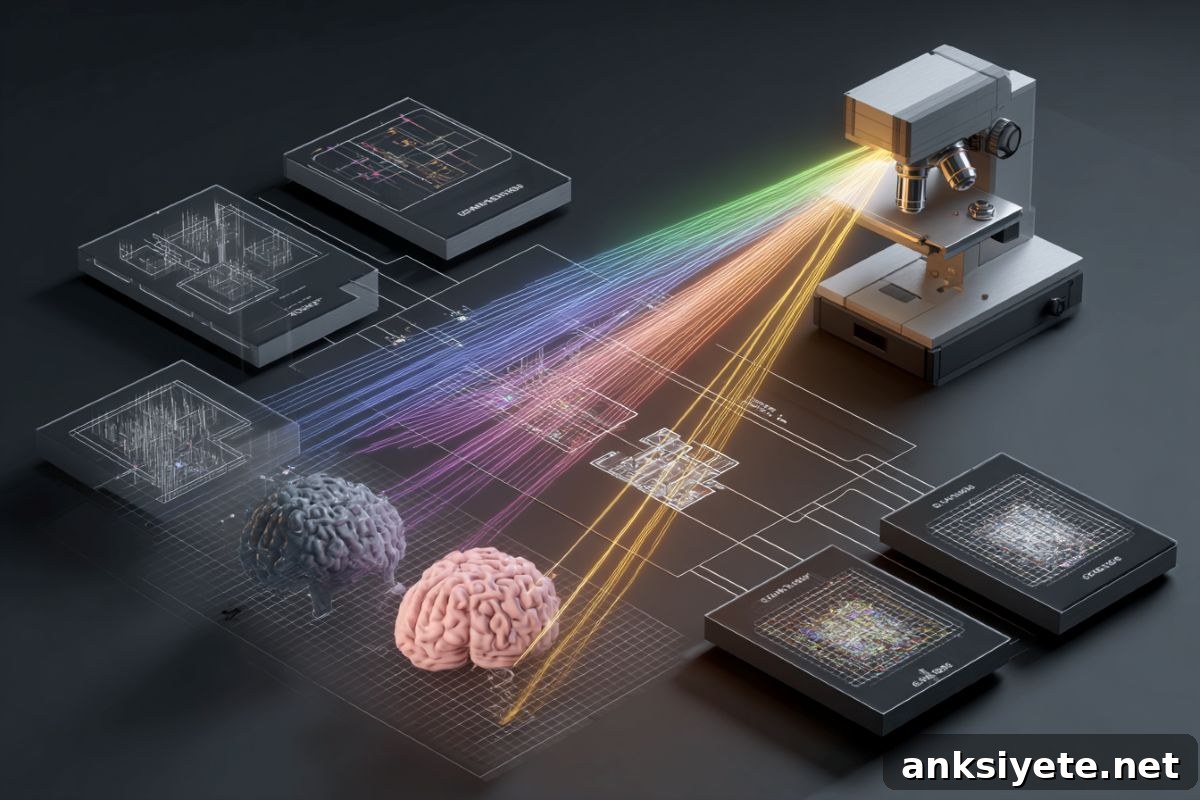
Neuroplex overcomes these limitations by combining complementary imaging methods in the same living animal. First, researchers label up to nine circuit- or cell-type–specific populations with spectrally distinct fluorescent tags. They then implant a gradient index (GRIN) lens and use a head-mounted miniscope to record calcium-dependent activity while the animal behaves freely.
After functional recording, the miniscope is gently removed and the animal is imaged through the same implanted lens with a spectral confocal microscope capable of resolving multiple fluorophores. In the study, scientists used a ZEISS LSM 980 with spectral detection to separate each fluorescent tag. These confocal images reveal color-coded identities of the same neurons that appeared in the miniscope recording.
Finally, a custom Python-based alignment tool co-registers the miniscope activity video and the multicolor confocal images using anatomical landmarks. This automated mapping assigns fluorophore-defined identities to individual neurons’ activity traces, enabling direct, within-animal comparison of multiple circuit populations.
“MetaCell contributed computational methods to convert complex imaging data into a reproducible workflow for imaging, registration, and analysis,” said Dr. Zhe Dong, co-author and data scientist at MetaCell. “Neuroplex demonstrates how carefully designed computational tools make it feasible to study multiple neuronal populations at once and across time.”
As proof of principle, the team retrogradely labeled nine projection targets of the medial prefrontal cortex (an area involved in decision making) and recorded activity across those circuits while mice engaged in social behaviors such as sniffing, approaching, and following. About 75% of active neurons could be assigned to one of the nine projection-defined groups, and the automated assignment algorithm showed approximately 90% accuracy with few false positives.
“Neuroplex enables direct comparisons of activity patterns across circuits during behavior, overcoming long-standing spectral limits of miniscope recordings and increasing the efficiency and reproducibility of data collection,” explained senior author Dr. Ryohei Yasuda.
Because the entire process is non-destructive and uses the same implanted lens, researchers can identify cell populations before behavioral experiments and follow the same cells over weeks or months. This capability opens studies of learning, aging, and disease progression that require longitudinal, cell-type–specific functional measurements.
What Comes Next
The team is refining Neuroplex to improve the accuracy of color-code identification and to broaden access to the approach. They plan to adapt the workflow for labs that lack high-end spectral confocal systems by demonstrating implementations with standard filter-based widefield microscopes, extending the method’s core benefits across the neuroscience community.
“Greater efficiency in collecting cell-type and circuit-specific functional data will accelerate our understanding of the neural computations that underlie behavior,” said Dr. Phillips. “Beyond basic research, Neuroplex promises to speed investigations of circuit-specific changes in disease models, especially for disorders where tracking progression in the same animal over time is essential.”
To encourage adoption, the team has prepared tutorials and resources for laboratories interested in using Neuroplex. The developers also plan community outreach, training materials, and presentations to share practical guidance for implementing the pipeline.
Funding:
This research was supported by National Institutes of Health grants R35-NS-116804 and F32MH120872. The content is the authors’ responsibility and does not necessarily represent the official views of the funders.
Key Questions Answered:
A: The limitation was not the availability of colored labels but the optical constraints of tiny, lightweight miniscopes. These miniature devices must be small enough to sit on a mouse’s head and are optimized for fast activity imaging. Their spectral resolution is limited, so live miniscope videos often appear as monochrome activity without reliably distinguishing multiple fluorophores. Neuroplex solves this by pairing miniscope activity recordings with spectral confocal imaging through the same implanted lens and then aligning the two datasets.
A: Neuroplex treats the task as an automated alignment problem. First, the miniscope records the uncolored activity of all neurons during behavior. Then, the miniscope is removed and the same field of view is imaged with a spectral confocal microscope that resolves the full fluorescence spectrum. A custom Python program aligns anatomical landmarks between the two image sets and maps each cell’s fluorophore signature to its recorded activity trace.
A: Many neurological disorders disrupt communication across multiple cell types and circuits over time. Traditional methods that require tissue removal prevent longitudinal tracking of identified cell types in the same animal. Because Neuroplex is nondestructive and performed in vivo through the same implanted lens, investigators can follow how multiple circuits change across weeks or months in disease models, enabling finer-grained studies of progression and compensation.
Editorial Notes:
- This article was edited by a Neuroscience News editor.
- The original journal paper was reviewed in full.
- Additional context was added by staff editors.
About this neurotechnology and research report
Author: Lesley Colgan
Source: MPI Florida
Contact: Lesley Colgan – MPI Florida
Image: Image credited to Neuroscience News
Original Research: Open access. “Functional imaging of nine distinct neuronal populations under a miniscope in freely behaving animals” by Mary L. Phillips, Nicolai T. Urban, Taddeo Salemi, Zhe Dong, and Ryohei Yasuda. eLife. DOI: 10.7554/eLife.110277.3
Abstract
Functional imaging of nine distinct neuronal populations under a miniscope in freely behaving animals
Head-mounted miniscopes have enabled functional fluorescence imaging in freely moving animals, but current devices are limited to recording at most two spectrally distinct fluorophores, which constrains the number of identifiable cell types. Here, we introduce multiplexed neuronal imaging (Neuroplex), a pipeline that combines miniscope calcium recordings with in vivo multiplexed confocal spectral imaging to distinguish nine projection-defined neuronal subtypes through the same GRIN lens. By co-registering neurons with fluorophore-specific spectral fingerprints through linear unmixing, we link projection-defined identities to behaviorally relevant neuronal activity, overcoming spectral constraints of miniscopes and enabling circuit-level analysis of behavior within single animals.