
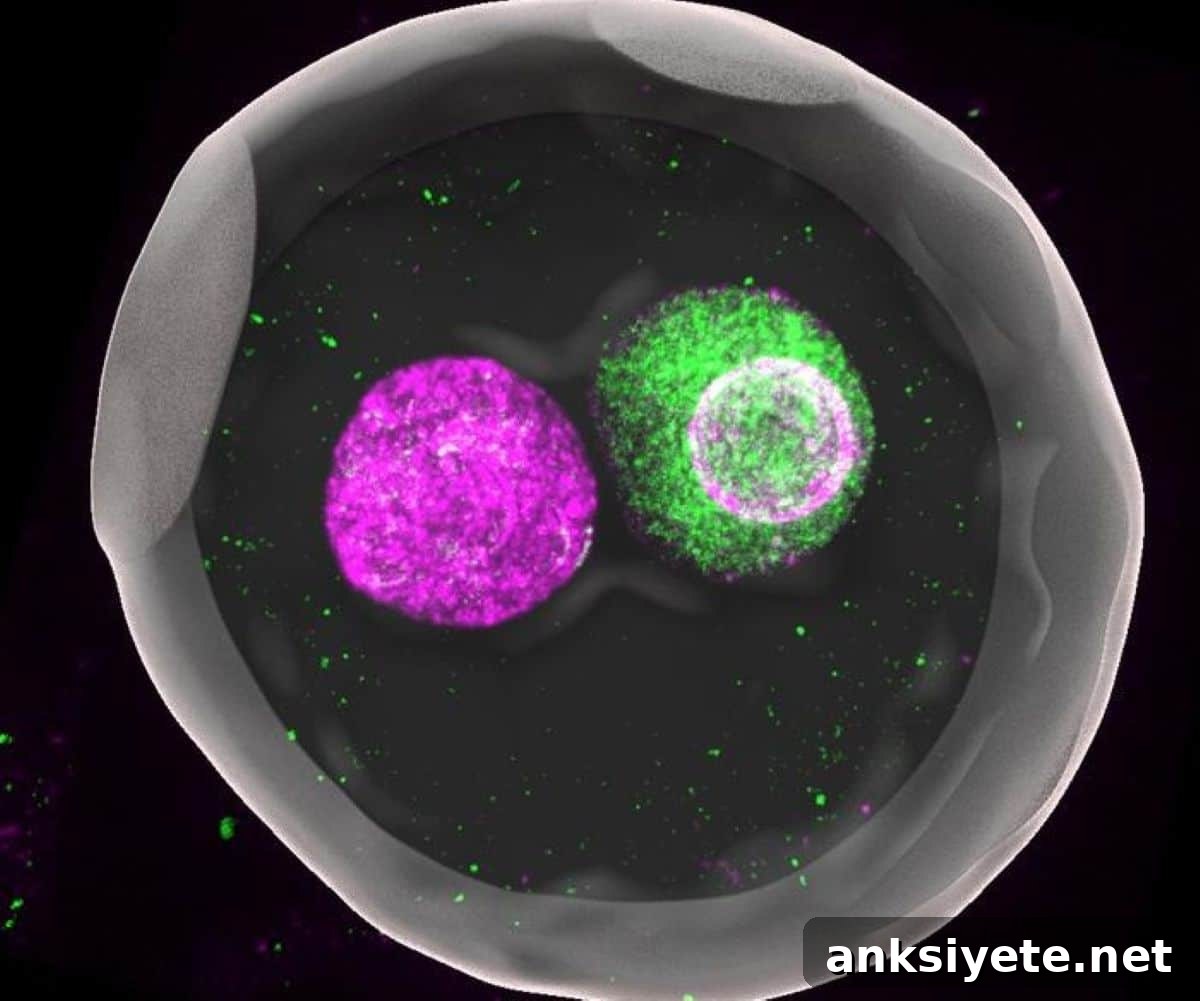
Summary: For decades, biologists have noticed a curious feature of the earliest moments after fertilization: the maternal and paternal nuclei inside a newly formed zygote remain separate rather than fusing immediately. New research now explains the reason for this delay. The two pronuclei remain apart to enter a high-stakes competition that preserves critical regulatory marks on the genome and supports healthy embryonic development.
By staying separate, the maternal and paternal pronuclei compete to absorb growth-regulating factors from the surrounding cytoplasm. This competition limits each nucleus’s size and prevents dilution or loss of essential epigenetic marks—chemical tags on histones that control gene activity and guide early development.
Key Facts
- Competition mechanism: The two pronuclei draw growth factors from the same cytoplasmic pool. The interaction functions like a race: neither nucleus is allowed to grow unchecked because both must compete for a limited supply.
- Size matters: If the pronuclei merge prematurely into one large nucleus, that single structure grows larger than normal. The increase in volume dilutes histone modifications and other regulatory marks, weakening the genome’s instructions for early development.
- Epigenetic blueprint: The maternal genome carries many histone modifications at fertilization that the sperm genome lacks. These marks are crucial for controlling gene expression during the first cell cycles.
- Experimental rescue: Researchers tested the model by introducing a temporary additional pronucleus into zygotes whose pronuclei had already fused. Re-establishing competition reduced nuclear size and partially restored epigenetic marks and developmental potential.
- Implications for assisted reproduction: These results clarify why embryos with early-fused pronuclei in clinical settings tend to have lower success rates. Spatial organization within the zygote—how nuclei are arranged and sized—matters as much as genetic content.
Source: Kobe University
Context and significance
At fertilization, an egg and a sperm form a zygote. In mammals such as mice and humans, the two sets of chromosomes are initially sequestered in separate pronuclei—one maternal, one paternal—until just before the first cell division. Although this separation has been documented for decades, its functional purpose was unclear and largely treated as descriptive.
Kobe University developmental biologist Hirohisa Kyogoku and colleagues investigated whether pronuclear separation influences the maintenance of epigenetic information. They focused on histone modifications—small chemical groups attached to histone proteins around which DNA is wound—that instruct the embryo which genes to activate or silence. The maternal genome arrives with many of these marks; the paternal genome typically has fewer at fertilization. Proper preservation of those marks is essential for normal development.
Using mouse zygote manipulation, quantitative imaging and theoretical analysis, the team discovered that pronuclear size is the key parameter that maintains those regulatory modifications. When a nucleus is allowed to become abnormally large—either by experimental manipulation or through premature fusion of the two pronuclei—the concentration of histone marks falls and critical epigenetic information is lost.
The researchers traced the mechanism that keeps pronuclei small in natural zygotes to a cytoplasmic competition for growth factors. Because each pronucleus must capture factors from a shared cytoplasmic pool, neither can swell without consequence. If the two pronuclei are merged and the competition disappears, the resulting single nucleus grows larger and epigenetic marks are diluted, explaining the reduced developmental potential of such embryos.
To validate the model, the team reintroduced a third, transient pronucleus into zygotes with prematurely fused nuclei. This re-established competition, limited nuclear size and partially rescued the loss of histone modifications and the ability of the embryo to continue development.
These findings reveal that the spatial arrangement inside a zygote—two separate, competing pronuclei—is not incidental. Rather, it is a functional design that safeguards epigenetic information at the earliest stages of life, helping to explain both the robustness and vulnerability of early embryos.
Key Questions Answered:
A: In normal development the maternal and paternal pronuclei remain distinct until the first mitotic division begins. At that stage, the nuclear envelopes naturally break down so chromosomes can align on the spindle and segregate into two daughter cells. Thus the apparent fusion occurs as part of the regulated process of cell division rather than as premature merging during the pronuclear stage.
A: Potentially. Understanding that nuclear size and cytoplasmic competition preserve epigenetic marks offers embryologists a new parameter to monitor. Future protocols might aim to maintain or mimic this competition to improve the developmental quality of lab-cultured embryos.
A: These tags are primarily histone modifications—small chemical groups such as methyl or acetyl groups attached to histone proteins. They control whether nearby genes are read or silenced. When nuclear volume increases excessively, these modifications can be diluted or lost, impairing gene regulation.
Editorial Notes:
- This article was edited by a Neuroscience News editor.
- The original journal paper was reviewed in full by our staff.
- Context and explanations were added for clarity.
About this genetics research news
Author: Daniel Schenz
Source: Kobe University
Contact: Daniel Schenz – Kobe University
Image: Image credit: KYOGOKU Hirohisa
Original Research: Open access. “Cytoplasmic competition between separate parental pronuclei in zygotes” by Hirohisa Kyogoku et al., published in Nature. DOI: 10.1038/s41586-026-10417-7
Abstract
Cytoplasmic competition between separate parental pronuclei in zygotes
Embryogenesis begins with a zygote—a single cell containing two pronuclei that separately enclose maternal and paternal chromosomes. The functional significance of keeping parental chromosomes in distinct pronuclei has been unclear, even though one-pronuclear biparental zygotes are used clinically.
Using mouse zygote manipulation, quantitative imaging and theoretical modeling, the study demonstrates a cytoplasm-mediated competition between separate parental pronuclei that preserves developmental potential. This competition limits pronuclear volume and prevents dysregulation of epigenetic marks, including loss of trimethylated histones.
One-pronuclear biparental zygotes lack this competitive mechanism, leading to a reduced rate of development to term. The study shows that competition-based interventions or drug treatments that restore epigenetic marks can partially rescue developmental potential. These results link spatial organization at fertilization to the establishment of full developmental capacity and suggest caution in clinical use of one-pronuclear biparental zygotes.
Funding: This research was supported by grants from the Japan Society for the Promotion of Science (multiple grants), the Japan Science and Technology Agency and the Japan Agency for Medical Research and Development. The work was conducted in collaboration with researchers at the RIKEN Center for Biosystem Dynamics, Kyushu University, and the RIKEN Center for Integrative Medical Sciences.