
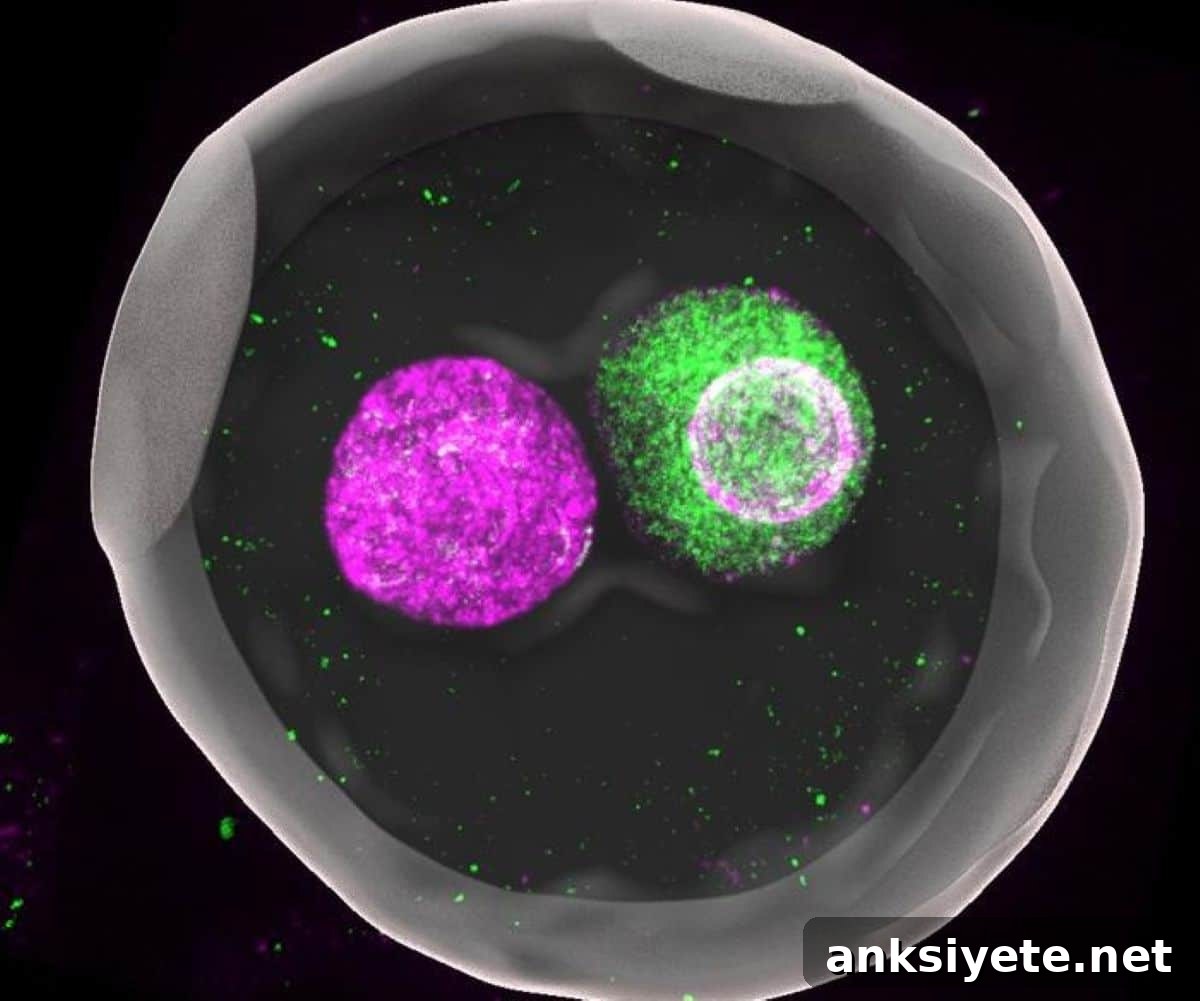
Summary: For decades, biologists noted a curious feature in the earliest minutes after fertilization: the egg’s and sperm’s nuclei remain separate instead of merging immediately. New research from Kobe University now explains why this separation matters. Rather than being incidental, the two pronuclei engage in a competitive process that preserves essential regulatory chemical marks and supports healthy embryonic development.
Shortly after sperm and egg meet to form a zygote, the maternal and paternal genomes are housed in distinct pronuclei. By remaining apart, each pronucleus competes for limited growth factors in the surrounding cytoplasm. This competition keeps each nucleus relatively small and helps maintain epigenetic modifications—chemical tags on histone proteins that guide early gene regulation. If the nuclei fuse prematurely and form a single, oversized nucleus, those regulatory tags are diluted or lost, harming the embryo’s developmental potential.
Key Facts
- Competition Mechanism: The maternal and paternal pronuclei draw on the same pool of cytoplasmic growth factors. Their competition for these factors limits individual pronuclear growth.
- Size and Regulation: When the nuclear volume becomes large—due to experimental manipulation or premature fusion—the concentration of histone modifications drops, compromising gene regulation.
- Epigenetic Differences: The maternal genome arrives enriched with histone modifications, while the sperm genome carries few of these marks. Maintaining those maternal tags is crucial for correct early development.
- Experimental Rescue: Researchers restored a competitive environment by adding a temporary third pronucleus to zygotes with prematurely fused nuclei. That intervention restricted nuclear size and partially recovered the epigenetic marks and developmental potential.
- Implications for Assisted Reproduction: These findings help explain why embryos that show early pronuclear fusion in vitro have lower success rates. Spatial organization inside the zygote is as important as genetic content.
Source: Kobe University
Background: At fertilization, an egg and a sperm form a single cell called a zygote. In mammals, the DNA from each parent remains enclosed in separate pronuclei until just before the first cell division. This long-known observation had lacked a clear functional explanation—until now.
Kobe University developmental biologist Kyogoku Hirohisa and collaborators investigated whether the physical separation of parental genomes influences epigenetic regulation. They focused on histone modifications, small chemical groups attached to the histone proteins around which DNA is wrapped. These modifications serve as marks that instruct the cell which genes to read or silence during early development. The maternal genome typically carries abundant histone marks, whereas the paternal genome has comparatively few.
Using precise mouse zygote manipulations, quantitative imaging and theoretical modeling, the team showed that the pronuclei effectively race to absorb cytoplasmic factors that limit nuclear growth. When both pronuclei are present and competing, each remains small enough to preserve histone modifications at appropriate concentrations. But when a single oversized nucleus forms—either naturally in some one-pronuclear zygotes or experimentally—the concentration of those crucial modifications falls, and embryos are less likely to progress to term.
To test causality, the researchers reintroduced competition into zygotes with prematurely fused pronuclei by adding an extra temporary pronucleus. This reinstated the tug-of-war for growth factors, reduced nuclear volume, and partially restored histone modifications and developmental outcomes. The result supports a spatial, competition-based mechanism that links the physical arrangement of chromosomes to the embryo’s epigenetic state and developmental potential.
“A familiar structural feature—the two separate pronuclei—turns out to have a clear functional role,” says Kyogoku. “Separation creates a competitive environment inside the zygote that helps preserve epigenetic regulation and supports development.” These insights establish that spatial organization at fertilization is not incidental: it helps set up the molecular landscape required for robust early embryogenesis.
Key Questions Answered
A: The pronuclei remain separate until the first mitotic division begins. At that point the nuclear envelopes disassemble so parental chromosomes can align and segregate into daughter cells. The observed separation functions as a protective holding pattern that preserves regulatory marks until division.
A: Potentially. Recognizing that nuclear size and spatial competition matter gives embryologists a new parameter to monitor. Future clinical techniques might aim to preserve or mimic this competitive environment in cultured embryos.
A: The tags are primarily histone modifications—small chemical groups such as methyl or acetyl groups attached to histone proteins. These modifications influence whether nearby genes are expressed or silenced. Excessive nuclear expansion can dilute these marks, reducing their regulatory effect.
Editorial Notes
- This article was edited by a Neuroscience News editor.
- The original journal paper was reviewed in full.
- Additional context was added by editorial staff.
About this genetics research news
Author: Daniel Schenz
Source: Kobe University
Contact: Daniel Schenz – Kobe University
Image: Image credited to KYOGOKU Hirohisa
Original Research: Open access.
“Cytoplasmic competition between separate parental pronuclei in zygotes” by Hirohisa Kyogoku, Mitsusuke Tarama, Masahiro Matsuwaka, Tappei Mishina, Akihito Harada, Reiko Nakagawa, Mami Kumon, Yoshihiro Shimizu, Yasuyuki Ohkawa, Tatsuo Shibata, Azusa Inoue & Tomoya S. Kitajima. Nature. DOI: 10.1038/s41586-026-10417-7
Abstract
Cytoplasmic competition between separate parental pronuclei in zygotes
Embryogenesis begins with a zygote—a single cell containing two pronuclei that separately enclose maternal and paternal chromosomes. The functional significance of keeping parental chromosomes in distinct pronuclei has been unclear, despite clinical use of one-pronuclear biparental zygotes. Using mouse zygote manipulation, quantitative imaging and theoretical approaches, the study demonstrates a cytoplasm-mediated competition mechanism between separate parental pronuclei that preserves developmental potential. This mechanism limits pronuclear volume and prevents dysregulation of epigenetic marks, including loss of trimethylated histones. One-pronuclear biparental zygotes lack this mechanism and show reduced rates of development to term; the low developmental potential can be partially rescued by restoring competition or pharmacologically recovering epigenetic marks. The results reveal a spatial mechanism that links fertilization to establishment of full developmental potential and highlight important considerations for the clinical use of one-pronuclear biparental zygotes.